




The Texas Rangers offense has been assessed the lion’s share of the blame for the team’s struggles last year, as well as their hovering around .500 so far this season. If the team would just hit like an average team, the argument goes, the pitching is strong enough for the Rangers to excel.
I have a variety of issues with that sentiment, but something that jumped out at me, in looking at the team’s offensive numbers for 2026, is that the offense has been hitting like an (at minimum) average team this year.
Advertisement
Baseball Reference shows the 2026 Rangers with a team OPS+ of 108, tied for third in the majors. Fangraphs, which uses a park factor that doesn’t treat the Shed as pitcher-friendly as B-R does, has the Rangers’ wRC+ at 101, tied with the Orioles for 15th.
But let’s set aside park-adjust numbers for a moment. Let’s look just at raw numbers:
The Rangers’ wOBA this year is .316 — tied with the Orioles for 16th in the majors, and barely below the league average of .317.
The Rangers’ batting average this year is .244 — tied with the Red Sox for 15th in the majors, and one point above the league average of .243.
Advertisement
The Rangers’ OBP this year is .320 — 13th in the majors, and one point above the league average of .319.
The Rangers’ slugging percentage is .392 — tied with the Marlins for 20th in the majors, and eight points below the league average of .400.
Looking at just the non-park-adjusted numbers above — wOBA, average, OBP, slugging — you would expect the Rangers to be average to a hair below average in runs scored in 2026.
Instead, though, the Rangers are 23rd in the league with 4.07 runs per game — barely ahead of the Giants, Jays and Mariners, at 4.05, and almost half a run per game behind the league average of 4.49 runs per game. Over the 85 games they’ve played, that’s a 36 run shortfall compared to if they were scoring runs at the sort of league average rate you would expect, given their team offensive numbers
Advertisement
That doesn’t make a lot of sense, so I decided to poke around and figure out where the Rangers are falling short.
I thought, maybe the Rangers are underperforming with runners in scoring position. Taking a look at that, they are right around league average hitting with no one on, men on base, and runners in scoring position. So that’s not it.
They’ve not been good with runners in scoring position and two outs — they’ve slashed .195/.288/.307, compared to .227/.325/.378 overall. That might explain part of it, I guess, though that means that they are overperforming the league with runners in scoring position and either one out or two out.
Then I took a look at the team’s baserunning data on Baseball Reference, comparing it to the league as a whole, and an unexpected explanation for at least part of the discrepancy jumped out at me.
Advertisement
B-R shows you the percentage of times that each team takes an extra base on a hit, as well as the league as a whole. That incorporates scoring from second on a single, advancing to third or scoring from first on a single, or scoring from first on a double.
The league average is 42% — that is, 42% of the team, on a single or double, a runner takes more than than one base (on a single) or two bases (on a double). The Detroit Tigers have the highest percentage, at 53%, with the Royals next, at 50%. Most teams are between 40% and 49%, with the Twins and Angels tied for next-to-last at 37%.
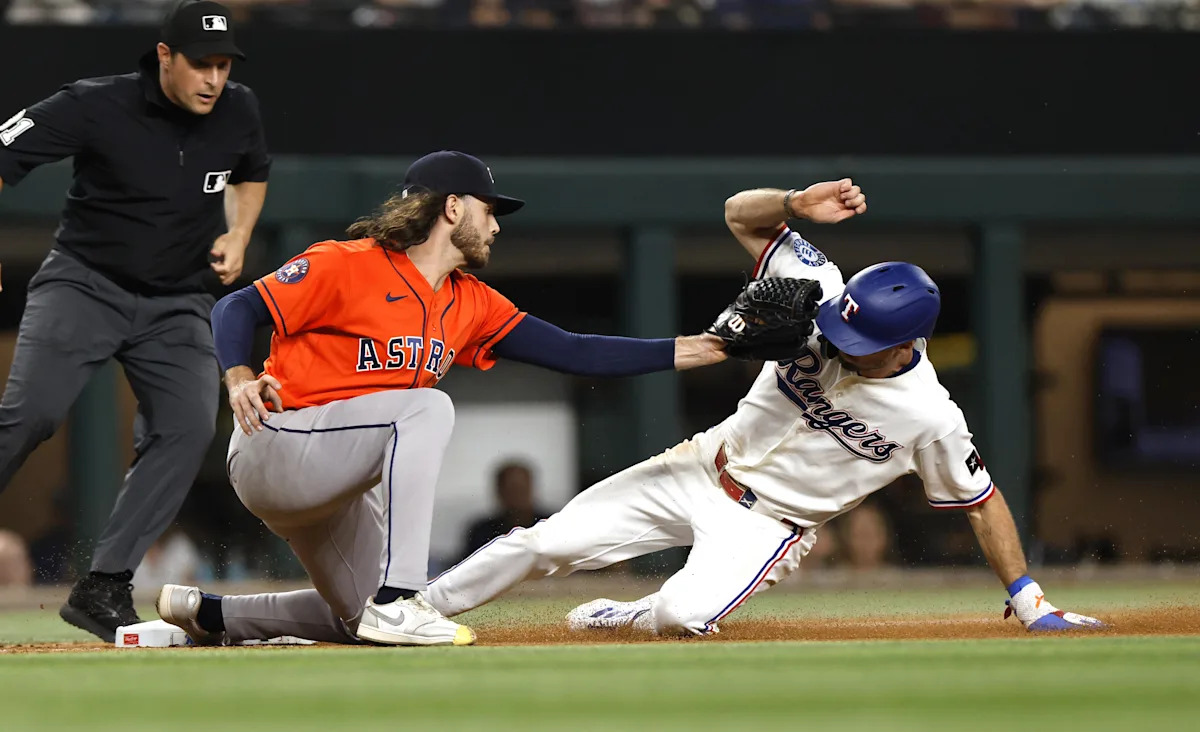
The Rangers? They are last, at 34%. The Tigers take an extra base on a hit more than 50% more often than the Rangers do. The league as a whole does so almost 25% more often.
The Rangers lag even most dramatically in regards to going from first to third on a single. The Rangers have singled with a runner on first 163 times this season — sixth most in MLB, and 15 more times than the league average of 148.
Advertisement
Despite that, they are dead last in the majors in the number of times they’ve had a runner go to third, or score, from first on a single. They’ve done it only 34 times — barely 20% of the time, compared to over 35% for the league as a whole.
If the Rangers were going first to third on singles at a league average rate, they’d have put a runner on third base on a single, instead of having them stuck at second, 23 more times this season.
They also don’t score from 2nd on a single as often as the league as a whole, though there, the difference is less dramatic — the league scores from second on a single about 61% of the time, while the Rangers do so about 55% of the time. The delta there would indicate five additional runners scoring from second on singles, as compared to sticking at third, if they were scoring from second on singles at a league average rate.
It isn’t the whole explanation, but it does help explain why the Rangers have been so bad at converting baserunners into runs — just 27% of their baserunners this season have scored, tied with the Mariners for last in the majors. The percentage for the league as a whole is 30% — and if the Rangers were cashing in 30% of their baserunners this year, they’d be scoring runs at, if not a league average clip, pretty close.
Advertisement
It just advancing on singles, to be clear. The Rangers have hit into 65 double plays, tied for the third most in the majors, and 12 more than the league average. They are a little below average in sacrifice flies, as well. And although the team has been successful when it has attempted to steal — their 80% success rate is tied for 6th in the majors — only five teams in baseball have attempted fewer steals.
I don’t have a solution to the issues, and I don’t know that there necessarily is one. The Rangers have a number of slow players, and those have been the guys who have been getting on base most often. If Joc Pederson or Josh Jung — two of the Rangers’ best OBP guys this year — get on, they are likely going station-to-station, which also effects anyone getting on base behind them. Wyatt Langford and Evan Carter are fast, but they’ve also missed much of the season and not been getting on base at great clips.
I suck at typing conclusions, so I’ll just end this by saying, hopefully this improves going forward.
Read the full article here


