





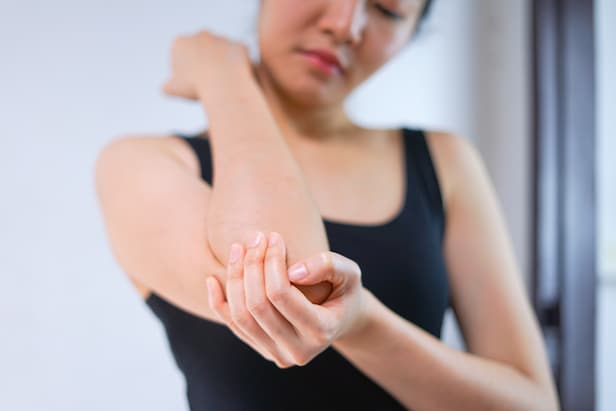
Last summer, I was playing late in the evening, and out of nowhere I felt a searing pain on the inside of my left elbow. It happened at contact as I hit my drive on the 18th. What was that? I decided to walk it off. Must’ve been a fluke. I stood over my next shot, swung, and at impact, there it was again. A quick, intense pain that was fleeting, but significant. What is happening? I finished the hole, didn’t experience any pain while hitting a chip and putt. I went to the range to hit a few balls, testing out the pain to see if it’d return. Every swing, at impact, the same thing. This isn’t good.
Those of you who have been down this road before know: I had golfer’s elbow. The injury is inflammation and small tendon tears on the inside of the elbow.
Advertisement
“It’s an overuse injury of these tendons, as well as the muscles we use to grip the club and control the wrists,” Golf Digest Best Fitness Instructor, Lauren McMillan, explains. “Repeated swinging, bending, or twisting of the wrist and arm can lead to tiny tendon strains or tears that cause elbow, forearm, and wrist pain—and weaker grip strength if it’s ignored.”
For me, the timing wasn’t ideal. I had agreed to play in the member-member. It was two weeks away. I’d also signed up for the State Am. That was four weeks out.
“The best way to treat golfer’s elbow is to reduce irritation, then slowly rebuild flexibility and strength,” McMillian says. “That means giving the elbow a break from painful activity—even putting away the golf clubs for a bit—using ice or anti-inflammatories as needed, and supporting the forearm with a brace or tape if helpful.”
I was prescribed an anti-inflammatory, stayed away from my clubs, went through a lot of ice and did this exercise, the Tyler Twist, daily.
Advertisement
To do the exercise, you need a Theraband Flexbar, which was $19 on Amazon. I ordered it immediately. I pulled up videos of the exercise to make sure I was doing it correctly, and went down a rabbit hole on Reddit where people were raving about it, claiming recoveries so swift it sounded too good to be true. I was skeptical, but willing to try anything. I did three sets of 10 on each side daily.
“Treatment should focus on gentle wrist stretches and controlled strengthening, especially slow, eccentric exercises like the Reverse Tyler Twist, which retrain the tendons to tolerate load and heal properly,” McMillian says. “Because the elbow is affected by what’s happening above and below it, stretching the wrists and forearms—and even the neck and shoulders—can help reduce excess strain and improve how force moves through the arm during the golf swing.”
I wanted to give my elbow as much time as possible to recover. The day before the member-member, I went to the range to test it out. I hit a wedge. No pain. I couldn’t believe it. I hit another. Nothing. I was lucky; it was a mild case that had healed quickly. The rest and exercises had kept my golf season alive.
I continued to do the Tyler Twist throughout the season and iced my elbow nightly. I’m not great about warming up before rounds, but found that doing some upper-body warmups also helped. I didn’t have any issues beyond some slight soreness for the rest of the summer.
Advertisement
McMillan says that every case of golfer’s elbow is different. It can take anywhere from a few weeks to a few months before a golfer is able to hit balls pain-free. She also recommends easing back into playing gradually (unlike what I did).
“Warming up the wrists, forearms, shoulders, and neck, and continuing regular strength and mobility work can help prevent golfer’s elbow from flaring up again,” McMillan says.
If you’re experiencing pain, you should go see a doctor. And if they tell you to do the Tyler Twist as part of your recovery, don’t skip it. It might just save your golf season.
Read the full article here