DARLINGTON, S.C. — Even before NASCAR Cup Series cars hit the track for Saturday’s preliminaries at Darlington Raceway, Chris Buescher said he didn’t envy the job that RFK Racing colleague Scott Graves had ahead of him — when to pit, when to save tires and when to switch it up when strategies shift.
“I‘m glad I‘m not a crew chief this weekend. Let‘s put it that way,” Buescher said with a grin. “I don’t want to have to make that decision and have to live with the consequences if it doesn‘t go the right way.”
Advertisement
Drivers are expected to have a handful with a revamped rules configuration in Sunday’s Goodyear 400 (3 p.m. ET, FS1, HBO Max, MRN Radio, SiriusXM NASCAR Radio), with a horsepower boost, reduced aero stability and tire management all at a premium on an already abrasive asphalt surface. Crew chiefs won’t have it too much easier, trying to thread the right balance on strategy with fresh Goodyear rubber being a precious commodity.
RELATED: Schedule, TV info: Darlington | Goodyear tire notes
Crew chiefs have already heard an earful from Saturday’s practice and qualifying sessions, held in the same warm conditions that are expected to make the surface slick again Sunday afternoon. “I told ya I’m sideways,” Team Penske’s Joey Logano told No. 22 crew chief Paul Wolfe over the team radio in the second 25-minute session. “I’m freakin’ hanging on here.” Fellow Ford driver Zane Smith had similar sentiments for his No. 38 Front Row Motorsports team: “Extremely, extremely loose. Just about wrecked a few times.”
The increased falloff in lap time over the course of a run was evident, roughly 1.5 seconds after a 10-lap stretch. Spire Motorsports veteran Michael McDowell said his first lap in Saturday’s practice felt like what 15-lap wear would have resembled a year ago. Crew chiefs cued in on that, too, and will adjust their Sunday plans accordingly.
Advertisement
“I feel like the package change definitely was noticeable for us,” Brandon McSwain, first-year crew chief for Ross Chastain’s No. 1 Trackhouse Racing Chevrolet, told NASCAR.com. “Definitely down on grip, as we kind of thought. Just the magnitude of it, I think, is a little bit higher for us than we predicted, but it gives us some data points that we can kind of mull over for tonight and work on for tomorrow and make it better.”
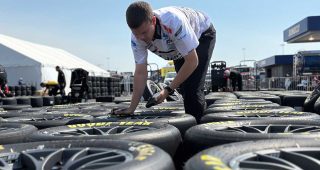
Cup Series teams will have an allotment of 10 new sets of Goodyear tires for Sunday’s race, plus one that carries over from Saturday’s qualifying. The stages roughly split the race into thirds, with breaks at Lap 90, Lap 185 and the full distance of 293 laps — making the final stage the longest by a slight margin.
MORE: Paint Scheme Preview | Fantasy Fastlane
When to use those sets of tires depends on how caution flags fall and how frisky teams want to get with bucking established trends. As the garage observed in Friday night’s Craftsman Truck Series race, Corey Heim was able to bolt through the field in a series of overtimes, using a reserve set of gently used scuffed tires to a winning advantage. Holding a fresh (or fresher) set for such an occasion could also be Sunday’s winning play, but the potential cost is waiting for a yellow flag that never comes and going home with an unspent set.
Advertisement
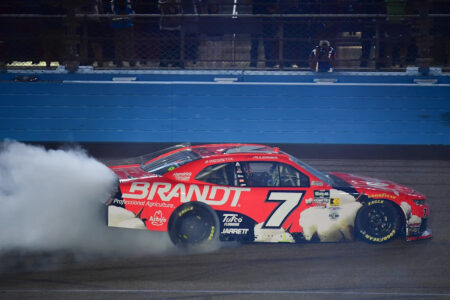
“If you could get away with just splitting a stage in half instead of pitting twice, I think that’s the big question for all of us,” said Ryan Sparks, crew chief for Daniel Suárez’s No. 7 Spire Motorsports Chevrolet. “Obviously we’d want to just split one in half so you can save a set of tires, right, because we saw what happened (Friday) night and how important tires are. So I think the guy that can give up the least track position and keep a set will probably be in a really good spot. So if you end up having to pit twice each stage, it really puts you in a bind on tire allotment. So it’s in the back of all the crew chiefs’ minds. That’s the big question this weekend.”
Pole winner Tyler Reddick said he was able to coax 42 laps out of a set during practice, “and I was hanging on for dear life,” he added. Sunday’s race-day results may vary for other teams, but the merits and perils of gambling and pushing those runs farther versus stopping more frequently will weigh heavily atop each pit box.
“Traditionally, we don’t use all the sets here because you don’t have those natural cautions,” McSwain said. “And I definitely think now that you’re going to see guys being more aggressive on strategy, essentially two-stopping the stages, because the falloff is so high and they drive so bad. So I think you will see a different Darlington than what we have in years past from a strategy side. So you’ve really got to stay on top of what’s best for your car. In particular, you may have some guys that are one stop versus two, just because their long run is very high. So I think that that’ll be the difference is you’ll have guys on varying strategies.”
Said Sparks: “It’s a game of risk, right? Risk versus reward. You know, it can be very rewarding if you had a set laying at the end that you could use with a caution with 10 laps to go. And man, if we all knew the answer when the caution was going to come … What’s scary to me is, historically, there’s a caution right off the bat at the start of this race. So if you have to throw a set on it Lap 12, you’re going to have to pit again before the end of stage, so you’re down a set from where you want to be already. I think that’s what’s bothersome to all the crew chiefs in the garage. So, the good news is we all have the same amount. So whoever can come up with the cutest strategy, I think will be in a good spot.”
Advertisement
Drivers and crews alike will face another test with Darlington’s unique pit-road layout. The entry requires a long, sweeping entry down off the banking of Turns 3 and 4, and the chance of missing the opening is greater here than other tracks on the circuit.
Once drivers get there, they’ll find that the first six pit stalls are slightly isolated — still part of the track’s Turn 4 bend before the pit road straightens out on the frontstretch. Suárez qualified 11th, giving Sparks a better pit-stall choice — stall No. 7 for car No. 7 — and some say in setting up camp in a preferred spot.
“I don’t like being in that curve down there, me personally. Some people love it. I do not,” Sparks said. “For the drivers, as far as just getting on pit road with the falloff and stuff, I mean, there’s no grip, so you’re out of control trying to get to pit road under green, which we’re going to do a lot, pitting under green here. So the driver has to be extremely focused. You’ll see guys miss pit road here, so I definitely like to be on the other end of pit road, just because you have a little time to prepare your crew. If you hit the wall here, coming off of (Turn) 2, you’d better be ready if you’re at that end of pit road. The driver’s coming to you quick. Just so many things that happen quickly here and often, so a lot to think about … but that’s what makes our job challenging and fun.”
Read the full article here