




More than half the Spring Training games are in the books. The Cardinals have played to a winning record, showed off some top prospects, and avoided catastrophic injuries. This is the first year that all spring games have been Statcast tracked, giving us plenty of data to keep an eye on while we wait for the real games to begin. Today I’m checking in on a few early Statcast indicators to see which Cardinals might be showing real underlying changes. As always, small-sample-size, spring training caveats apply to every word of this article!
Starting Pitchers
Counter to most of our offseason discussions, Oli Marmol has repeatedly mentioned that he sees the pitching as the strength of the Cardinals. Early spring Statcast numbers offer at least a little support for that optimism.
Advertisement
Velocity
As has been widely discussed, Dustin May and Richard Fitts rolled into camp ready to rip the fastball as both are averaging above 97 MPH on their four-seam fastballs at 97.7 and 97.4, respectively. Matthew Liberatore’s velocity has hovered around 94 MPH on both his fastball and his sinker, but his stuff has looked great overall (more on that shortly). Kyle Leahy’s velocity is down about 1.5 MPH as he ramps up and moves from the bullpen to the rotation. Andre Pallante started off the spring in the low 90s, but was up to 94 MPH in his last outing, so probably nothing to be concerned about there. Michael McGreevy’s fastball is down almost 2 MPH and it has actually gone down each of his last two starts. This has probably reached the keep an eye on it stage as he does not have the fastball shape to get away with too much of a velocity drop. On the prospect side, Quinn Mathews has maintained his regained velocity sitting in the 94-95 MPH range in each of his appearances.
Swing and Miss
Matthew Liberatore has quietly put together a dominating spring training with a 14/1 K/BB rate across 10 innings. Yesterday, Eno Sarris tweeted the Stuff+ pitching leaders among starting pitchers this spring.
If these improvements for Liberatore and Fitts hold, this would be a huge development for the staff. The Cardinals haven’t had a starting pitcher register above a 107 since the inception of the statistic in 2020. For Liberatore, this improvement in stuff is backed up by the numbers as he is generating the second-lowest contact rate in baseball this spring, behind only Chase Burns, as batters are making contact on only 60% of their swings against him (min 60 swings against). Liberatore isn’t the only lefty that has proved tough to square up. Brycen Mautz ranks 4th in all of baseball so far this spring, generating swing and miss with a 61% contact rate. He had good success with his fastball (65% contact rate), but his slider was absolutely devastating, generating a swing and miss almost half the time. Mathews has missed a ton of bats too with 66% contact rate in aggregate. Here are the contact rates against so far for the starting pitchers.
As a point of reference, the league-wide contact rate against is 77%. For starting pitchers, 70% is elite, potential Cy Young votes territory. Small-sample-size caveats abound here, but you can start to see the outline of a staff that can miss some bats here. Leahy’s contact against will be worth watching as we get into the season. He has never been great at missing bats, despite having stuff that grades out well, so seeing him start off slow in this department is not ideal.
Advertisement
Speaking of Contact Rates
On the hitting side, Joshua Baez and Nolan Gorman have largely had their careers defined by power and ability, or lack thereof, to make contact. Both have had good springs offensively, but in very different ways.
Baez did not disappoint in his Spring Training cameo as he blasted three home runs and slashed .333/.417/.762 in 24 plate appearances. Baez hit four out of 15 balls in excess of 100 MPH and showed off his ability to drive the ball in the air, which is crucial to get to in-game power. While his strikeout rate was acceptable at 25%, his underlying numbers were concerning as he ran only a 59% contact rate. As a point of reference, the lowest contact rate among qualified major leaguers last season was 67.6% by Aaron Judge. Christopher Morel has a career contact rate of 65.5%. 24 plate appearances is nowhere near the number needed for this statistic to stabilize, but this will be one of the key numbers that I will be watching for Baez as he moves up to Memphis. If you can take anything away from a spring training performance, Baez confirmed why he is one of the more polarizing prospects in baseball. If you are high on him, you can look at his results and see a player that will be ready to hit in the middle of a big-league lineup by this summer. If you are a non-believer, you can see the unplayable contact rate that plagued Baez for his first four professional seasons. My prediction: if Baez can keep his contact rate from Double-A in the mid-70s, he will be a star.
Nolan Gorman, plagued by a career strikeout rate of 34%, has fanned in only 12.9% of his trips to the plate this spring. Is this small sample-size noise, or has Gorman made a real adjustment? Looking at Gorman’s seven-game rolling average K% for his entire career, you can see he hasn’t touched a stretch like this in over two years.

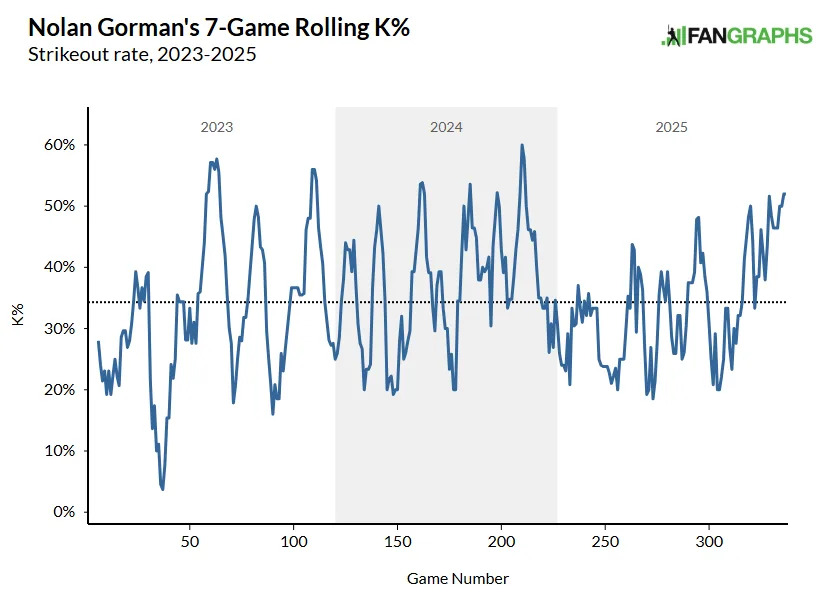
I am not sure what to make of this, but given where Gorman has been over the last two seasons, I will take this as an encouraging sign that he has made an adjustment of some kind. If the improved contact ability is real, it will allow Gorman to access more in-game power and perhaps give the Cardinals the home run pop the lineup is currently missing.
Read the full article here


