





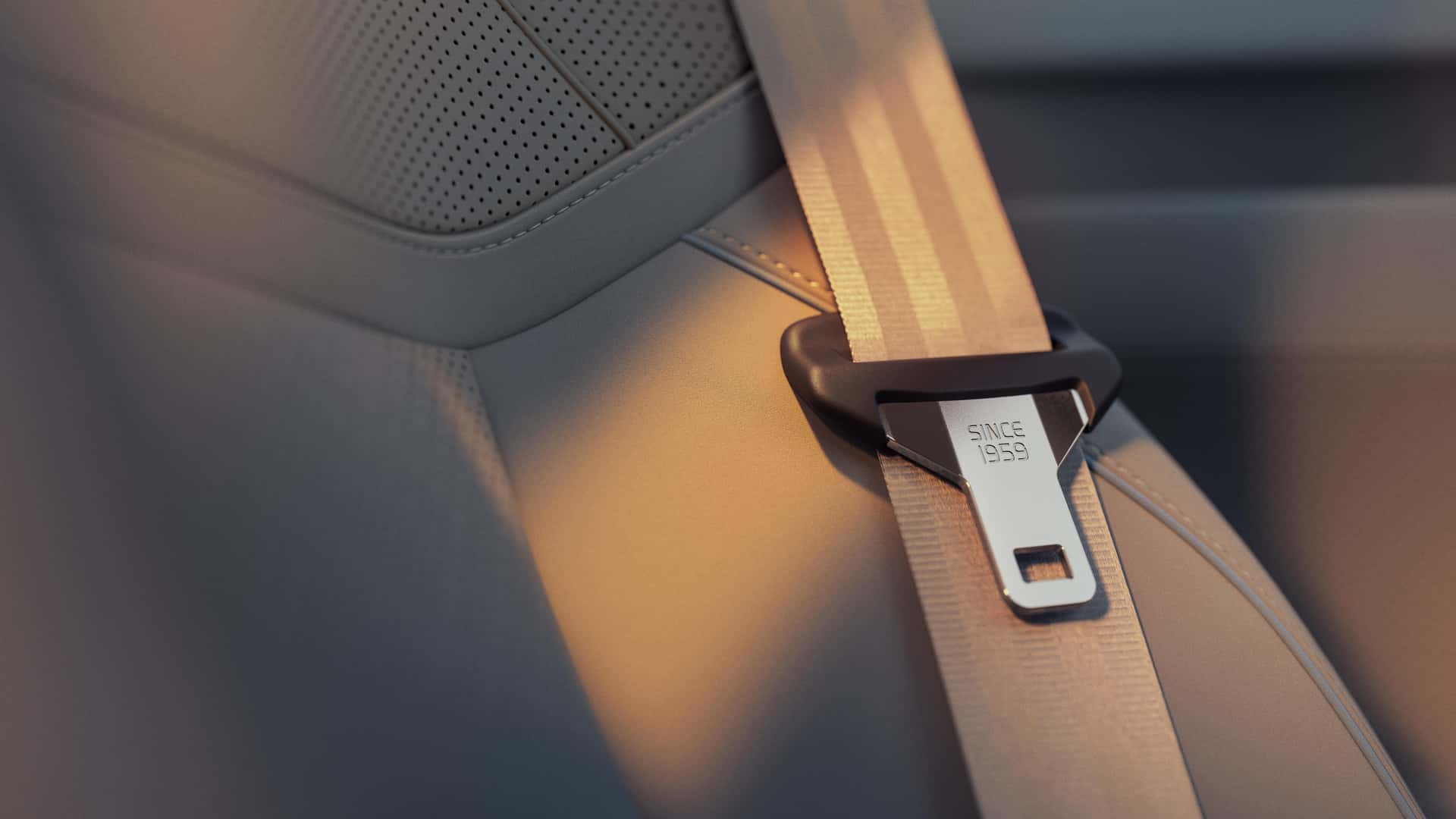
- Volvo is celebrating 70 years since its first seatbelt prototype.
- The company is debuting a new ‘multi-adaptive’ seatbelt in the EX60.
- The EX60 SUV goes on sale later this year.
Depending on who you ask, the first traditional seatbelt debuted as a concept 70 years ago—happy birthday, king. Even though there’s a bit of controversy over when the first official seatbelt was patented (inventors Roger Griswold and Hugh de Haven applied for a patent in 1955), Volvo’s two-point, cross-chest diagonal belt was largely considered the first of its kind when it debuted in 1956.
The Amazon prototype was the first vehicle to use Volvo’s new two-point belt, and it reached production shortly thereafter. Just three years later, in 1959, Volvo became the first automaker to offer the modern three-point seatbelt as standard safety equipment in its vehicles. The final version was created by Volvo design engineer Nils Bohlin, and it’s been saving lives around the world ever since.
To celebrate the occasion, Volvo is introducing a new seatbelt technology in the upcoming EX60 SUV, which is scheduled to go on sale later this year. The company calls it the “multi-adaptive” seatbelt, and safety experts in Sweden hope this is the next big step forward for in-car safety.
What Is The Multi-Adaptive Seatbelt?
Volvo EX60 Cross Country Interior
Photo by: Volvo
Here’s how it works. The multi-adaptive seatbelt will use a network of sensors inside and outside the vehicle to gather real-time data on each passenger’s build, seating position, impact dynamics, and deceleration intensity.
Based on that information, the system automatically adjusts the seatbelt’s load and chooses the optimal restraining strategy for each occupant. Larger passengers, for example, may receive more restraining force to reduce the risk of head injuries, while lighter passengers get less tension to minimize chest injuries.
The goal is to move beyond the traditional “one-size-fits-all” seatbelt, tailoring protection to each and every individual inside the car. The system is adaptive and continually learns, adjusting to different body types and potential road hazards. It also supports over-the-air software updates, ensuring the technology improves over time.
“Volvo has always been at the forefront of safety evolution and innovation, and we’re pleased that we can continue to make new developments on such vital features like the seatbelt,” said Nicole Melillo Shaw, Managing Director of Volvo Car UK. “The latest multi-adaptive seatbelt in the new EX60 is a testament to our pioneering technology and approach to safety that is continued today.”

73
Source: Volvo
Motor1’s Take: For 70 years, the seatbelt has gone largely unchanged. Now, the company that pioneered the traditional three-point belt is using technology to make its cars even safer. It’s just a great use of technology.
Read the full article here