



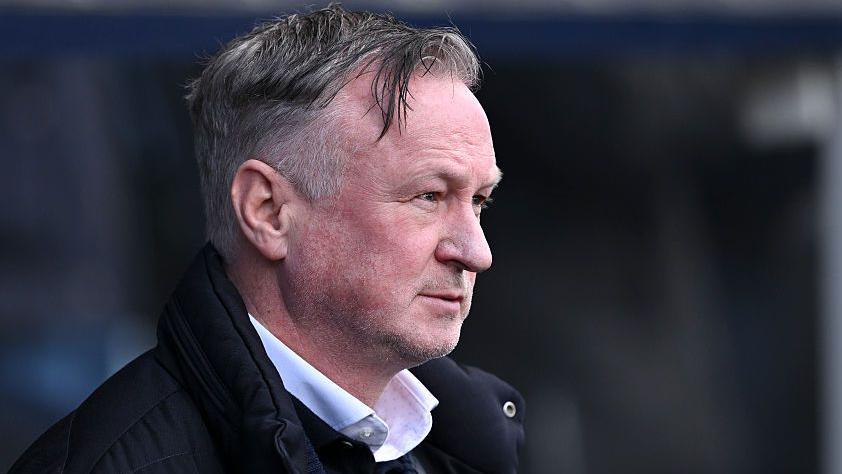
Michael O’Neill’s decision to remain with Northern Ireland and end his association with Blackburn Rovers represents a significant moment for the club as they looks ahead to next season.
While there had been a degree of expectation that O’Neill might consider a full-time return to club management, his confirmation, delivered 10 days after the end of the Championship campaign, brings clarity to a situation that had lingered since the final whistle sounded in the home defeat by Leicester.
Advertisement
O’Neill’s tenure at Ewood Park was brief but notably stabilising. Appointed during a period of uncertainty, his primary objective was clear – secure the club’s Championship status.
He achieved that aim.
A record of five wins from 15 matches does not immediately stand out, but in context it represented a tangible improvement. The rot was stopped. It reflected a side that became harder to beat, more disciplined, and better organised defensively despite a chronic lack of goals.
However, the fact that survival was only confirmed on matchday 45 underlined the scale of the challenge he inherited. Blackburn were not a side operating from a position of comfort – they were one navigating a genuine relegation fight.
Advertisement
O’Neill’s approach was consistent with that reality. His focus remained on efficiency rather than expansion – managing games, minimising risk, and extracting enough from the massively stretched squad available to achieve the desired outcome.
O’Neill’s choice not to extend his stay appears to have been shaped by a combination of professional considerations and personal circumstances.
From a footballing perspective, discussions with the club would likely have centred on areas such as recruitment strategy, budgetary constraints, and long-term planning. These are standard elements of any managerial negotiation, particularly for a coach with O’Neill’s level of experience.
Equally, his existing role with Northern Ireland offers a different type of stability. He is well established within that environment and faces the prospect of leading the national team into a European Championship qualifying campaign for the 2028 tournament, which will be hosted across the UK (excluding Northern Ireland) and the Republic of Ireland.
Advertisement
For Blackburn Rovers, the timing of this decision offers both a challenge and an opportunity.
In recent seasons, managerial appointments have largely been reactive, taking place mid-season in response to results or performance. This summer represents a different scenario and one in which the club has the opportunity to plan ahead rather than respond under pressure.
Attention will now turn to identifying O’Neill’s successor.
As is often the case, early speculation has included familiar names, many of whom have been linked with the role in previous months. However, recent history suggests that the eventual appointment may not necessarily emerge from the most obvious candidates.
Advertisement
The key requirement appears to be a manager capable of operating within the realities of the Championship, a division defined by competitiveness, physical demands, and for those without parachute payments, tight margins, while also contributing to a more stable, longer-term framework.
O’Neill’s contribution ultimately centred on stability. He inherited a challenging situation and achieved the immediate objective.
The next phase, however, is different.
With a summer window ahead and time to plan, the club are positioned to make a more measured and strategic choice than has been possible in recent seasons.
Read the full article here