




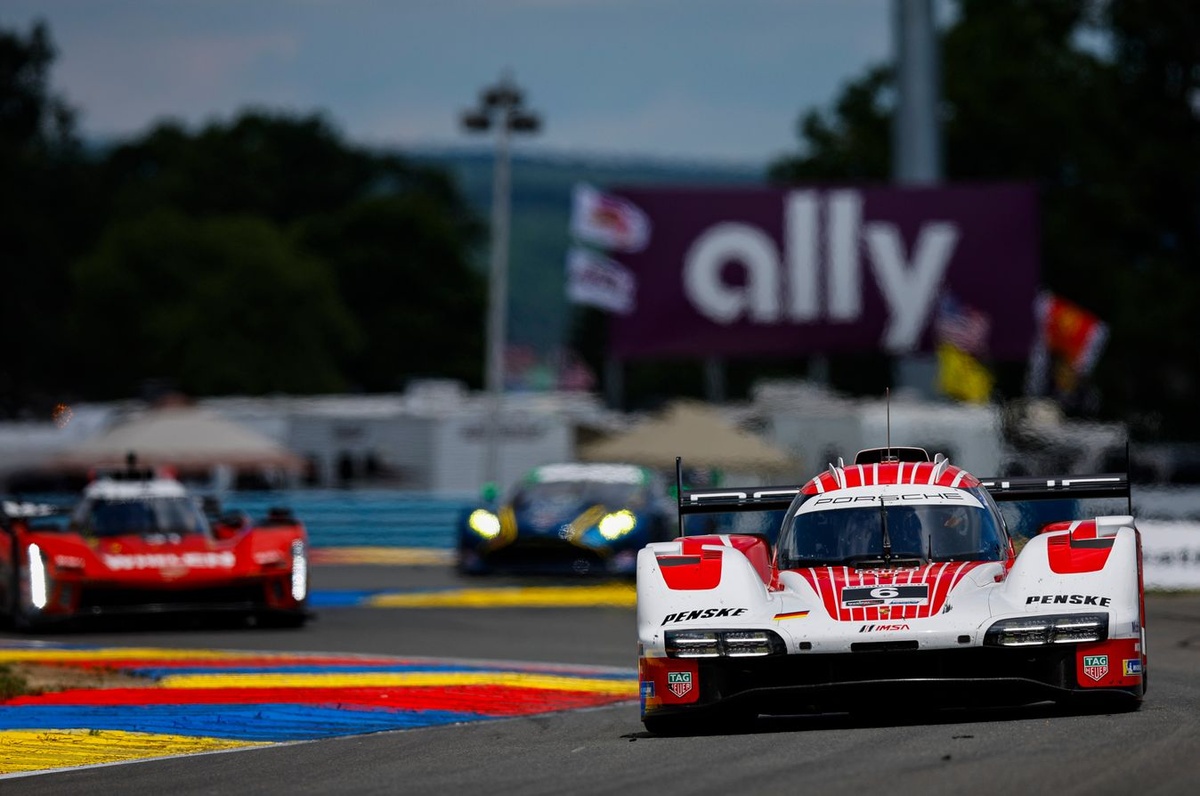
A dramatic and prolonged Saturday at Watkins Glen International culminated in historic lap times and a significantly reshaped racing line through the famous “Bus Stop” chicane ahead of the Sahlen’s Six Hours of The Glen.
During the late stages of the IMSA Michelin Pilot Challenge support race on the 3.4-mile, 11-turn natural terrain road course, a piece of curbing detached at the entry to Turn 5. The loose curb severely damaged a wheel on a Turner Motorsports entry, ruining a likely strong finish for the team and forcing track officials into immediate action. Extensive track repairs delayed the subsequent WeatherTech Championship qualifying session by two hours and 40 minutes, pushing it until after another scheduled IMSA support series race.
Advertisement
In response to the safety hazard, track officials opted to completely pull up the curbs in that section for the qualifying sessions. The sudden modification transformed the characteristics of the chicane, leading to shattered track records in both the GTP and GTD Pro classes.
Officials confirmed that the curbing will not be replaced ahead of Sunday’s main event; instead, the area will be painted overnight to ensure proper driver visibility.
Advertisement
Following the marathon session, pole-sitters from various classes shared how the sudden track alterations impacted their approach and what they anticipate for race day.
GTD Pro: “Balls to the Wall” in the Bus Stop
Jack Hawksworth secured the GTD Pro pole position in Vasser Sullivan’s #12 Lexus RC F GT3 after navigating what he described as a grueling wait.
“Yeah, it was definitely a strange day,” Hawksworth said. “Obviously feels like we’ve been here for 24 hours. You know, we did the one practice this morning and then, yeah, we sat around really for seven or eight hours waiting to go out and qualify. Finally GTD Pro side anyway got the opportunity to do that.
Advertisement
“The changes to the Bus Stop were pretty dramatic. Going out there and trying to figure out the track and understand exactly how much of the curb you could take compared to practice was interesting. Glad we could get a pole and this marathon day at Watkins Glen. Looking forward to race day tomorrow.”
Hawksworth noted that removing the curbs completely altered the physical sensation of attacking Turn 5, allowing GT cars to aggressively straighten out the corner.
Advertisement
“It’s wildly different,” Hawksworth explained. “I mean, certainly in our car, I don’t know about the Aston, but the curb that was previously in the Bus Stop, when we hit that with the center of the car, it was quite a big jump, which really changed the whole feel of the Bus Stop. Now you can really almost be up to the metal fence. Kind of like the NASCAR guys do. It really doesn’t affect the car.
“It opens up the corner a lot more. The corners are quicker. Certainly for us in our car it was very, very different. It did all right, because you’ve got that guardrail. Normally when we’re driving really close to guardrail, it’s second, third gear corners, so it’s easier to judge exactly where the side of your car is. When you do it fourth gear entering at 110 miles an hour to a corner like that, it’s quite difficult. It’s a challenge, but it’s balls to the wall. It was fun to drive, that’s for sure.”
LMP2: A New Opportunity for Aggressive Passing
For the LMP2 class, the missing curbing offers a distinct tactical advantage. Jeremy Clarke, who took class pole honors in the #43 Inter Europol Compétition ORECA 07, explained that the structural change benefits prototype geometry.
Advertisement
“It changes the whole corner for P2 because we use a lot less curbing than the GTs,” Clarke said. “Now that the curbing is mostly gone, it changes the line for us, and we’re able to kind of get more over and it opens up the entire corner. I’m sure we carry much more speed through there now. Yeah, it’s a benefit for us, for sure.”
Clarke expects the wider, faster line to fundamentally alter traffic management during Sunday’s multi-class endurance race, unlocking a new overtaking zone.
“With that new line, I think we can be a little bit more aggressive going into the brake zone of those corners where we have a bit more space now on the inside, to whereas before if you’re not quite alongside a GT before that section, they’re going to kind of squeeze you over into a spot that if you go over that, the car is done,” Clarke noted. “It just gives us a little more [room] because it’s a good passing zone. We’re able to just kind of get an extra pass done that maybe we would have had to wait until the exit of the Carousel.”
Advertisement
GTP: High Risks and Low Clearance
In the premier GTP class, Jack Aitken put the #31 Whelen Cadillac on the overall pole, but he voiced a more cautious outlook on the modified chicane. Unlike the production-based GT cars, top-tier prototypes lack the ground clearance to exploit the newly flattened area without risking catastrophic underside damage.
“It was okay,” Aitken said. “It’s just a tough one to adjust going into qualifying. Any time the track changes halfway through a weekend, it’s never ideal. IMSA did a really good job under the circumstances. It hasn’t changed the line a huge amount for us. Some of the GT guys can cut it a lot more now.
Advertisement
“We just don’t have the clearance for that. There’s still those two little curbs that potentially could cause a lot of damage. I think there was some chat before the session [of] maybe you can cut it, maybe you can’t. The consequences of cutting it and bottoming out hard at 180k (112mph) or whatever it is, is obviously quite big. I’m not going to be the first one to do it. If I see someone else try it, then I might. But I don’t think anyone did.”
When asked if the widening discrepancy between how GTD and GTP cars handle the Bus Stop would complicate multi-class traffic dynamics during the six-hour race, Aitken remained unfazed.
“We have corners like that only on the calendar, where the GTDs can cut a lot more than the Prototypes,” Aitken said. “It does make it a bit awkward sometimes, but it’s not something we haven’t dealt with before. It’s not ideal, but I think if this is the best we can do in the circumstances, then that’s how it is.”
Advertisement
Watch: The Rolex 24 at Daytona: Precision, Perfection, and The Road To Victory (IMSA Endurance Racing)
Read Also:
Jack Aitken storms to Watkins Glen IMSA pole for Cadillac

Kaylen Frederick returns to a very different JDC-Miller team
To read more Motorsport.com articles visit our website.
Read the full article here


