





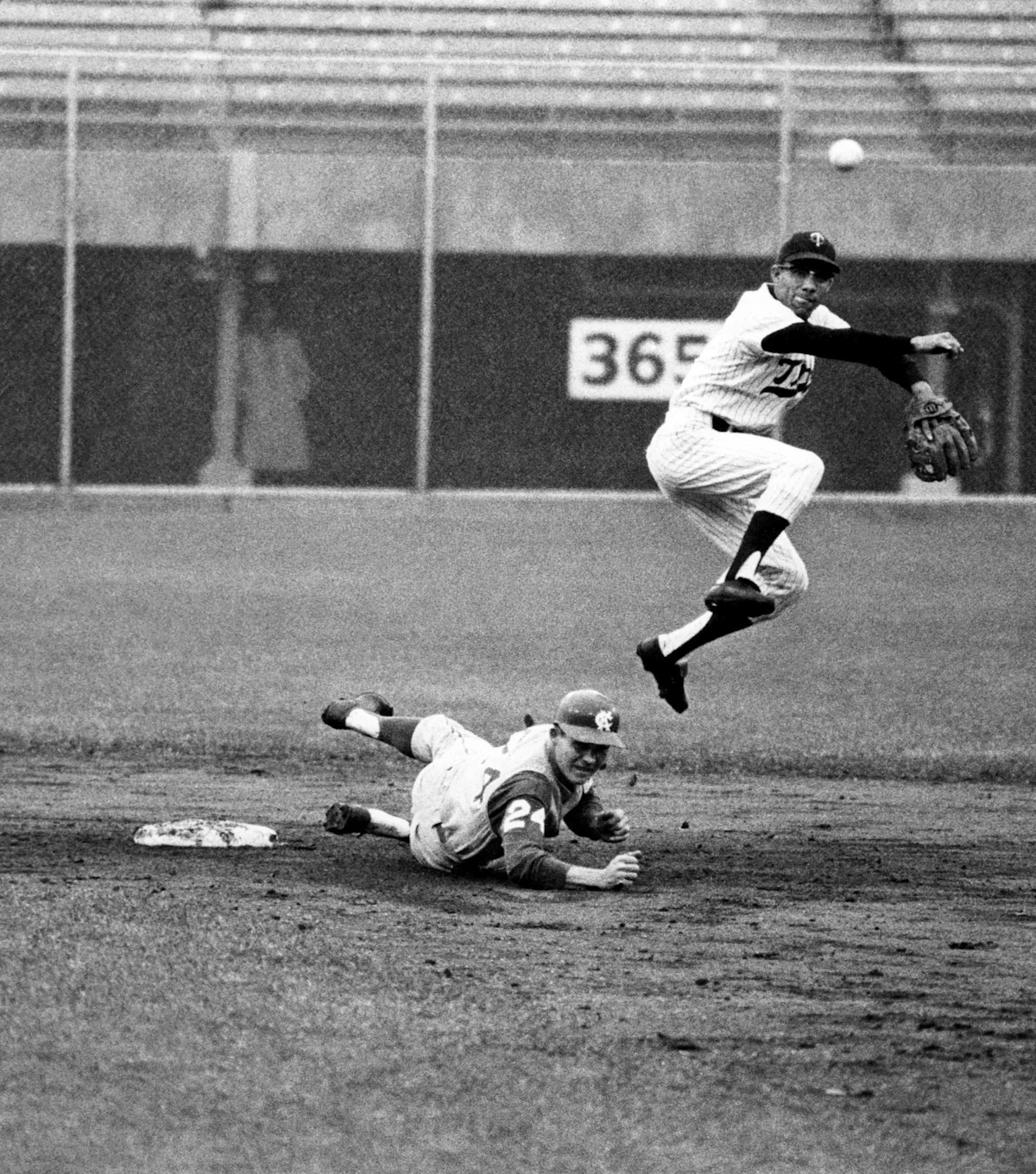
The name Larry Stahl won’t ring with any younger baseball fans, but older fans will remember Stahl for a couple of key events in Kansas City and baseball history.
The Kansas City Athletics signed the 19-year-old Stahl as a free agent shortly after his high school graduation.
Advertisement
He spent the first four seasons of his career riding buses and living in cheap motels in the lower rungs of the Athletics system. Places like Albuquerque, Visalia, Minot, Tidewater and Lewiston.
He finally broke out in his age 23 season when he hit .286 with ten home runs and 47 RBI in 104 games at AA Birmingham.
That earned him a late season callup to Kansas City. He made his debut on September 11th, 1964, in a game at Baltimore. He made a 7th inning pinch hitting appearance against future Kansas City Royal Wally Bunker.
He recorded his first hit a week later with a ground rule double off Ralph Terry in Yankee Stadium, a memorable way to start a career.
Advertisement
On September 29th he recorded the first home runs of his career with a two-home run day at Metropolitan Stadium against the Twins. He victimized Dave Boswell on both blasts.
Stahl split the 1965 season between Kansas City and Vancouver before sticking with the big-league club for good in the 1966 season.
He was a steady, if unspectacular right fielder. Decent with the glove and arm with occasional power.
Stahl’s claim to Kansas City fame came on May 11th, 1966, in a game at Municipal Stadium against the Boston Red Sox. Only 2,700 hardy souls came out that day as the Athletics beat the Sox by the score of 6 to 5. Too bad because they missed an exciting finish.
Advertisement
Boston led 4 to 2 going into the bottom of the 9th. Mike Hershberger led off with a single bringing Stahl to the plate to face former teammate Jose Santiago. Stahl teed off, blasting a Santiago offering over everything in right field and onto Brooklyn Avenue to tie the score. The bomb was estimated to have traveled 503 feet, making it one of the longest home runs in Municipal history as well as one of the very few to have made the trip onto Brooklyn Avenue.
Bob Cerv is regarded as having the longest home run in Municipal history with his 528 blast in May of 1958. Stahl only hit five home runs in the 1966 season, so this one was both timely and historic.
The Athletics put Stahl on waivers after the 1966 season and the New York Mets snapped him up. He played two seasons in New York before the expansion San Diego Padres tapped him with the 26th pick in the 1968 expansion draft.
He played four seasons in San Diego before being sold to the Cincinnati Reds prior to the 1973 season.
Advertisement
He had the best production year of his career in 1971 with the Padres, appearing in 114 games, hitting .253 with a career high 8 home runs and 36 RBI.
He appeared in 76 games for the pennant winning Reds. He recorded his last career home run on August 20th with a 2nd inning dinger off Tom Seaver. Not a bad way to close things out. 1973 Tom Seaver was one of the best what with his 2.08 ERA which earned him his 2nd Cy Young award.
He picked up his last regular season career hit two weeks later with a game winning, pinch hit single off Atlanta’s Adrian Devine. Nice way to go out.
There wasn’t a lot of playing time for Stahl on that Red’s team, which was loaded with All-Stars and future Hall of Famers. He was a valuable bat off the bench though.
Advertisement
Stahl got into four games, all as a pinch hitter, in the 1973 NLCS, his only post-season appearance.
His last major league plate appearance came in Game Five of the NLCS, with the Reds desperately trying to mount a rally against Seaver. Stahl did his part, stroking a single to left. The Reds loaded the bases, but Tug McGraw put out the fire, getting Joe Morgan and Dan Driessen to end the game and Stahl’s career.
Stahl’s second claim to fame? That came on September 2nd, 1972, in a game at Wrigley Field. Milt Pappas was on the mound for Chicago and he was dealing. 26 up, 26 down. Stahl came up as a pinch hitter and with the count at 2-2, Stahl watched two close pitches go by, one on a check swing. Home plate ump Bruce Froemming called them both balls, which set off a few seconds of Pappas jawing at Froemming. The walk spoiled a perfect game bid for Pappas, who did get the no-hitter by retiring the next batter.
The no call, especially on the check swing, ignited a firestorm from Pappas and the Chicago media. You can watch video of Stahl’s at bat online. Video wasn’t great in 1972, but both pitches looked outside to me. Should Froemming have called them strikes given the circumstances? Is that something that’s covered in baseball’s unwritten rules?
Stahl passed away March 17th at the age of 84 in Caseyville, Illinois.
With Stahl’s passing, the number of remaining Kansas City Athletics is down to approximately 68.
Read the full article here