




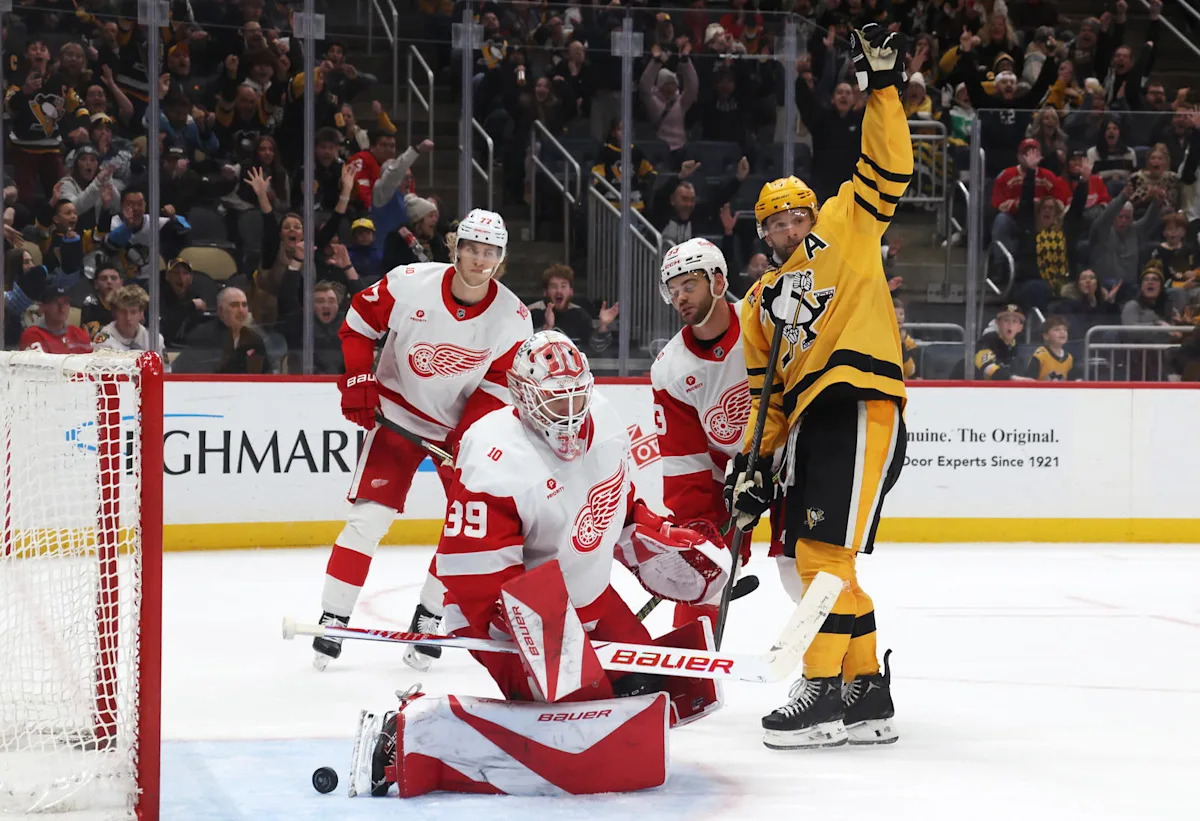
It was a tough season for the Detroit Red Wings as they aimed to finally snap their playoff drought, but by the time the postseason arrived, they were left watching from home once again.
After briefly leading the Atlantic Division earlier in the year, Detroit’s season unraveled slowly and painfully, with inconsistency, defensive struggles and a lack of finishing ability ultimately costing them a playoff spot in heartbreaking fashion.
Advertisement
For frustrated Red Wings fans searching for answers, NHL EDGE data provides a clearer picture of what went right and what went disastrously wrong over the course of the regular season.
Offensively, Detroit actually produced at a level that should have translated into far more success. The Red Wings generated 2,316 shots on goal, ranking 11th in the NHL, while their 685 high-danger scoring chances also placed them 11th league-wide. Their underlying possession metrics were respectable as well, posting a plus-0.5 shot-attempt differential that ranked 14th and a plus-0.1 shots-on-goal differential that ranked seventh overall.
Those numbers suggest Detroit frequently controlled play at even strength and created quality opportunities on a nightly basis. The problem was turning those opportunities into goals.
Advertisement
Despite generating offense consistently, the Red Wings scored just 239 goals this season, ranking 22nd in the NHL. Their shooting percentage of 10.3 percent ranked 26th, revealing a team that simply struggled to finish chances when it mattered most. Too often, Detroit outplayed opponents for stretches only to fail to capitalize offensively.
The deeper puck-possession numbers tell an even more concerning story with Detroit spending 42.5 percent of its total ice time in the defensive zone, meanwhile, they spent only 40 percent of their time in the offensive zone, ranking 26th, while their neutral-zone possession time of 17.4 percent ranked 29th.
For a club attempting to establish a controlled, possession-driven identity under its current core, those numbers expose a major weakness. Detroit frequently found itself hemmed into its own zone and struggled to sustain pressure offensively for long stretches.
Bookmark The Hockey News Detroit Red Wings team site to stay connected to the latest news, game-day coverage, and player features.
Red Wings Lose Out On Charlie Coyle As Center Re-Signs With Blue Jackets
Red Wings Lose Out On Charlie Coyle As Center Re-Signs With Blue Jackets Columbus secures a reliable two-way veteran with a long-term extension, forcing Detroit to pivot their offseason strategy after missing out on a premier middle-six depth solution.
Advertisement
The Red Wings also weren’t the slowest team in the league by any means by lacked top end speed as they recorded a maximum skating speed of just 22.84 MPH this season, ranking dead last among all 32 teams.
Their total number of 22+ MPH speed bursts, just 45, ranked third-worst in the league. In an NHL increasingly dominated by transition offense and explosive skating, Detroit lacked the high-end pace necessary to keep up with other teams.
Detroit ranked 32nd in total miles skated on the penalty kill at 159.32 miles, while their average of 7.15 miles skated per 60 minutes while shorthanded ranked second-worst in the NHL. Their total movement during penalty-kill situations in individual periods also ranked last league-wide.
Combined with Detroit’s bottom-10 penalty kill ranking this season, the data reinforces what fans often saw with the eye test, a passive unit that struggled to pressure puck carriers or disrupt offensive setups.
Advertisement
On the bright side, Detroit’s power play emerged as one of the team’s strengths, finishing seventh in the NHL in most miles skated during a game on the power play and second in most miles skated during a single period with the man advantage. This was largely because they tied with the Dallas Stars for the seventh-most power play opportunities in the NHL with 248 this season.
At even strength, the Red Wings also posted respectable skating numbers, ranking ninth in total miles skated and 10th in average miles skated per 60 minutes. While their top-end explosiveness lagged behind the league’s elite teams, their overall work rate remained competitive.
The Red Wings showed they can generate chances, compete territorially at times and create an active power play. But their inability to finish scoring opportunities, sustain offensive-zone possession and match the league’s speed ultimately doomed them when the playoff race tightened.
Never miss a story by adding us to your Google News favorites!


Image
For action-packed issues, access to the entire magazine archive and a free issue, subscribe to The Hockey News at THN.com/free. Get the latest news and trending stories by subscribing to our newsletter here. And share your thoughts by commenting below the article on THN.com or creating your own post in our community forum.
Read the full article here


