




There isn’t much in the wide world of sports that you can look at and genuinely call a “travesty”. Especially when you consider all of the instability in the world at large, sports are merely entertainment. They’re designed to provide an escape, a distraction, and something for us to care about for a few hours before returning to the things that actually matter.
But much like “sports hate” is different from real hate, I think there’s room for “the sports travesty”. It’s something that isn’t a true tragedy in any meaningful sense of the word, but within the strange little universe we’ve created around games, statistics, legacies, and the people who play them, it feels egregiously wrong.
Advertisement
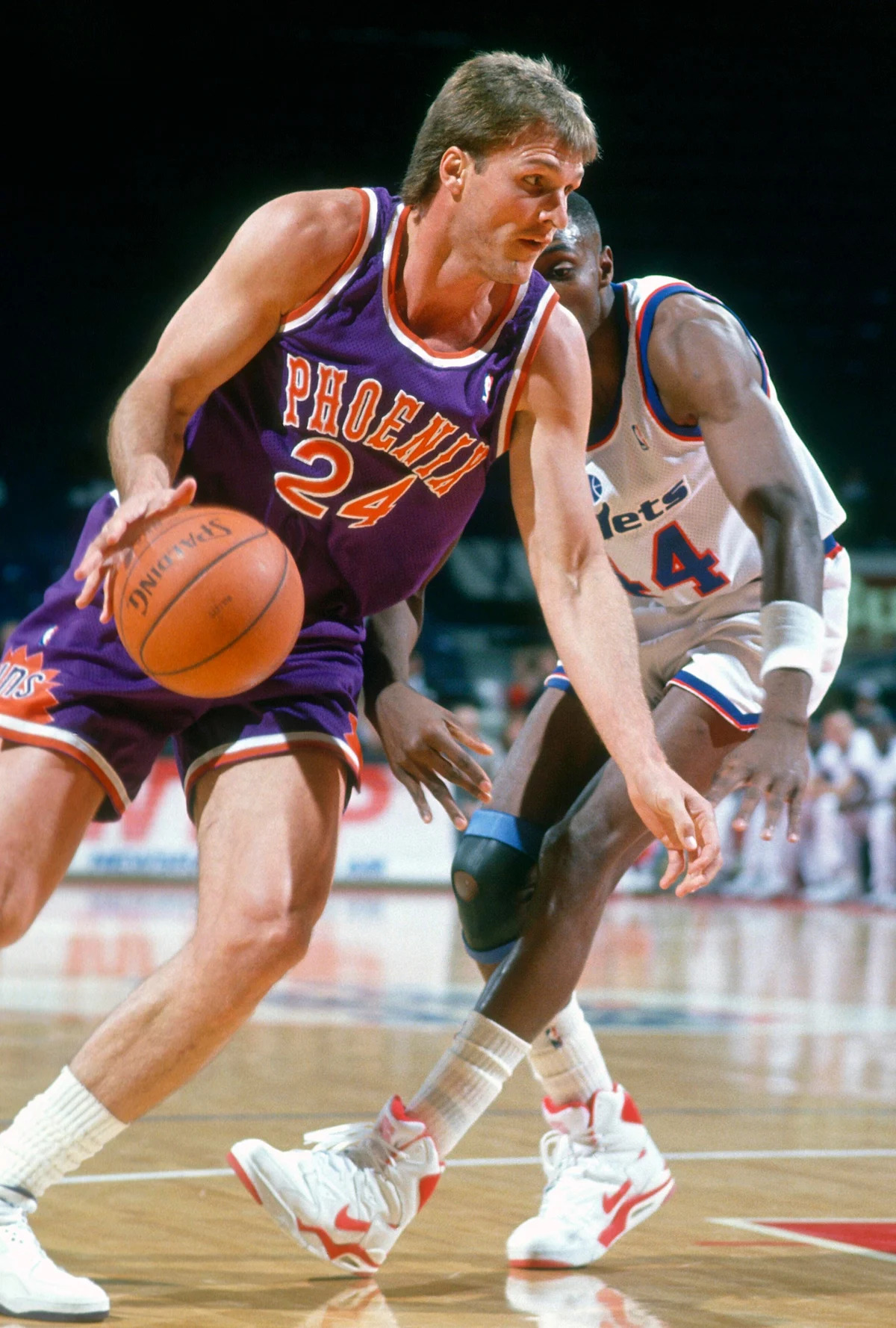
Tom Chambers not being in the Naismith Memorial Basketball Hall of Fame falls into that category for me.
I’m not alone. Granted, the results of the polling we’ve done here are most certainly biased. Asking a community of Phoenix Suns fans whether Tom Chambers belongs in the Hall of Fame isn’t exactly a scientific exercise conducted under the watchful eye of Gallup. Still, the response showcases that there is some merit to the argument. Tom Chambers should be in the Hall, and 79% of the Bright Side community concurs.
Why? I’ll start with something that occasionally gets lost in these conversations. This is the Naismith Basketball Hall of Fame. It isn’t the NBA Hall of Fame. It isn’t the College Basketball Hall of Fame. The Naismith Basketball Hall of Fame encompasses all aspects of the sport. It exists to honor, recognize, and celebrate the history of basketball in its totality. Careers are supposed to be viewed through that wider lens, which makes Chambers’ absence increasingly peculiar the longer you stare at it.
Advertisement
Start with 20,000 points. Chambers scored 20,049 of them during his NBA career, and he is one of only four eligible players in NBA history to cross the 20,000-point threshold and remain outside the Hall of Fame. The others are Antawn Jamison, LaMarcus Aldridge, and Joe Johnson. That’s the list. How many of those guys hold the all-time single-season points per game record for a franchise? Still, Chambers isn’t among the names ESPN’s Ben Golliver identifies as being on the waiting list for the Hall of Fame. Joe Johnson is, as is LaMarcus Aldridge.
Of the 156 NBA players who have been inducted into the Hall of Fame, 43 scored at least 20,000 points. Chambers did something that has historically served as one of basketball’s great monuments to longevity, production, and sustained excellence, and somehow he remains standing outside the gates. That doesn’t automatically make him a Hall of Famer. No single statistic should. But when you’re searching for historical oddities, places where the numbers make you stop, scratch your head, and wonder how the hell we arrived here, Tom Chambers scoring more than 20,000 points and never receiving the call from Springfield is a pretty damn good place to start.
Going a step further, Chambers played during an era of basketball loaded with stars, and he still found a way to thrive offensively. Perhaps his career average of 18.1 points is viewed as some kind of gatekeeper, a number that doesn’t quite scream “Hall of Fame” when you first see it. Once you start digging through the players who are actually in Springfield, however, that argument begins to lose some of its weight. Chambers averaged more points for his career than Kevin Garnett, Kevin McHale, Scottie Pippen, and plenty of other players whose Hall of Fame credentials have never been questioned. In fact, 80 of the 156 NBA players currently in the Hall, or 51.3%, averaged fewer than Chambers’ 18.1 points.


SEATTLE – FEBRUARY 1987: Tom Chambers #23 of the Eastern Conference All-Stars celebrates after winning the 1987 NBA All-Star Game MVP award circa 1987 in Seattle, Washington. NOTE TO USER: User expressly acknowledges and agrees that, by downloading and or using this photograph, User is consenting to the terms and conditions of the Getty Images License Agreement. (Photo by Andrew D. Bernstein/NBAE via Getty Images) | NBAE via Getty Images
There will always be another side to the argument, especially when discussing the Hall of Fame. Chambers never won a championship. He never made an All-NBA First Team. His résumé lacks that one obvious achievement you can point to and declare the conversation over.
Advertisement
Still, we’re talking about a player who was a quality and effective forward for more than a decade, scored more than 20,000 points, was a two-time All-NBA Second Team recipient, made four All-Star teams, won an All-Star Game MVP, and averaged more points than half of the NBA players who have already been enshrined. At some point, the accumulation of accomplishments has to matter.
Then there is Chambers’ place in NBA history, and this is where I believe his case becomes even more interesting. Tom Chambers was the first unrestricted free agent in NBA history, and his decision to sign with the Phoenix Suns in 1988 represents a seminal moment for the league.
Think about how much of the modern NBA revolves around free agency. Think about the television specials, the airport tracking, the social media detectives, the cap space clearing, and the annual hysteria surrounding where the biggest names are going next. There had to be a first domino, and Chambers was it. A star player exercised his newfound freedom and chose to leave Seattle for Phoenix, helping usher the NBA into an era that now defines how teams are built and how players control their careers.
And yet, he’s probably not going to make it. I’m not sure what the FanDuel odds are, but Basketball Reference gives Chambers a 5.2% probability of reaching the Hall of Fame, which feels remarkably low when you stack everything together. The 20,000 points, the 18.1 points per game, the All-Star appearances, the longevity, the production, the historical significance as a pioneer of unrestricted free agency. Individually, perhaps you can poke holes in each piece of the argument. Collectively, they tell the story of somebody who mattered to the NBA, both in what he accomplished on the court and what he represented off of it.
For a place tasked with preserving and celebrating the history of basketball, you’d think that would matter. Apparently, it hasn’t mattered enough. And that’s a damn shame.
Read the full article here


