





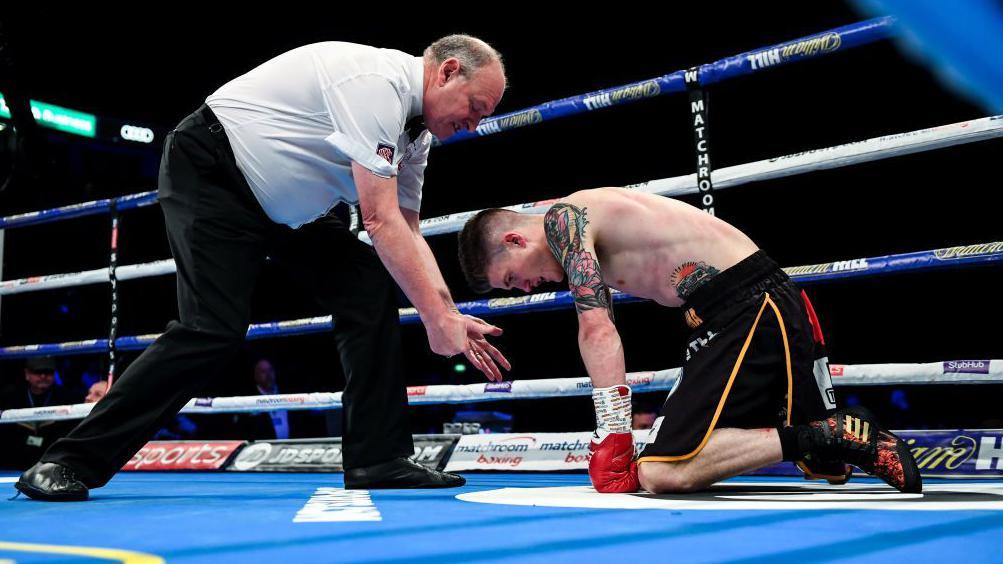
Some say it is the best seat in the house when it comes to the big fights. There’s certainly nobody who gets closer to the action.
But being a professional boxing referee is not for the faint hearted. The third person in the ring has the most important job – keeping the fighters safe in a sport where life-changing injuries can happen.
Advertisement
“You can’t afford to sort of switch off for a moment,” said Phil Edwards, one of the most well-known professional boxing referees in Britain.
“Anything can happen when you least expect it and you have to be prepared to handle whatever is thrown at you.”
Now retired from in the ring but still working as a judge, the Preston-based Welshman has been involved in the sport since the 1990s and has overseen world title fights involving the likes of Anthony Joshua and Josh Warrington.
Referees rarely talk but Edwards spoke on the condition of not going into detail on specific bouts he has taken charge of which include some of the most high-profile fights of the past 30 years.
Advertisement
Edwards got involved with the British Boxing Board of Control (BBBofC) in the 1990s. An avid boxing fan as a younger man, his wife implored him to find a passion outside of his work in the insurance industry.
With the waiting list long at his local golf club, he opted to start as an inspector with the BBBofC and later trained as a referee.
“It’s very intense, it’s enjoyable as it’s great to be involved and it’s a privilege to be in the ring with the boxers,” Edwards, 70, told BBC Sport.
“But it’s like any other job, you enjoy it afterwards in a way because you have to be absolutely 100% focused.
Advertisement
“The most important part of the job is doing everything you can to ensure the safety of the boxers.”
Criticism part of being a referee
One of the many things thrown at referees in the sport is criticism. Particularly when they stop a bout early, don’t punish fouling or let fights go on too long.
Judges are open to more abuse given how they score a contest is subjective.
It should be noted some criticism is deserved and there is an obligation on media and stakeholders in the sport to question and query to ensure standards are met but sometimes it also goes too far, particularly online.
Advertisement
Yet referees have to make decisions in high-pressure circumstances, often with health of the fighters firmly in mind.
“There are situations where you get criticism and certain things are regarded as, if you like, ‘controversial’,” said Edwards.
“You get [made] aware of criticism, but I’ve always taken the view that comes with the territory.
“And if you don’t want to be in that situation, you shouldn’t be doing it.
“Obviously there might be situations where you do something and you think, ‘I’ll learn from that’ because we’re all learning all of the time and you can never say you’ve stopped learning.”
Advertisement
But social media means the negative examinations are very public.
“Personally, I don’t look at social media or anything like that,” said Edwards.
“Some do. I just take the view I’m there to do a job. I do it as best I can and get on with it.”
The risks of boxing are too well known, of course. Unfortunately death can happen.
The boxers’ corners know their fighters best but are invested in their success so sometimes can miss the time to pull a fighter out.
Nobody is closer than the referee.
“You do have to be always on it to notice if there is a change in one boxer, starting to tire, starting to become outclassed,” said Edwards.
Advertisement
“You develop that skill and that almost like a sixth sense for seeing what changes can take place. The corners know exactly what their boxer is capable of and see signs because, of course, the corner know the boxer so well.
“But you [the referee] do have, if you like, the best seat in the house in terms of seeing what’s happening.
“I’d also like to see more people aware that sometimes if a stoppage is made, they should just be aware that there is a danger involved and that the referee is best placed to make that decision as to when to stop a contest.
“Sometimes if I hear talk about that was premature and so on, I often think if it hadn’t been stopped what would have happened?”
Advertisement
‘VAR not a perfect fit for boxing’
VAR has been suggested in boxing to review contentious decisions [Getty Images]
Other sports have turned to Video Assistant Referees which has had mixed success depending on where you sit on the debate.
The sanctioning body WBC has used video replays in boxing but the BBBofC does not.
In 2019, Charlie Edwards was knocked out by Julio Cesar Martinez in the third round but WBC boss Mauricio Sulaiman reviewed the footage ringside, saw Martinez landed a blow when Edwards was down and changed it to a no-contest.
“VAR is an interesting concept,” said Phil Edwards.
“The difficulty with that is that you don’t want to have too many breaks in the action because in effect you can take away one boxer’s advantage and so on.
Advertisement
“I think we have ways of dealing with things sometimes.
“For instance, a cut occurs and the referee is entitled to ask the judges did you see what caused that and so on and get that view.
“It’s not an easy thing to apply in a sport like boxing.”
Edwards now works with younger officials and offers guidance as part of the referees committee while aiming to improve standards.
He’s a champion for more diversity among officials and would like to see more women getting involved.
Amy Pu is currently the only licensed female referee with the BBBofC.
The official would advise anyone with a love of the sport to consider getting involved despite the difficulty of the job.
Advertisement
“The good outweighs the bad,” he added. “It’s a very rewarding job.
“The best seat in the house as they say.”
More boxing from the BBC

Read the full article here