
Subscribe
Demo

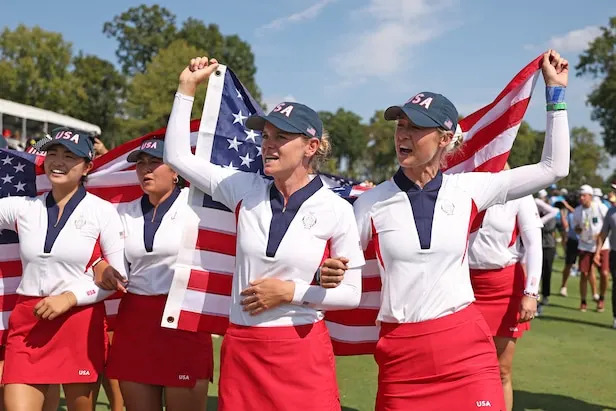
The women took a week off after Boston and now head to Europe for the 20th edition of the Solheim Cup. A biennial international team event mirroring the format of the Ryder Cup, 12 women from the United States take on 12 women from Europe. The matches started in 1990, and the United States holds an 11-8 record. Unlike the Presidents Cup we will see in two weeks, these matches have been close. Europe has won three of the last four matches, and four of the past six Solheim Cups have been decided by two points or less! The two lineups are listed below. At first glance, the rosters reveal a bunch of new names, and one immediately realizes how much of an influence Asia and the surrounding region has on the women’s Rolex World Rankings.

  • United States Team: Nelly Korda, Angel Yin, Jennifer Kupcho, Yealimi Noh, Auston Kim, Lauren Coughlin, Allisen Corpuz, Andrea Lee, Alison Lee, Lindy Duncan, Megan Khang, Rose Zhang

  • Team Europe: Charley Hull, Esther Henseleit, Lottie Woad, Maja Stark, Céline Boutier, Carlota Ciganda, Linn Grant, Nanna Koerstz Madsen, Leona Maguire, Julia López Ramírez, Nastasia Nadaud, Mimi Rhodes

RELATED: All 24 players competing in the 2026 Solheim Cup, ranked

Advertisement

The average world ranking of the United States is 38, while Europe’s is 54. That’s pretty close when you consider the gap you will see in Chicago for the Presidents Cup in a couple of weeks. The United States has two rookies on its roster, and Europe has four. That would lead you to believe the U.S. has more experience on its side, but Europe’s roster has played in 27 total matches to 24 for the United States. Both sides hold a combined career winning record: United States (44-28-12), Europe (50-40-13). That shows you how close the matches have been in recent years.

Preview: format and venue

The Solheim Cup is a three-day match play competition that utilizes three different formats of play. The women will start on Friday morning with foursomes. Those familiar with the Ryder Cup and Presidents Cup know this is the alternate-shot format. One player tees off on the odd holes, and their partner tees off on the evens. Players then alternate shots until the ball is holed. The low team score wins the hole. Friday afternoon we will see fourball play. Known as better ball of partners, each competitor plays her own ball into the hole. The team with the low score wins the hole. Saturday the Solheim Cup repeats the same format. Four foursomes matches in the morning and four more fourball matches in the afternoon. On Sunday, the competition concludes with 12 singles head-to-head matches. There are 28 matches in total, and each is worth one point. If the United States reached 14 points, they retain the Solheim Cup. If Europe gets to 14.5 points, they win the Cup. The match is being played at Bernardus Golf Club in the Netherlands. Host of the 2021, ’22 and ’23 Dutch Open, this is the first time the Solheim Cup will be played in the Netherlands.

RELATED: Solheim Cup 2026: How to watch on TV, streaming all the action from the Netherlands

Advertisement

Course Conditions, Weather, Wind

The uniform committee will be happy as the forecast calls for layering. The days will begin in the low 50s. Keep in mind, the women will play 36 holes on Friday and Saturday. That means an early start for the morning foursomes and plenty of clothing. The afternoons warm up to the high 60s, and the wind will be minimal as the predicted breeze does not get over 10 mph any of the days. The teams will need some luck if they plan on staying dry. Rain is in the forecast for all three days. The total amount is under 0.25″ for the matches, but it will play a role as the surfaces will be receptive to scoring.

The official scorecard for the Solheim Cup measures 6,578 yards and plays to par of 72. Now distance and par are not all that important in match play, but they do matter when you are building the blueprint for winning. Players will be faced with four par 3s and 5s, and 10 par 4s. Nine holes have water in play, and the course is covered by 74 bunkers. Unlike a regular stroke play week on the LPGA, captains are required to pair players for the 16 partner matches. A big part of how those pairings should be made is determined by the golf course. Here are a couple of summary points for both Solheim Cup Captains.

  • The golf course routing has been changed. Matches will begin on hole 3 and if they make it to the 18th hole will finish on hole 2.

  • The par 3s are split evenly. The front nine 3s are on the even holes, and the back nine 3s are on the odds.

  • Three of the four par 5s are even numbered holes.

  • Bernardus Golf Club has one drivable hole, hole 8.

  • Holes 2, 5, 8, 9, 10, 13, 14 and 16 favor length off the tee. Five of those holes are even numbered.

  • If you like a left-to-right ball flight off the tee, then holes 2, 5, 8, 14, 16, and 17 will suit your eyes.

  • Conversely, if you like a right-to-left trajectory off the tee: holes 1, 7, 9, 10, 12, and 18 are better for you.

Looking at the scorecards for each format, scoring is a priority. The course will be set up to make low scores. The 2021 Dutch Open winner was 23 under par. The average par 3 is 166 yards, 387 yards for the par 4s and 510 yards for the par 5s. Those averages are below the weekly LPGA setup. This is the basic information needed to build a team and commit to a pairing strategy. Which team can take advantage of my notes and research? The United States is slightly favored at +105. Team Europe is a +114 option. If you believe the two teams will tie, then it’s a +1200 return. Have they ever tied? Yes, in 2023.

Advertisement

Who wins?

The official match pairings and order are announced just before each round. Wagering on most points, frequency, etc., is a fool’s errand. To assume Nelly Korda and Charley Hull will each play five matches is a big presumption, and what if they get paired against one another four times? The place to make money is the opening match bet, one or two props, and then the head-to-head match bets during the exhibition. Our Solheim Cup coverage will extend past the weekly preview and into the weekend (make sure to subscribe to our newsletters here and follow us on social media). RTL will be selecting live head-to-head bets once the pairings are posted throughout the competition. For now, it is important to compare the composition of the two teams and how they both fit the field of play; Bernardus GC.

BGC is a modern professional layout. Designed in 2018 by Kyle Phillips, players are treated to many risk-reward situations during a round. Those decision-making moments are best utilized from a design perspective in match play. The careful rerouting also considers that most matches will not play the 18th hole. Switching the order features more of the signature course moments. Solheim Cup officials have created an exceptional stretch of holes from 13 to 16 by using the actual 15th through 18th holes. Looking closely at the course, what skills will help you win matches? Most pundits believe it just comes down to putting, but it is not that simple. Approach play creates scoring opportunities. Considering that eight points are available in alternate shot, ball-striking is the main driver of scoring ability. Which team can put the ball in play further down the fairway? Bernardus Golf Club’s green complexes sit at funny angles to the approach zones. The closer players are to attacking the greens, the bigger the advantage. I would weigh putting over short game simply because if you are chipping, you are probably not putting for birdie.

Various elements of the winning team equation have been broken up to try and efficiently summarize which team will win.

Advertisement

  • Home-field advantage: I know the Netherlands is not the golf mecca of Europe, but the crowds are going to show. Have you ever watched one of their World Cup matches? Sending the Solheim to the middle of Europe is also going to limit American enthusiasm for traveling over. There’s a significant edge for the European side when it comes to homeland hollering.

  • Ball-striking: The United States has a slight edge in world ranking, total driving, driving accuracy, approach play and overall tee-to-green play. The most significant separation can be seen in the scrambling statistics—an area the U.S. must take advantage of on the short par 4s and par 5s.

  • Putting: Neither team has assembled a great collection of flatstick aficionados. That being said, when it comes to putts per GIR, Team Europe statistically leads the two sides. Unlike strokes gained/putting, that measure describes players who convert birdie chances. If you really need to answer the question who makes more putts when it matters, it is Europe.

  • Scoring: A careful comparison of rounds in the 60s, birdie averages, Birdie or Better Percentage and strokes gained scoring help determine which team is comprised of better sub-par players. The United States is statistically better at scoring. One important element to keep in mind when it comes to match play is a player’s ability to score under pressure. Neither team has a ton of prolific winners on their roster. Contending counts when it comes to handling pressure. Which team has more players that can handle the heat? That’s the best scoring measure; just possessing better season-long averages will only take your team so far.

  • Pairings: Both teams are very complementary on paper. Each side is even in their options, but which one will select the best pairings? Team Europe has proven themselves time and time again to use analysis versus their gut to create partnerships. When it comes to overall strategy, Europe continues to have an edge, and this is just one example of it.

  • Experience: Team Europe has more rookies, but their core group of players have played (and won) more matches than the American side. Both sets of veterans have concerns, but Europe has won five of the last eight and three of the last four.

  • Health: Angel Yin has played once since June due to stomach issues. Rose Zhang recently WD from the CPKC Women’s Open with a sore back. We’re heading into three days of intense physical competition, and captain Angela Stanford has added an alternate player to the team roster for precautionary reasons. That player? Lilia Vu, a former two-time major champion who has missed 10 straight cuts in individual events and has dropped to 235th in the Rolex Rankings.

That last bullet point might be the most significant factor outside of home-course advantage, and not many are talking about it. The captain’s agreement between Stanford and Anna Nordqvist states that every player must compete at least once prior to Sunday’s singles matches. If Yin or Zhang are not 100 percent, each has to play two matches at a minimum. We might not be as familiar with a few of the European players, but that doesn’t mean they cannot play golf. Lottie Woad and Charley Hull are both top 10-ranked players in the world. Carlota Ciganda has a winning record after playing in seven Solheim Cup matches. Winning on the road is incredibly difficult in these international matches, and with the teams so close statistically, I believe the intangibles give Europe an unbeatable edge.

I’m taking Team Europe (+114 DraftKings) to win the Solheim Cup.

RELATED: In a pro golf first, thousdands of fans expected to ride bikes to Solheim Cup, so we gave it the ol’ Dutch try

Read the full article here

Leave A Reply

2026 © Prices.com LLC. All Rights Reserved.