







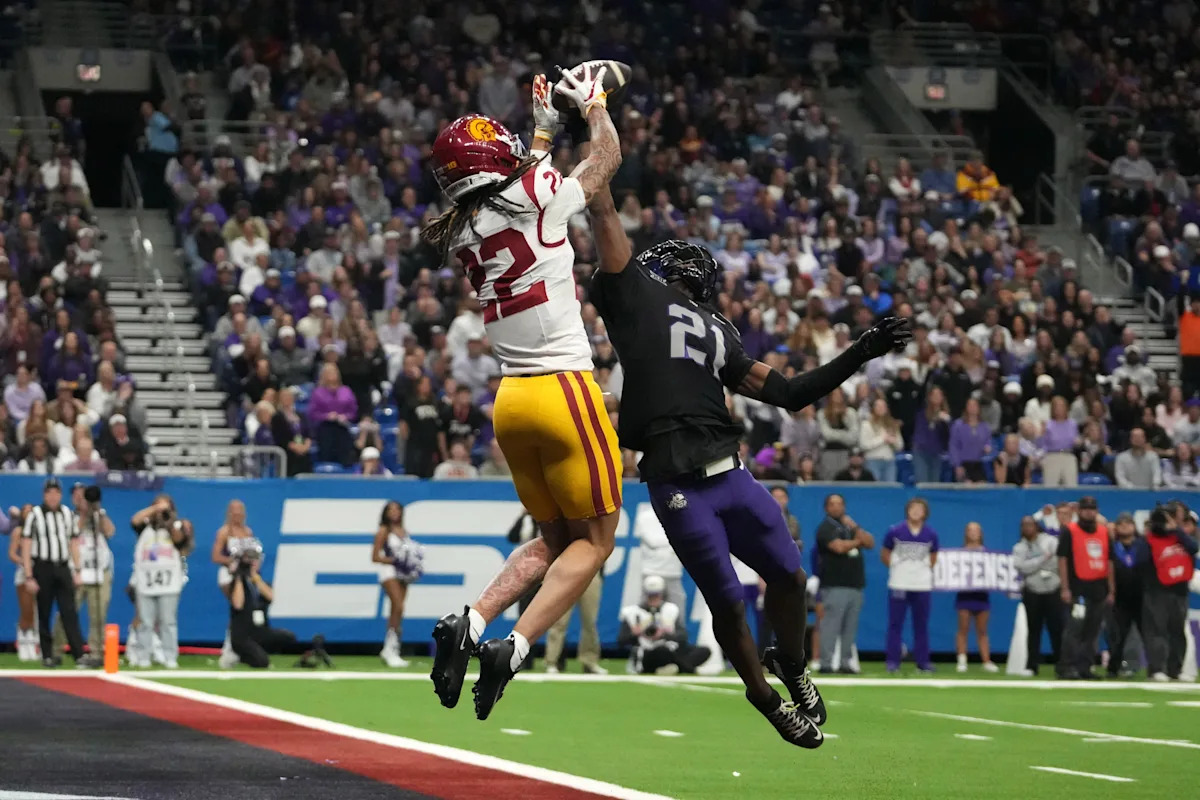
After opening their draft with Jadarian, the Seahawks almost doubled down on the theme in Round 2 with a Ja’Darius. At pick No. 64, Seattle selected Ja’Darius ‘Bud’ Clark, a versatile defensive back out of TCU who projects as one of the more intriguing fits in Mike Macdonald’s evolving secondary. With Coby Bryant now in Chicago, Seattle clearly wanted another movable chess piece capable of wearing multiple hats on the back end.
Clark arrives in the NFL carrying the reputation of a true ball-hawk. The question now becomes: how exactly will Seattle deploy him?
Advertisement
Who is Bud Clark?
Clark originally envisioned himself as a wide receiver during his early high school years, but it quickly became obvious that his future was on defense. He flashed at both corner and safety, even taking emergency quarterback reps at times, though his instincts in coverage ultimately became his calling card. A standout baseball athlete as well, Clark entered the recruiting cycle as a four-star prospect. He initially committed to Virginia before ultimately landing at TCU.
He enters the NFL as a six-year college player, and that naturally brings some durability questions into the conversation. During the COVID season he took advantage of the additional year of eligibility granted to players, and the following season was cut short after he missed eight games with an injury, leading to a redshirt year. Outside of the 2023 campaign, Clark missed time in every season of his college career, totaling 14 missed games overall. None of the injuries — aside from the redshirt season — were viewed as catastrophic, but the recurring nature of them will absolutely be something NFL teams monitor closely as the physical demands ramp up at the pro level.
Beyond the injury history, Clark established himself as one of the leaders of TCU’s defense. A multi-year captain, he consistently produced splash plays and led the Horned Frogs in either pass breakups or interceptions every season he saw the field. He also accepted an invitation to the Senior Bowl, where he reportedly turned heads throughout practice week by winning a large percentage of his one-on-one reps.
Advertisement
Evaluating the pick
It’s always worth noting when a player had a formal pre-draft connection with Seattle, and Clark was indeed one of the Seahawks’ 30 visits. With that context in mind, this felt like one of the cleaner value selections of Seattle’s draft class. Clark came off the board almost exactly where most evaluators projected him, typically somewhere in the 60-74 range on consensus boards.
Based on reporting from Brady Henderson and John Boyle, Clark was apparently the highest-ranked remaining player on Seattle’s board at the time of the selection, alongside an unnamed EDGE prospect. One possible candidate may have been Keyron Crawford, who went to the Las Vegas Raiders shortly afterward. Crawford also visited Seattle during the pre-draft process and frequently appeared in mock drafts connected to the Seahawks at No. 64.
From a value standpoint, the pick makes sense. It wasn’t some massive steal relative to consensus, but it also wasn’t a reach or a misuse of draft capital. My one reservation at the time was that AJ Haulcy was still available, and personally I had him graded slightly higher than Clark. Considering the current makeup of Seattle’s safety room, Haulcy’s physicality may have complemented the group a bit more naturally.
Advertisement
That said, Mike Macdonald’s post-draft comments tell you exactly why Seattle leaned toward Clark instead.
“We’re not just going to use him at safety. He can play nickel. He can probably play corner for us too. We’ll figure that out throughout the process.”
Once you frame the pick through the lens of positional versatility, Clark becomes an extremely logical addition.
The playmaking upside is real
If there’s one word that defines Clark’s tape, it’s “playmaker.” Whether that level of production fully translates to the NFL remains to be seen, but at TCU he consistently played like a magnet for the football. Some defensive backs simply have a natural feel for where the ball is going, and Clark absolutely falls into that category.
His quarterback vision is disciplined, and he attacks the football more like a receiver than a traditional safety. On the tape, you constantly see him reading through route concepts while keeping his eyes balanced between the quarterback and his assignment.
Clark processes route combinations extremely quickly and consistently takes efficient angles toward the catch point. Whether he’s playing zone coverage or carrying routes in man, he maintains excellent spatial awareness while reading both the receiver and the quarterback simultaneously. Once he diagnoses the concept, the athletic ability shows up immediately. He has the burst and closing speed necessary to drive downhill and cut off throwing lanes before the quarterback fully realizes the window is disappearing.
The range on the back end is outstanding. Over and over again on film, Clark finds hidden shortcuts to the football by anticipating route timing and understanding where concepts are trying to stress coverage leverage. On this particular rep, he narrowly misses the interception, but honestly it’s another example of how he probably could’ve finished his college career with even more than the 15 interceptions he already recorded.
This rep is a great example of his discipline as a single-high defender. Clark aligns deep while shading toward the strength of the formation, keeping both the quarterback and vertical route in his peripheral vision. The instant the receiver breaks beyond the underneath defender’s zone responsibility, Clark triggers downhill without hesitation, arrives at the catch point with perfect timing, and delivers a clean hit that prevents the completion.
This might honestly be my favorite snap on his entire tape. The offense calls a Smash concept, giving the quarterback a classic high-low read. Clark recognizes it almost immediately and begins gaining depth toward the vertical route. What stands out most is his awareness at the catch point. He understands he’s not in position to locate the football early, so instead of panicking and drawing a flag, he patiently waits until the last possible moment before attacking through the receiver’s hands to break up the pass.
Clark isn’t some elite testing outlier, but his 8.90 Relative Athletic Score gives him more than enough movement ability to survive at safety, nickel, and potentially even outside corner in certain packages — exactly like Macdonald hinted after the draft. On this rep, he’s assigned a difficult coverage responsibility against a receiver going in motion across the formation. He never loses phase, stays attached through the route stem, and effectively forces the quarterback to work elsewhere.
Advertisement
Run defense still needs development
Clark’s missed tackle rate sits at 14.5%, and that’s something that absolutely has to improve at the next level. Safety play in the NFL often comes down to preventing explosive plays. The difference between a five-yard gain and a 40-yard run is frequently the last defender making the tackle in space.
A few snaps after one particularly rough miss, though, Clark responds exactly how coaches want to see. That ability to self-correct matters. No defensive back plays mistake-free football, especially aggressive ones. What matters is whether they learn from errors and adjust accordingly. On this rep, he takes a much cleaner pursuit angle, stays balanced through contact, and finishes the tackle properly.
As mentioned earlier, Clark isn’t an especially physical defensive back, so bigger tight ends and offensive linemen can overwhelm him once they get their hands attached. However, one thing he does exceptionally well is using his quickness to avoid blocks before they fully develop. On this snap, he diagnoses the Power concept almost instantly, slips around the pulling guard before contact arrives, and shoots into the backfield to finish the play. Outstanding processing speed.
Advertisement
The fine line between aggression and recklessness
Clark’s aggressive mentality is both what makes him special and what occasionally gets him into trouble. The same instincts that generate splash plays can also create unnecessary risks.
On this rep, TCU is sitting in a two-high shell. Clark locks onto the quarterback’s eyes and decides to gamble on the throw. He jumps the passing lane early trying to create a turnover opportunity. This time he at least manages to get a hand on the football for the pass breakup, but NFL quarterbacks will punish those calculated risks much more consistently if the timing is off.
Here’s another example. Clark diagnoses the play extremely quickly and immediately drives downhill toward the tight end. He could simply stay patient, secure the tackle, and prevent yards after the catch. Instead, he sees an opportunity to attack the football itself and undercuts the route trying to generate either a breakup or an interception. The problem is that he loses leverage on the target, allowing the offense to move the chains for a first down.
The competitiveness is obvious throughout his tape. Clark is capable of staying attached in coverage regardless of alignment or matchup, but the same aggressive approach can occasionally cross the line. He tends to remain overly handsy at the top of routes, and that contributed to four pass interference penalties during the 2025 season alone.
Advertisement
Final thoughts
Clark enters Seattle as the exact type of defensive back modern NFL defenses covet: versatile, instinctive, and capable of aligning in multiple roles without forcing the structure of the defense to change. Mike Macdonald’s system heavily depends on safeties who can handle deep responsibilities reliably enough to free up the rest of the secondary, and Clark’s range plus ball skills fit that philosophy extremely well.
Even without imposing size or elite physicality, he compensates with urgency, instincts, and effort as a tackler. Stylistically, there are definitely shades of Coby Bryant in his game, though Seattle may envision Clark as an even more flexible piece capable of rotating between safety, nickel, and situational outside duties.
There will almost certainly be an adjustment period. Macdonald’s defense places a huge mental burden on defensive backs in terms of communication, leverage, and route recognition. But the talent is obvious on film. Maybe Clark doesn’t immediately open Week 1 next to Julian Love as a full-time starter, but the long-term fit inside this defense makes it very easy to understand why Seattle invested in him.
Forever a 12!
Read the full article here


