




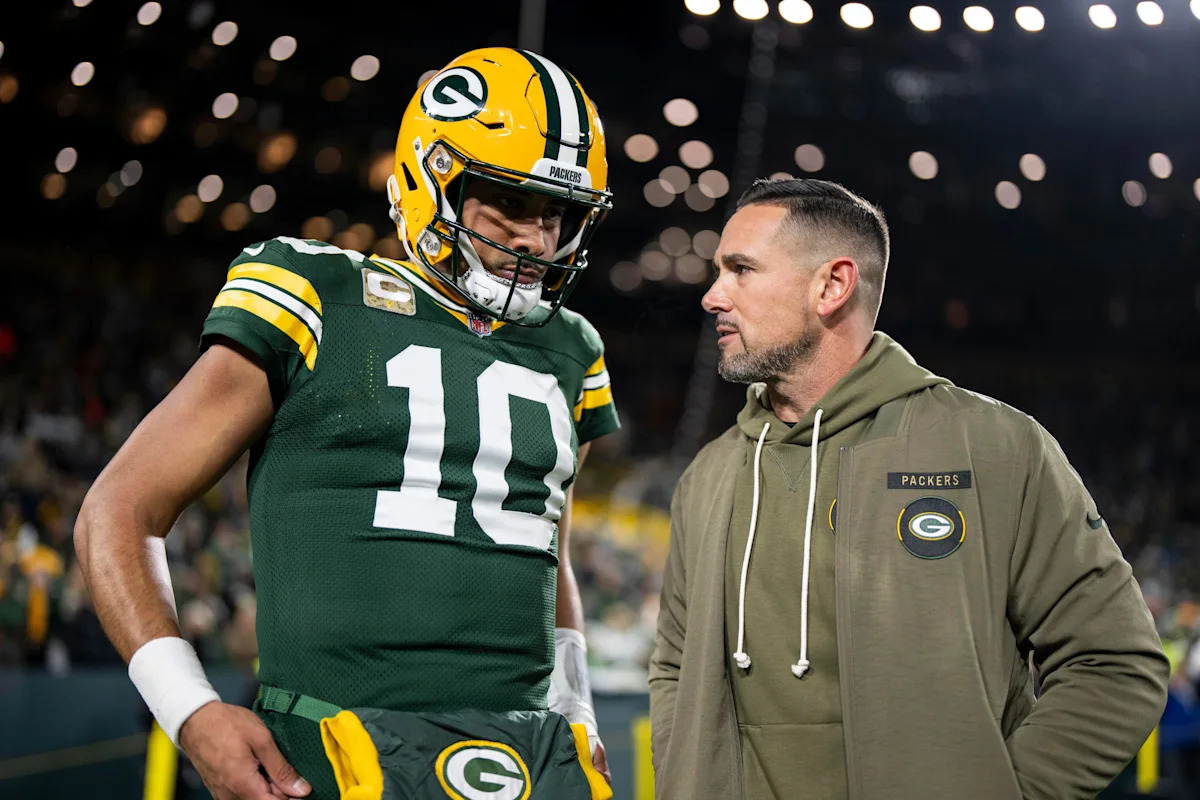
I continue my series on forecasting the record of each NFC North team this season by focusing this time on the Green Bay Packers. You can find my forecast for the Detroit Lions and Chicago Bears by following the links.
Green Bay Packers 2025 Season and Offseason Changes
The Green Bay Packers had a disappointing 2025 season, finishing 9-7-1, a half-game ahead of the Lions and Vikings, and once again gained the 7th seed in the playoffs and were one-and-done. They also finished 4-2 in the division, sweeping the Lions and splitting with the Bears and Vikings, although their loss to the Vikings came in a meaningless week 18 game in which they played their backups.
Advertisement
The Packers season began with high expectations after the Packers took a swing for the fences in trading two first-round draft picks and defensive tackle Kenny Clark to the Cowboys for Micah Parsons, who they subsequently signed to a 4-year, $186 million extension ($46.5 million AAV, $136 million guaranteed) making him the highest paid edge rusher and non-quarterback at the time of the deal. Unfortunately for the Packers, Parsons later suffered a torn ACL in week 15 and was lost for the season. The Packers lost every game last season without Parsons. He’ll also miss at least four games this season as he rehabs from the injury.
The Packers finished with an offense that ranked 16th in points but 6th in DVOA. Their defense, by contrast, ranked 11th in points allowed but 19th in DVOA. The explanation is that the Packers offense was good at limiting turnovers (they ranked 3rd), but the defense didn’t produce many (they ranked 26th).
Overall, the Packers finished 11th in Total DVOA and were that just enough above average team that sneaks into the playoffs but doesn’t do much.
Looking at the offseason changes for the Packers, let’s start with a key coordinator change. Packers defensive coordinator Jeff Hafley became the head coach of the Dolphins this offseason and was replaced by the recently fired head coach of the Arizona Cardinals Jonathan Gannon. I don’t think Gannon provides much added value as a coordinator beyond what his defensive roster has to offer. He had one top defense in Philadelphia in 2022 with a pretty solid roster that landed him the head coaching job in Arizona, where his defenses have ranged from mediocre to poor. The Packers have a better defensive roster than the Cardinals, but without Micah Parsons it will be up to Gannon, who historically hasn’t blitzed much, to manufacture a pass rush. And even with Parsons, there are weaknesses Gannon will need to manage. There are also scheme differences the defensive personnel will need to master as the Packers will be going from a 4-3 front under Jeff Hafley to a 3-4 front under Gannon, and primarily a Cover-3 zone coverage scheme to a disguised two-high safety-based zone scheme (including quarters and Tampa-2 variations) under Gannon.
Advertisement
The Packers return head coach Matt LaFleur (who was extended) who is the de facto offensive coordinator and play caller, and Adam Stenavich who maintains the offensive coordinator title.
In terms of roster changes, the Packers added defensive tackle and former Viking Javon Hargrave to bolster their interior pass rush, but moved on from edge rusher Rashan Gary, hoping Lukas Van Ness can pick up the slack. Hargrave has been a good defensive tackle, but at age 33 he isn’t the force he once was as a pass rusher and can be a liability in run defense at times. They also moved on from linebacker Quay Walker and replaced him with 30-year-old Zaire Franklin who struggled last season. At cornerback the Packers look to start rookie 2nd-round pick Brandon Cisse opposite of Keisan Nixon as outside corners- Cisse replaces Carrington Valentine- with Javon Bullard as slot corner. Overall, not much to move the needle here for the Packers, and the net roster changes may actually a bit of a regression. We’ll see.
Offensively, the Packers moved on from some of their receivers like Romeo Doubs as they hope to have kept the best of the bunch- Christian Watson and Matthew Golden as outside receivers and Jayden Reed in the slot. Combined with Tucker Kraft who is returning from an ACL suffered last November, and quarterback Jordan Love, this is easily the strength of the Packers team. Golden still has question marks and Reed is returning from injury- and Watson is oft-injured as well- but if Golden can step up and the rest return to top form and stay healthy, this is a top passing offensive skill group.
The issue for the Packers offense is they are still trying to figure out their offensive line and I don’t think they’ve made much progress this offseason. Zach Bako-Bewele (formerly Tom) is a good right tackle, but beyond that things get shakier. 2024 first-round pick Jordan Morgan will start at left tackle, replacing Rasheed Walker last season, while Aaron Banks and Sean Rhyan return at left guard and center respectively. Both were mediocre last season. And at right guard it looks like 2024 5th-round pick Jacob Monk will become the new starter, replacing Morgan who moves to left tackle. This may be the weakest position group on the team, which isn’t good considering how much the rest of the team depends on the offensive line.
Advertisement
Lastly, starting running back Josh Jacobs is on the commissioner’s exempt list for an indefinite period at the moment following a domestic incident for which he is making a court appearance next week. It is unclear when Jacobs will return to the Packers lineup, but there is some speculation that it may not be real soon. That leaves a group of mediocre running backs led by Marshawn Lloyd, who has a total of six rushing attempts since being drafted by the Packers in 2024, to fill in his absence.
Overall offensively for the Packers, the net roster changes also don’t move the needle but have the potential to regress at least as much as improve.
Injuries
Last season the Packers finished 15th in adjusted games lost (AGLs) which is pretty close to average. The methodology attempts to account for starters missing due to injury or not playing at 100%. They ranked 21st in offensive AGLs and 6th in defensive AGLs. What we are looking for here are outliers in terms of extraordinarily good or back luck with injuries in the previous season that may revert to the mean or average the following season and therefore result in an adjustment to the team’s projected win total.
Advertisement
Certainly losing guys like Micah Parsons for the last part of the season and tight end Tucker Kraft for the last half of the season hurt them on both sides of the ball, but overall they were not outliers when it came to injury luck last season at 15th overall, so like with roster/coaching adjustments, there is no adjustment needed here for regression to the mean in injury luck this season.
Luck Factors
As I’ve mentioned previously, I’ve had to slightly modify the sources for luck factors this year as one of the sources from last year stopped publishing their data. To determine luck factors, I am going again with the Luck Ratings from Team Rankings, and using the differential between actual and estimated wins from the DVOA stats at FTN. I average the two numbers to get a game adjustment amount.
Last season the Packers had estimated wins of 9.6 compared to an actual win total of 9, so a bit of bad luck there. Team Rankings also gave them a -0.6 luck rating, which is the same as the estimated wins. So, with rounding, this results in a one win adjustment to their season projection. However, given the Packers had a tie last season, it seems more appropriate to make this a half-win adjustment instead, which is more accurate and eliminates having a tie (which is unusual) in the projection.
Advertisement
Strength of Schedule
Based on actual opponent win totals last season, the Packers had the 9th easier schedule last year. This year, using opponent over/under win totals, which are more accurate than last year’s win totals in gauging strength of schedule because they account for offseason changes, the Packers have the 17th easiest schedule. That’s close in terms of whether than merits a win total adjustment for this season’s forecast, but looking at the Packers actual schedule and the teams they drew based on division finish last year, I’m inclined to make a one-win adjustment to their win total.


Here is the Packers 2026 schedule:


In terms of the three different opponents each team in the division plays based on what place they finished within the division last year, the Packers may have got the toughest slate overall in the Rams, Texans, and Cowboys. That’s a big difference from what the Lions got in the Cardinals, Titans, and Giants.
Advertisement
Overall, the Packers have their easier matchups mixed in with longer stretches of difficult ones. For example, the Packers face the Jets and Falcons in weeks 2 and 3, but that comes after starting on the road against the Vikings and just before four tougher games on the road against the Bucs, Bears, Cowboys, and at the Lions. And beginning week nine on the road against the Patriots, I see only two easier matchups (Saints, Dolphins) on the Packers schedule.
Prediction for the Packers this Season
Looking back at the key change factors from last season- coaching/roster changes, injuries, luck factors, and strength of schedule, and beginning with the Packers 9-7-1 record last season, I did not make any changes based on coaching or net roster changes, as they were not warranted. I also did not make any changes based on injuries. I did add a half-win based on luck factors (replacing the tie last season with a win), while also deducting one win from last season based on a tougher strength of schedule this season.
That results in a 9-8 record prediction for the Packers this season. I doubt that will be good enough to win the division, but it might be enough to secure, once again, the 7th seed in the NFC playoffs for the fourth straight season. But I doubt it.
Follow me on X/Bluesky @wludford
Read the full article here


