




NEW YORK — Through the first two games of the 2026 NBA Finals, Victor Wembanyama had taken more shots outside the paint (22) than inside the paint (20). His first three shots of Game 3: an alley-oop dunk, a dunk after rolling to the rim following a low ball screen and a layup after catching a half-court alley-oop from Stephon Castle.
Wembanyama said at the San Antonio Spurs’ Tuesday practice that he didn’t emphasize point-blank, high-percentage looks at the outset of Game 3 any more than he would in any other game. But he did make it clear that he wants to own that high-value real estate in front of the rim.
Advertisement
“Especially early in games, yeah, you have to put pressure on the rim, because it’s the most efficient shot. Then we look for other options,” Wembanyama said. “The goal is always to go inside. The best shot in the game is an alley-oop, the most efficient shot. But teams don’t just let you do that.”
The Spurs certainly didn’t let the New York Knicks do that in Game 3, allowing the hosts to take just nine field-goal attempts after a paint touch, down from 12 in Game 1 and 11 in Game 2, according to Second Spectrum tracking data. After scoring a playoff-leading 53.3 points per game in the paint in their run to the Finals, the Knicks have averaged just 42 points in the paint over the last two games — a mark that would’ve been the second-lowest in the regular season, ahead of only a Milwaukee Bucks team that prioritized 3-point volume and didn’t have Giannis Antetokounmpo for most of the season.
The process of tamping that number down and forcing an outward migration for New York’s offense, began with refusing to give the Knicks what they want.
Advertisement
“Yeah, I mean, at this point when you’ve played a team so many times, you know what they’re going to do, they know what you’re going to do,” All-Star guard De’Aaron Fox said after the Spurs’ Game 3 win at Madison Square Garden. “They got us in rotations. It’s not a secret: Teams want to get Vic out of the paint. That’s not a secret.”
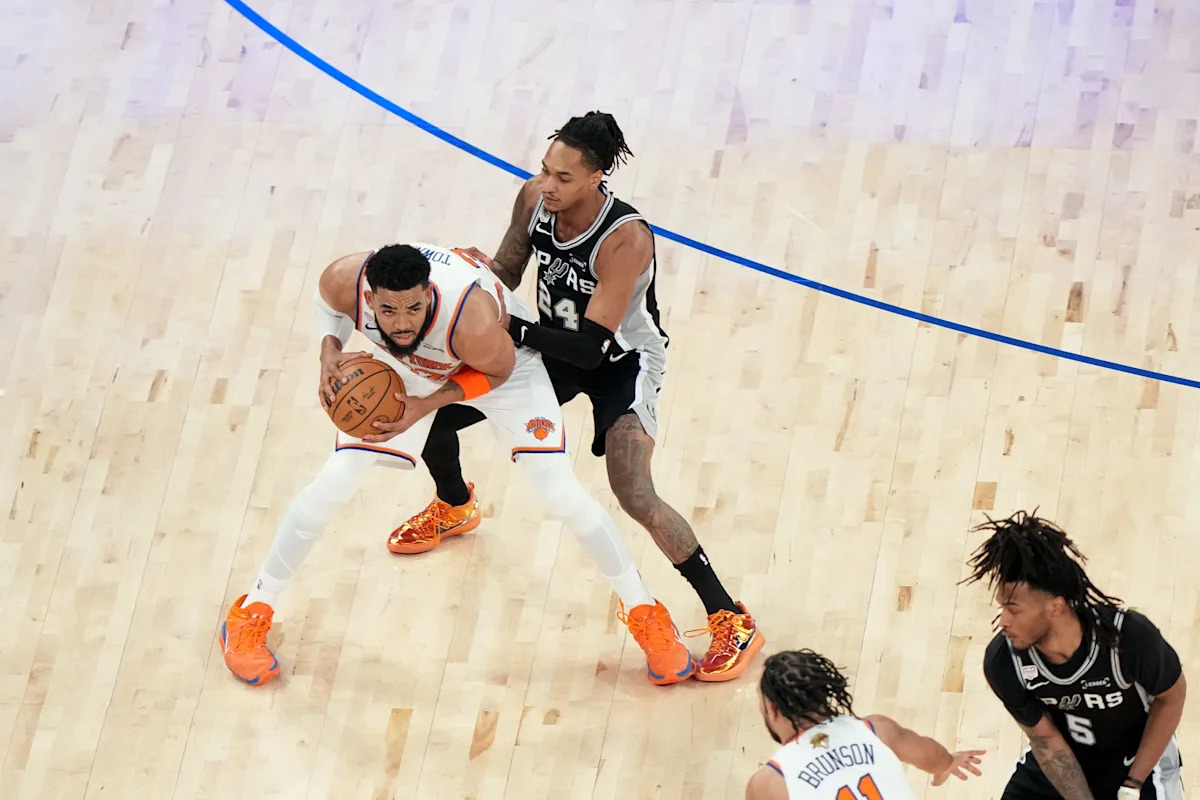
The most direct path to pulling Wembanyama away from the paint for the Knicks? Getting him to guard stretch 5 Karl-Anthony Towns, whose combined threat as an elite 3-point shooter and a physical driver off the catch helped mitigate Wembanyama’s defensive effectiveness — well, as much as you can limit the impact of a unanimous Defensive Player of the Year, anyway — through the first two games of the series as the Knicks took a 2-0 lead in San Antonio.
In Game 3, the Spurs were much more intentional about moving Wembanyama out of that matchup, sending an armada of wings and guards — Castle, Keldon Johnson, Devin Vassell, Julian Champagnie, Dylan Harper, even the 6-foot-3 Fox — to guard Towns, either to start possessions or by switching onto him in the pick-and-roll. According to NBA.com’s matchup tracking data, more than three-quarters of Towns’ offensive possessions in Game 3 were spent with a perimeter player on him, pressing up into his airspace as he looked to survey and facilitate from the top of the floor:
“You try to get under them — I try not to let bigger guys dribble against me,” Fox said of his approach to guarding a larger player in a cross-match. “Obviously, the closer they get to the basket, the easier it is for them. I think despite my size, I feel like I’m pretty physical, especially on the defensive end, just being able to try to take those hits and stand guys up. If you can force a shot to be [from] 13 feet rather than 10 feet, the [field-goal percentage] numbers drop drastically.”
Advertisement
Towns has the tools to punish smaller defenders in those cross-matches: muscling them with drives off the dribble, taking them to the post (either on the low block or from the middle of the floor at the nail, a la Dirk Nowitzki) or getting off the ball and rushing into offensive rebounding position. He has to aggressively seek those opportunities, though, rather than allow the physicality of the Spurs’ perimeter defenders — who did a great job in Game 3 of making those processes tougher on Towns — to influence him into getting off the ball and just sort of floating out of the play.
Play 2026 Soccer Pick ‘Em with FOX One and make your picks for the world’s biggest soccer tournament
“Whenever the defense presents itself to me, I just want to solve that puzzle,” Towns said Tuesday. “My whole career, I’ve seen a bunch of cross-matching, and utilizing that experience now is [more] important than ever.”
Particularly because of the other part of the cross-matching strategy.
Advertisement
“Knowing I have help on my side, knowing I have Victor behind me, it allows you to be a little bit more aggressive on the defensive end,” Fox added.
That’s the reason so many of us expected to see Wembanyama start the series primarily guarding Josh Hart, sagging off him in “ghost” coverage to lock down the lane. The Spurs ramped up that gambit in Game 3, more aggressively pre-switching New York’s attempts to bring Wembanyama into the action — both with KAT on the floor and when he sat, in small-ball looks with OG Anunoby at the 5 — so that they could keep the league’s premier interior deterrent as close to the basket as possible, as often as possible.
After the Knicks came out ahead in the center battle in Games 1 and 2, the Spurs grabbed the sticks in Game 3, with Towns getting 18 fewer frontcourt touches than he had in Games 1 and 2, and his average touch time being a half-second longer than it was in the previous two games — a function of his difficulty shedding the Spurs’ dogged perimeter defenders and the challenge he faced attacking with Wembanyama (or Luke Kornet) lurking off Hart in help position on the second layer of the defense.
That problem was once again particularly acute late, as Towns was scoreless in the fourth quarter for the third time in this series. In the Finals thus far, the All-Star big man — second among the Knicks’ starters in usage rate in both the regular season and postseason thus far — has finished just 8.1% of New York’s fourth-quarter possessions with a shot attempt, foul drawn or turnover. That, head coach Mike Brown acknowledged Tuesday, can’t continue.
Advertisement
“It’s extremely important that he’s getting touches, that he’s involved — not just in the fourth quarter, but obviously throughout the ballgame,” Brown said.
Towns’ reduced effectiveness and longer Game 3 touch time also point toward the degree to which Wembanyama’s ostensible zoning up down low dampened the Knicks’ off-ball activity …
… a deterioration that New York lamented after Game 3, and again at Tuesday’s practice session.
Towns said that, when he looked back at the film, he saw a Knicks team that wasn’t “executing the little details that’s made us special,” namely “that ball movement and getting the ball zipping around the court, and allowing it to judge who shoots the ball.” The numbers bear that out.
Advertisement
As a team, the Knicks’ average touch took longer and featured more dribbles in Game 3 than in Games 1 or 2. They passed the ball less, generated fewer assists and potential assists, and had their fewest dimes and most turnovers in a single game than they had since Game 3 against the Atlanta Hawks in Round 1 — their last loss before reorienting their offense, opening things up and locking into the rhythm that led to one of the greatest runs of postseason play in NBA history.
“We just got to keep moving,” said Mikal Bridges, who was sharply critical of his own Game 3 performance after picking up two early fouls. “I think they do a great job defensively with the guards, and then Wemby staying low. It can draw confusion sometimes. I think if we keep moving, it’s going to help us and benefit us.”
Brown believes they can rediscover that rhythm, and that he can help them do it. But they’re also going to have to help each other.
“I’ve got to help them a little bit better on the fly, by putting them in better positions with stuff that they’re comfortable with,” Brown said. “But then, we have to play to our concepts, or play to what our strengths are. It’s been pace. It’s been space. It’s been getting the ball reversed. It’s been touching the paint. And, more importantly, it’s been making quick decisions.
Advertisement
“There were a lot of times where the decisions weren’t made quick [in Game 3],” Brown added. “One guy caught, held, held, held, held, held. Now the defense settles in. Now you’re in trouble.”
Over the course of Game 3, it was Jalen Brunson who was most frequently holding and dribbling the ball as the Spurs defense loaded up. That Brunson would be the Knicks’ primary bring-up ball-handler and shot creator isn’t anything new; that’s the role he’s played throughout his ascent to All-NBA status and the Knicks’ rise to championship contention.
The volume of it, though, has probably veered a little further toward the extreme than Brown would prefer. Through three Finals games, Brunson has been on the ball for nearly seven more minutes per game than any other Knicks starter and has dribbled the ball nearly twice as much as any other player in the series — with plenty of that on-ball activity coming against full-court pressure from the likes of Castle, replicating the 94-feet hectoring he turned in against Shai Gilgeous-Alexander in the Western Conference finals:
Castle’s average pickup point on the Knicks’ bring-up ball-handler was more than over 55 feet away from the rim, according to Jared Dubin at Last Night in Basketball — a major reason why New York so frequently took so long to get into their offense.
Advertisement
“I feel like my aggressiveness throughout the game was pretty consistent, pretty solid,” Castle said.
Brunson can break the pressure, and the Knicks can play out of it and eventually get good looks, but the consistency of the pressure is the point. The more Brunson has to battle to get the ball across half-court against Castle, Harper, Fox, Champagnie, Vassell, Carter Bryant and anyone else head coach Mitch Johnson can throw at him, the more miles he puts on his legs — regular deposits that the Spurs hope will pay dividends come crunch time, when the Knicks typically look to Brunson to make magic, possession after possession.
It also saps some of the dynamism out of New York’s offense. The longer it takes to get the ball up the floor, the less time the Knicks have to do something with it in the half-court. The less time they have to do something with it, the smaller the menu of sets and actions they have to choose from. The smaller the menu available, the more likely it is that they’ll just order the usual — Brunson chiseling his way into a contested midrange look late in the shot clock. The Knicks can eat that way; it’s just not nearly as satisfying as the meals they’ve been cooking up for the last month and a half.
(If this sounds familiar to you, it might be because you remember the Indiana Pacers executing a similar wear-down-effect game plan against Brunson in last year’s Eastern Conference finals — the series that effectively convinced Knicks brass that they needed a new plan of attack on offense and a new head coach to implement it.)
Advertisement
Against the Spurs’ persistent pressure, Brunson has turned in his two highest-usage games of this postseason — including Game 3, when he finished 38.4% of New York’s possession with a shot attempt, turnover or foul drawn. The pressure and the offensive primacy might not be mutually exclusive.
“I mean, they can be connected at times,” Brunson said. “That goes back to our attention to detail — understanding where we’re supposed to be, doing the things we’re supposed to do, as a team and obviously individually, as well. Remain focused on the things we’re supposed to do, and understanding the situations that we’re in as a team. Just help each other out.”
Bridges, too, made multiple mentions of how important it is to “help the next guy out” — the idea that your cut, your drive, your motion might not get you the shot, but it can help push the door open a little bit wider for a teammate, who then might be able to do the same. String enough of those together, and you can get the defense in the blender:
Struggle to do that, though, and you allow the Spurs to dictate the terms of engagement with their hellacious recoveries and rotations, enabling them to keep Wembanyama on the back line to just go ahead and stick a fork in that blender:
“We have gotten good about rotating around [Wembanyama]. He’s gotten better at closing out to shooters, getting guys off the line while trying to stay in front of them,” Fox said. “How many guys are going to get to the rim and finish over him? With someone like Landry [Shamet], who shoots the skin off the ball, shoots the leather off the ball, he got [Wembanyama] off the line, we’re scrambling around him. Does he want to finish over him or not? He elected to try to finish over him. He blocked the shot. If he passed the ball out, we’re X-ing, we’re X-ing around Vic, we’re scrambling. I think we’ve guarded them pretty well.”
Advertisement
That defensive approach requires a hell of a lot of energy, precision, connectivity and relentlessness by the Spurs. As Johnson sees it, though, if they want to come back to even and eventually win this series, they’re going to have to do the hard things over and over and over again.
“It’s going to have to [be sustainable],” Johnson said Tuesday. “They move the ball. I think there’s things we can be better at. I think we’ve had some really good moments of being connected in those rotations and taking certain things away, forcing the ball to certain spots or individuals in certain situations. We’ve forced them to take a lot of shots at the end of [the shot] clock. They’ve made a lot of those shots. There’s some give and take there.”
Through two games, the Knicks were giving the Spurs everything they could handle. In Game 3, the Spurs made the defensive adjustments to take back control; now that they’ve got the Knicks searching for answers — Better/more frequent screening, on and off the ball? More Bridges, Hart or two-point-guard looks with Jose Alvarado to help Brunson bring the ball up? — they hope to continue to press that advantage.
“I think we’ve shown that we can be impactful when we’re connected and doing it the right way,” Johnson said. “They’ve shown they do a great job moving the ball and making the basketball find the open man. I think it will be a little bit of tug-of-war until this thing’s over.”
Advertisement
“We know what teams want to do. Teams know how we want to defend them,” Fox said. “At this point, it’s a battle of wills, and a battle of who can execute the most.”
The Knicks just spent a month and a half proving they can generate better offense than what they got in the second half of Game 3, as they watched a potential 3-0 lead slip through their grasp. The task ahead of them in Game 4: proving it again, against the best defense they’ve faced thus far.
“We have, what, 13 games in a row, 50 days of film, to show what it looks like when we’re at our best?” Towns said. “So we’ve got good film. We’ll get back to our fundamentals, what makes us great, what made us great, and get back to work.”
Read the full article here


