


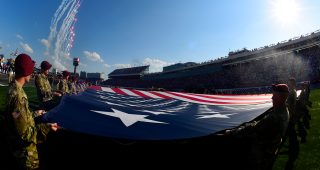
Fans rise to their feet before every NASCAR Cup Series race for the national anthem. Afterward, stunning aircraft whizz by at high speeds and low altitudes, giving thousands of spectators — and even competitors — an adrenaline rush moments before the best drivers in the world prepare to race.
Many of these flyovers are performed by military aircraft from bases near local markets. But NASCAR‘s roots with the armed forces date back to the sport‘s genesis.
Advertisement
RELATED: Cup Series schedule | Buy San Diego tickets now!
Some of NASCAR‘s pioneers served during World War II, before the sport‘s inception in 1948. In the late 1950s, the United States Air Force Thunderbirds completed a Daytona flyover — a tradition that still exists before each “Great American Race.” Soon after, NASCAR began racing annually on Independence Day.
The sport‘s patriotism ratcheted even higher in 1991, when five drivers donned military-themed paint schemes during Operation Desert Storm (part of the Gulf War) in the Daytona 500.
In the modern era, ties between NASCAR and the armed forces are stronger than ever. Cars don patriotic schemes multiple times a year. Teams honor fallen service members, culminating with the 600 Miles of Remembrance over Memorial Day weekend at Charlotte Motor Speedway. Drivers immerse themselves in military experiences, including Charlotte‘s Mission 600.
Advertisement
And when the stars of the Cup Series head to Naval Base Coronado to “Race the Base” on Sunday (4 p.m. ET, Prime Video, HBO Max, MRN Radio, SiriusXM NASCAR Radio), it‘ll take those ties to even greater heights as the United States celebrates its 250th anniversary.
The early years
NASCAR’s first champion — Hall of Famer Red Byron — served in the U.S. Army before the sport was even founded.
Serving as an engineer on the Army’s Air Corps B-24 Liberator bomber, he suffered severe leg injuries during a WWII run over the Aleutian Islands. A bomb detonated when it wasn’t supposed to. Byron recognized the impending problem and cut the bomb away, but it exploded while he was still exposed in the fuselage. He spent 27 months recovering in a Colorado hospital.
Advertisement
“That last bomb got hung up in the plane,” team owner Raymond Parks said, as recalled in a 2012 ESPN article. “It was Red’s job to get it loose.”
Byron drove for Parks — another Hall of Famer who also served in the Army — in NASCAR’s inaugural season. Parks fought in the Battle of the Bulge, the last major land battle in WWII. Together, they won the 1948 Modified Division (now the Whelen Modified Tour) and the 1949 Strictly Stock Division (now the Cup Series).
“[Byron] just thought about everything different than most folks,” Parks said. “You might look at something and think, ‘Wow, isn’t that pretty,’ but Red, he was thinking, ‘How in the world did they make that?’ Like an engineer, you know. That’s what made him such a great race car driver.”
Bud Moore, who began fielding NASCAR entries in 1961, was drafted into the Army in 1943. He participated in D-Day as a member of the 4th Infantry Division, and fought in Germany through the winter of 1944 into 1945. He nearly drowned at 19, moments after landing on Utah Beach in Normandy, France. But several years later, as a NASCAR owner, he won back-to-back titles with Joe Weatherly in 1962-63 (another Hall of Famer who previously served), and his cars won 63 times in Cup competition. Moore also served as a champion crew chief for Buck Baker and was inducted into the Hall in 2011, where his two Bronze Stars and five Purple Heart awards are displayed.
Advertisement
Arguably the greatest crew chief of all time, Dale Inman served as an ordnance specialist in the Army from 1959 to 1961. Just three years removed from service, he started working for some 26-year-old named Richard Petty. They won seven championships together, with Inman further cementing his legacy with a 1984 title with Terry Labonte. Petty, of course, became the winningest driver in Cup Series history.
But that’s to name a few. Industry legends Smokey Yunick, Cotton Owens, Junie Donlavey and Leonard Wood all served. Other drivers did as well, including Hall of Famer Tim Flock, Marshall Teague, Roy Mayne, Tiny Lund, George “Sarge” Green and Bugs Stevens. Most recently, U.S. Navy officer Jesse Iwuji competed in NASCAR, racing as recently as last year in the O’Reilly Auto Parts Series.
Building patriotism
Kicking off each Cup Series race with a flyover before the green flag is a normal practice these days. That wasn’t always the case.
Advertisement
The first known flyover before a race came in February 1957, with the Thunderbirds whizzing over Daytona Beach in the years before Daytona International Speedway completed construction. They returned over Daytona Beach in 1958, the final year of racing the dunes before the inaugural Daytona 500 a year later. Fast forward to the modern era, and the Thunderbirds — one of the most iconic flight groups in aviation, comprised of the top Airmen in the country — completed their 16th consecutive flyover this February to commence the Daytona 500. The Thunderbirds have piloted variations of the F-16 aircraft since the early 1980s.
The US Air Force Thunderbirds complete a Daytona 500 flyover.
In 1961, the U.S. Navy Blue Angels appeared on the program cover of the Southern 500 at Darlington Raceway, celebrating the 50th anniversary of Naval aviation.
Those moments helped lead to the weekly tradition on the Cup Series circuit, as well as in other sports and racing disciplines.
Advertisement
When Daytona International Speedway finished construction in 1959, NASCAR scheduled its summer Daytona race around the Independence Day holiday. From that year until 1987, the Cup Series raced every summer on July 4 — no matter what day of the week it fell on. Beginning in 1988, the race shifted to the Saturday of Fourth of July weekend, running every year until 2019 — a mid-summer classic fans yearned for.
But for the 2020 season, NASCAR moved the second Daytona race to late August, marking the Cup Series regular-season finale — a literal bookend from February’s 500-miler. It made for high-stakes racing with opportunities for competitors to make or break their championship hopes.
Despite the schedule change, NASCAR continued to make Independence Day weekend racing a ritual. The Cup Series visited the famed Indianapolis Motor Speedway in 2020’s pandemic season, before two consecutive seasons in the Elkhart Lake, Wisconsin, countryside of Road America. I mean, it quite literally has America in the name, and the 4.048-mile road course blended old-school tradition with a northern flair. Nowadays, it’s a trip to one of the largest cities in the country — Chicago — which started with three seasons on a first-of-a-kind street course before moving back to the Joliet, Illinois, intermediate for this year’s holiday rendition.
And the Independence Day tradition that stemmed from Daytona — celebrating the anniversary of the United States — continues to strengthen the parallels between NASCAR and patriotism that comes with it.
Advertisement
Operation Desert Support
When five Cup Series cars rolled into the 1991 Daytona 500 with military-themed paint schemes, it was rather unprecedented.
NASCAR launched Operation Desert Support on Feb. 5, 1991, one of the sanctioning body’s first-ever initiatives in support of the armed forces. The joint effort between the sport, Daytona, and RJ Reynolds Tobacco led to five cars for Speedweeks, each backing one of the five military branches fighting in the Persian Gulf.
Greg Sacks spearheaded the idea and represented the Navy. Alan Kulwicki represented the Army. Mickey Gibbs represented the Air Force. Dave Marcis represented the U.S. Coast Guard. Buddy Baker represented the U.S. Marines.

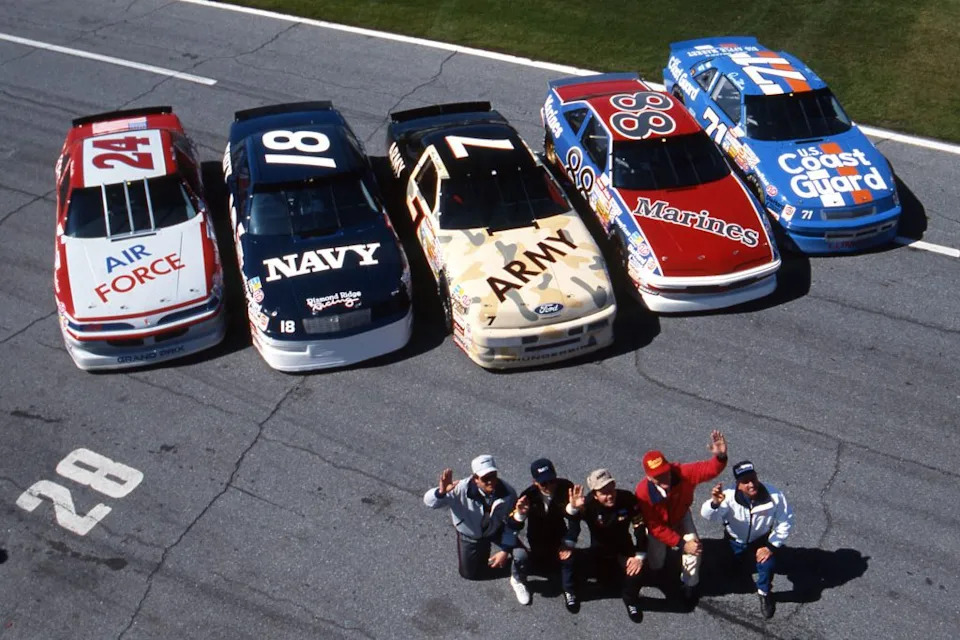
DAYTONA BEACH, FL – FEBRUARY 1991: Several drivers honored the U.S. Armed Forces during Desert Storm for the running of the Daytona 500 NASCAR Cup race at Daytona International Speedway. (L-R) No. 24 Mickey Gibbs (Air Force), No. 18 Greg Sacks (Navy), No. 7 Alan Kulwicki (Army), No. 88 Buddy Baker (Marine Corps) and No. 71 Dave Marcis (Coast Guard). (Photo by ISC Images & Archives via Getty Images)
“We felt the racing community would like the idea of paying tribute to the hundreds of thousands of Americans who are involved in the Gulf War and their families,” NASCAR executive T. Wayne Robertson said in a press release. “We felt having five cars on the track representing the Army, Navy, Marines, Air Force and Coast Guard would be a dramatic and fitting tribute.
Advertisement
“NASCAR and Daytona International Speedway officials quickly embraced the idea and it became a cooperative effort by all of us.”
Color guards from each of the five branches participated in pre-race festivities. The first 100,000 spectators inside the Daytona grandstands received American flags. Each car donned special decals. Jim Sasser, a U.S. senator from Tennessee, served as the Grand Marshal.
Those bold moves are much more common nowadays.
Most teams don patriotic paint schemes multiple times a year, specifically the Coca-Cola 600 over Memorial Day weekend and the Fourth of July weekend races. Many are planning to run them at Naval Base Coronado, too, including Chase Elliott — who recently revealed a special NAPA Gold Filters Chevrolet for the inaugural San Diego race. Color guards preside over pre-race festivities weekly. Government officials regularly visit tracks, and in 2004, George W. Bush became the first sitting president to attend the Daytona 500. Donald Trump followed suit in 2020 and 2025.
Advertisement
Ultimately, Operation Desert Support elevated that patriotism even further as NASCAR backed the military in a time of need.
The modern era
The traditions we see today were built over decades of patriotism shared by the industry, fans and military. But as the sport continues to evolve, so do those ties.
Much of it focuses around the Coca-Cola 600. For over a decade, each car entered in the 400-lap race — as well as other on-track vehicles — has honored a fallen service member by carrying that service member’s name above the windshield in the 600 Miles of Remembrance. Prime Video also honors those service members on the television broadcast. Gold Star Families come to the track and spend time with drivers on the pre-race grid.
Advertisement
Charlotte Motor Speedway completed its ninth year of the Mission 600 program in 2026, where drivers visit regional military bases for immersive, hands-on experiences about day-to-day life in service. Elliott visited Marine Corps Air Station Beaufort, Austin Dillon visited Fort Bragg and Daniel Suárez visited Seymour Johnson Air Force Base.
“Honoring those who have served our country and our veterans, the Gold Star Families that are on our cars, it‘s always special to me because America is really represented there and the patriotism behind it, and then all of our military branches coming out and just giving them some love that they deserve,” Dillon told NASCAR.com in May. “We always make connections, and then we go see each other [pre-race], and that‘s a big part of Mission 600.”

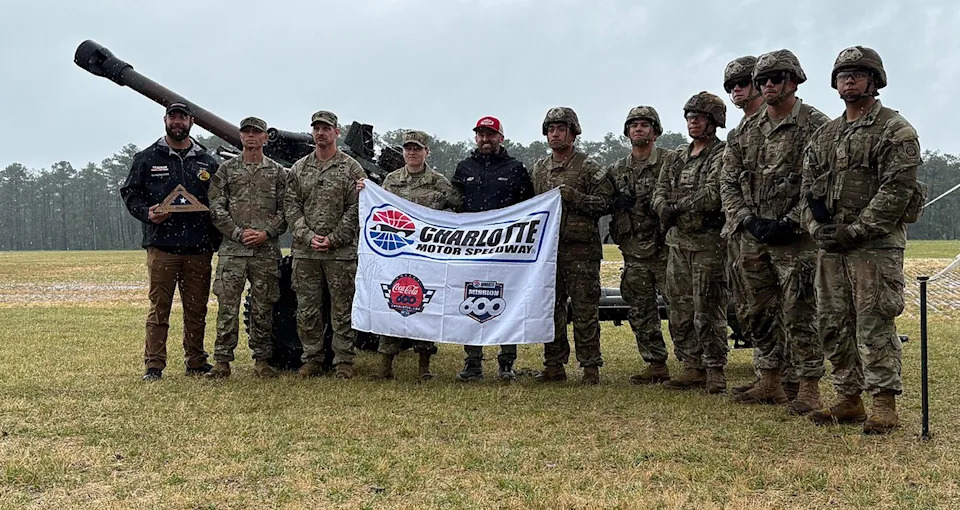
Austin Dillon visits Fort Bragg during Charlotte Motor Speedway
One of the most solemn traditions? Each Coca-Cola 600 winner lays a wreath at the Tomb of the Unknown Soldier in Arlington, Virginia. Ross Chastain, the 2025 victor, visited this spring, and Suárez, this year’s winner, will have the honor in 2027.
Advertisement
“To walk down those steps and to hear ‘Taps,‘ it‘s emotional. It‘s really, really emotional,” Trackhouse Racing owner Justin Marks told NASCAR.com in April. “It‘s heavy, but it‘s an honor and it‘s just really humbling. I had this moment there thinking it‘s amazing that we‘re here because of race cars, because of something so inconsequential and meaningless as a race car. We‘re meaningful in that we‘re entertaining people, we‘re inspiring people and we‘re supporting our families by finding lines of work that we‘re good at and passionate about. It was just a great, humbling moment.”
And starting this year, NASCAR and Coca-Cola introduced a Heroes Pass, where fans could nominate any service member or veteran in May for lifetime access to races.
Indeed, the connection between NASCAR and the military is stronger than ever, with much of that bond going all the way back to the sport’s earliest years. The next chapter will be written Sunday, when the stars of the Cup Series “Race the Base” in San Diego to celebrate America’s 250th birthday.
Read the full article here