
Subscribe
Demo

The Wizards spent the past few years trying to lose. Now they’re trying to win and develop players at the same time. Half the roster is young, the other half is old. But all of them are trying to figure out who they are. Washington is running a two-timeline experiment that features veterans Trae Young, Anthony Davis, Khris Middleton and Deandre Ayton. That group could accelerate or get in the way of the development of Washington’s interesting young core. This is the NBA’s weirdest group project.

The Wizards have a bunch of prospects who were drafted over the three seasons in which the franchise combined for only 50 wins: AJ Dybantsa, Tre Johnson, Alex Sarr, Kyshawn George, Will Riley and Bub Carrington. There’s a lot of talent here. There are also a lot of mouths to feed. And nobody matters more to making it work than Young, who was acquired in January from the Atlanta Hawks, played in only five games to aid Washington’s tank, and then was rewarded with a four-year, $212 million extension.

Advertisement

NBA Power Rankings: How all 30 teams stack up for 2026-27

Young has spent his entire career as the center of an offense, pounding the ball in pick-and-roll and creating shots for everyone on the floor. As a four-time All-Star, what he’s done has led to great individual success, and he even led Atlanta to the Eastern Conference finals in 2021. But that run proved to be the peak. The Hawks never won another playoff series with Young, cycled through coaches and supporting casts, and ultimately decided to pull the plug.

Washington can’t afford for this to become The Trae Young Show. Even if the Young-Davis pick-and-roll becomes one of Washington’s most reliable weapons, the offense still needs to leave room for all of the young players to experiment, make mistakes and expand their games. The Wizards need to learn what they can become, which makes Young’s willingness to evolve the biggest question hanging over this roster.

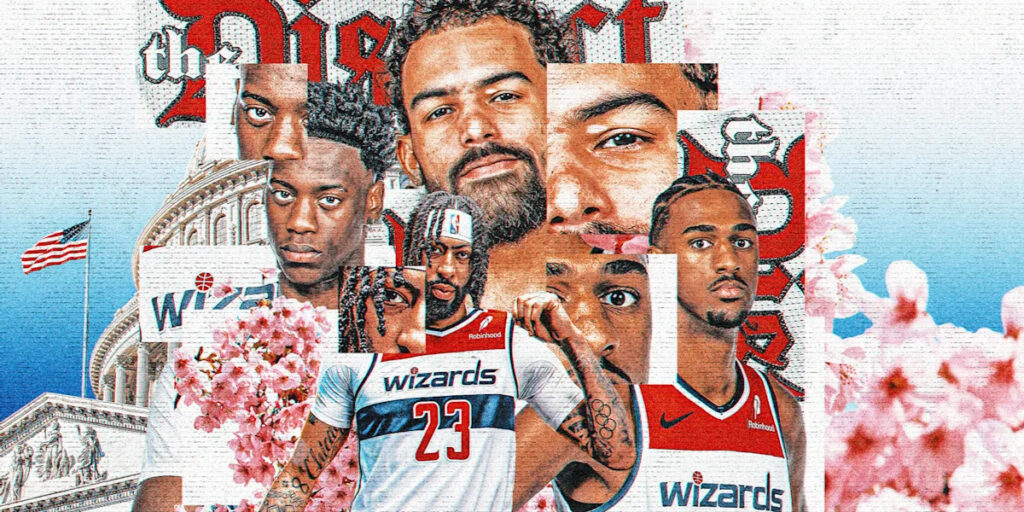
(Dillon Minshall/Yahoo Sports Illustration)

Sometimes the greatest contribution a player can make is the gravity he creates by sprinting hard through a screen, relocating to the corner after making a pass, or simply standing 28 feet from the rim. Young entered the 2018 draft drawing comparisons to Steph Curry and Damian Lillard because of this skill, but too often nowadays he plays like his job is done once he gives up the ball.

Advertisement

It wasn’t like that in college at Oklahoma. Young looks like a totally different player in some of these clips from his freshman year with the Sooners:

He ran through screens. He relocated off the ball. He got himself open. This was part of the appeal that Atlanta saw in trading up for him. Because even though he was primarily a high-usage shot-creator in college, he also willingly played off the ball and shined whenever he did. But it’s become a rare sight in the NBA.

Since Trae entered the NBA, he’s shot out of an off-ball screening action just 0.4 times per game. That’s nine times less often than Steph and more than twice less often than Dame during this same timeframe, as the below chart shows.

Player

FGA off screens

Screen shots per game

Points per screen

Steph Curry

1,566

3.6

1.16

Dame Lillard

431

1

1.03

Trae Young

192

0.4

1.02

Steph is obviously an outlier-level, all-time great shooter — and that comparison was never really fair to Trae — but Trae posts a scoring efficiency about equal to Dame in this action. Instead of absorbing even Dame-level off-ball usage, though, Young has leaned into his inner James Harden as an initiator who remains stationary off-ball. One of the skills that made him such an appealing draft prospect is lost.

Advertisement

But when Young does receive the ball off the catch? He produces! He has made 39.4% of his catch-and-shoot 3s in his career, a strong number that ranks in the 70th percentile of the 233 shooters to log at least 700 shots over that span. The issue is he’s taken only 725 of those shots in his 498-game career, a mere 1.5 per game. It’s a tiny amount compared to 3s off the bounce:

3-Point Type

Attempts

3PA/G

3P%

Catch & shoot

725

1.5

39.4%

Pull-up

2,946

5.9

34.3%

By no means should Young become some type of specialist given his creative talents as a passer and playmaker. But he should not be taking four times as many 3s off the dribble as he does 3s off the catch when his efficiency is so much better in spot-up situations.

Atlanta’s rosters never really had the amount of young talent worth investing in that Washington does. And Young has never been more doubted than he is at this moment. So if there’s any time to sacrifice and prove everyone wrong, it’s now.

The player worth the biggest investment was just drafted with the first pick: Dybantsa, who already has the 6-foot-9 size and natural scoring instincts to have a high floor as a rookie after leading the nation with 25.5 points per game as a freshman. He bends around defenders and explodes to the rim with the body control to draw fouls and the touch to cook in the midrange. His flashes as a passer hint that he has point forward potential too.

Advertisement

All of which makes Dybantsa’s fit with Young one of the most fascinating dynamics on the roster. The Wizards can’t spend Dybantsa’s rookie season treating him like a role player just because a veteran point guard is better at running an offense today. If Young finds the right balance, it will help set the Wizards on a path toward playing winning basketball.

The same principle applies to the other young guys. Middleton should be an easy fit. At age 35, he doesn’t need to play 30 minutes or take 20 shots. But if head coach Brian Keefe starts feeding important minutes to Middleton instead of Johnson, Wizards fans are gonna be protesting. Johnson was the sixth pick one year ago and just had one of the best midrange-shooting seasons in the NBA. Middleton should be mentoring him on how to extend his range to 3 and how to find angles to get to the rim, not stealing his minutes.

Advertisement

George arguably has even greater potential than Johnson. Drafted 24th in 2024, George is 6-8 and had seven games with at least 20 points, five assists and five boards before his year ended in March. He’s the type of player who can impact the game across the box score in different ways on different nights. The Wizards need to find out how those skills translate to a winning atmosphere, so his minutes should trend up, not down.

On paper, Davis should be an additive piece in the frontcourt next to Sarr. With his size and experience, maybe the Wizards might actually start getting stops. The last time the Wizards had a top-10 defensive rating was 2014-15. It’s been over a decade! But the word is that AD and the Wizards plan to spend some time together before deciding on his potential contract extension. Will he play all 82 games as he predicted? Or is he still made of glass? Do contenders try to scoop him from the Wizards? Could the Wizards pay him the full max and cause Wizards fans to have a heart attack?

The worst version is easy to imagine. AD gets hurt or the extension situation becomes a distraction, Trae inhales touches, and the young guys get squeezed. The best version is Young shares control of the offense, Davis anchors the defense, and the kids all get freedom to experiment. The Wizards could suddenly become competitive without sacrificing the future. 

Advertisement

Trying to simultaneously win and develop is what makes Washington one of the NBA’s most unpredictable teams. And for the first time in years, that makes the Wizards must-watch basketball.

Read the full article here

Leave A Reply

2026 © Prices.com LLC. All Rights Reserved.