





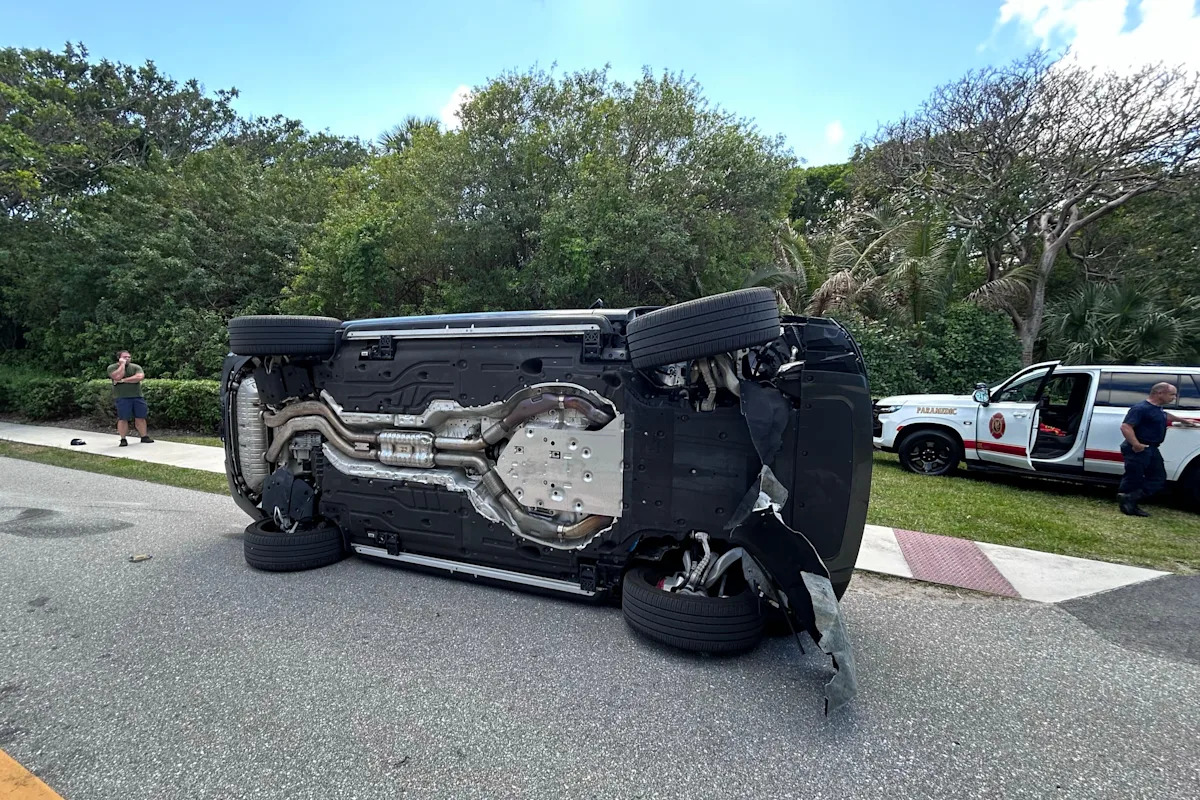
Golf star Tiger Woods was arrested on Friday afternoon after a rollover crash in Jupiter Island, Florida, marking his second DUI arrest in the state in less than a decade.
But, at least according to one Florida defense attorney, that part of Woods’ case isn’t likely to hold up.
Advertisement
“Seems like they have no case, no DUI case,” longtime South Florida defense attorney Robert Reiff told Yahoo Sports on Friday night. “Period, full stop.”
Reiff is not involved in the case.
Tiger Woods arrested for DUI
Woods was driving at a high rate of speed on Jupiter Island around 2 p.m. ET on Friday when police say he tried to pass a work truck. According to police, Woods’ Range Rover clipped the back of that truck’s trailer and flipped onto its side.
Woods was uninjured, and climbed out of the SUV on his own. Officers on the scene said Woods “did exemplify signs of impairment.” Officers were not suspicious of alcohol, but suspected medications or drugs. Woods took a breathalyzer test, which returned a 0.00 reading, but he did not submit to further testing, refusing a urinalysis test. He was described as “lethargic” on the scene, and tried to explain the injuries and surgeries he has undergone in recent months.
Advertisement
Neither Woods nor the driver of the truck were injured. Woods was arrested and charged with DUI with property damage and refusal to submit to a lawful test.
“He cooperated with the breathalyzer, and then the urine he wanted no part of,” Martin County Sheriff John Budensiek said. “He is cooperative, but he was not trying to incriminate himself. So he was careful in what he said and didn’t say.”
Because Woods didn’t submit to the urinalysis test, Reiff said, it’s going to be hard to prove that Woods was actually under the influence of a controlled substance — which is required to fit the definition of a DUI under Florida law.
That would leave the refusal to submit to a test charge, which is a second-degree misdemeanor in Florida that can lead to up to 60 days in jail. But without that test, barring new information or details coming out, it doesn’t appear from the outside looking in that there is any legal proof that Woods was impaired.
Advertisement
“Sometimes [officers] go to the default position, we think you’re impaired,” Reiff said. “Take a breath test, pass it. Oh well, then it must be drugs. Sorry, it doesn’t work that way.”
Friday’s crash was just the latest for Woods. He was involved in a single-car rollover crash in Southern California in 2021, which left him with multiple leg fractures and a shattered ankle. He was arrested for driving under the influence in 2017 during a Florida traffic stop, too. He said that incident was the result of “an unexpected reaction to prescribed medication” and pleaded guilty to reckless driving.
Those injuries, as well as the numerous other back procedures that Woods has undergone, Reiff said, would be reason enough to explain away any failed field sobriety tests, too.
Advertisement
“I wouldn’t be shocked at all if Tiger Woods and his team have had him try to [lift his leg six inches] as part of neurological testing and he couldn’t, especially with one leg shorter than the other and all those back issues,” Reiff said, referencing a common field sobriety test.
Golfer Tiger Woods stands by his overturned vehicle in Jupiter Island, Fla., on Friday, March 27, 2026. (AP/Jason Oteri)
(ASSOCIATED PRESS)
Woods was transported to the Martin County Jail, where he would be held for at least eight hours, according to Budensiek. Even that likely shouldn’t have happened, Reiff said. When a suspect is arrested for a DUI in Florida, they are held for either eight hours or until they blow under a 0.05 on a breathalyzer test. Woods already blew 0.00.
“It’s so indoctrinated into them that they have to hold him for eight hours … except if he blew under a 0.05. Then you release him, then you should release him,” Reiff said. “It’s like anything else, they don’t understand the nuance.”
Advertisement
It was just three days ago that Woods made his return to competitive golf, when he played in the TGL indoor golf final with his Jupiter Links Golf Club team. It marked his first true competitive golf, albeit in an indoor league, since the 2024 British Open. Woods ruptured his Achilles in March 2025, and underwent surgery for a lumbar disc replacement in October.
Prior to the accident, Woods had been non-committal one way or the other about teeing it up in this year’s Masters, which begins on April 9.
More information is sure to come out about Friday’s incident. Woods hasn’t had the chance to speak publicly yet, either.
But legally speaking from an outside view, at least based on what’s available for the moment, Rieff is convinced a DUI charge isn’t likely to hold up.
Advertisement
“There’s certainly more to this story and we need to find out [more],” Reiff said. “But I’ll certainly tell you from what I’ve been hearing … it sure doesn’t seem like they have proof — at least not of the DUI.”
Read the full article here