




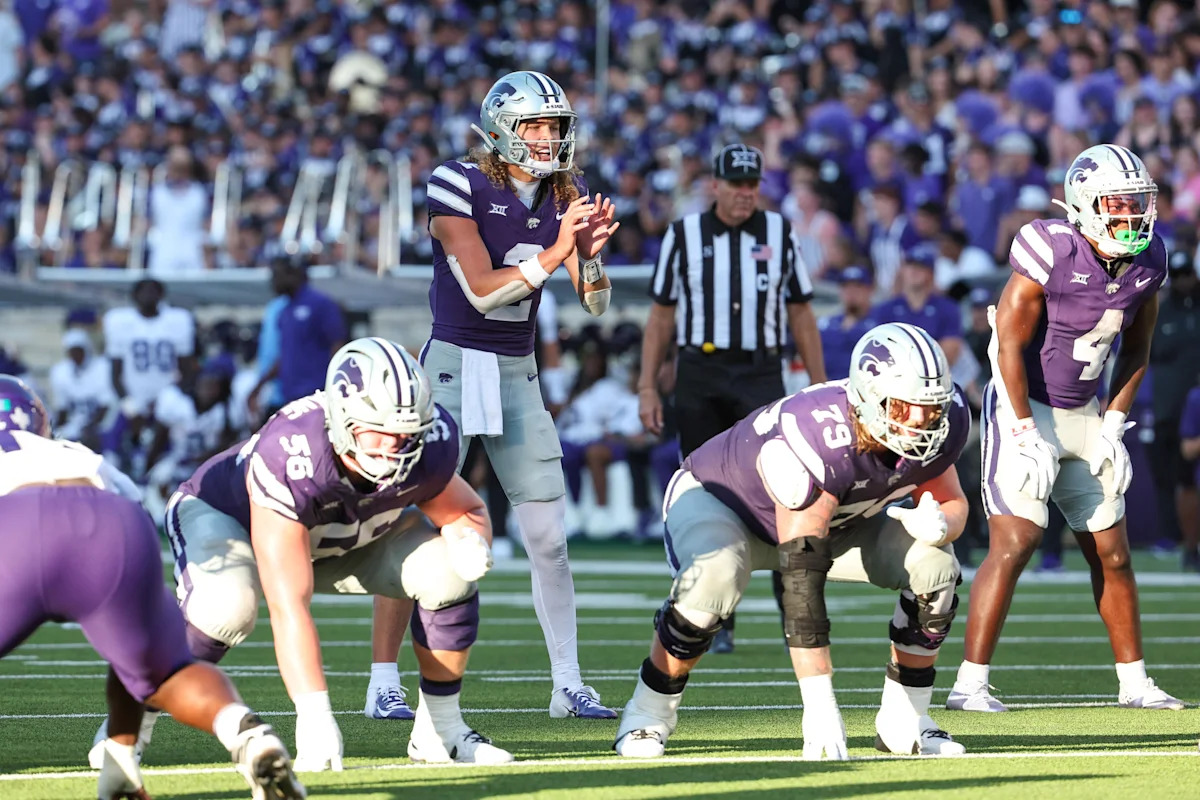
Coach Klein did me a solid this week and actually put out a depth chart. After months of idle speculation, it’s nice to have some concrete information to work with. I plan to add more position-group evaluations to my post-game articles, so I thought it would be interesting to give each position group a pre-season grade and see how things shake out as the season moves along. At the end of the season, we can take a look back at this article and see what I got right and where I was off base.
Anyways, enough chit-chat; there’s an actual depth chart!
Advertisement
Grading Scale
First off, let me turn back the clock to my teaching days and provide a grading scale.
A – Top 20 nationally
B – Above average for the Big 12
C – Average for the Big 12
D – Below average for the Big 12
F – Non-Functional
Offense
Quarterback – Grade – B+
-
#2 – Avery Johnson – 6’3″, 200 – 4th Year
-
#7 – Jacob Knuth – 6’4″, 225 – 5th Year – OR –
-
#3 – Blake Barnett – 6’1″, 218 – 3rd Year
Thoughts: Avery is the face of the program heading into his 3rd season as a starter at Kansas State; he’s looking to bounce back from an uneven 2025 in a new but familiar offense. Knuth making the depth chart is somewhat interesting because he was thought to be the odd man out most of camp, but he gets the nod because 2nd-year quarterback Dillon Duff got banged up at the end of camp. He’s joined by Blake Barnett, who I’m going to assume is the first quarterback off the bench based on last season.
Advertisement
This is a solid group. I thought about giving it an A- based on Avery’s experience and upside, but played it safe with a solid B+ rating. Kansas State is better off than most teams at quarterback. There’s not much game experience on the bench behind Avery, but that’s the nature of the 2026 college football beast. Barnett and eventually Duff both fit the offensive scheme and are solid options off the bench.
Avery has the talent to push this to an A or at least an A-, but I’m going to need to see it on the field.
Running Back – Grade – B+
-
#4 – Joe Jackson – 6’0″, 212 – 4th Year
-
#9 – Jay Harris – 6’1″, 225 – 5th Year – OR –
-
#20 – Rodney Fields Jr. – 5’9″, 193 – 3rd Year
Thoughts: Joe Jackson is back and managed to hold onto the starting job despite Jay Harris and Rodney Fields Jr. joining the team from the transfer portal. Jackson brings the best overall combination of outside speed and between-the-tackles power, with his game skewing more toward the speed side of the equation than power.
Advertisement
Depth is a clear strength for this group, with Harris providing a hard-charging power back and Fields Jr. adding elusiveness and receiving. Coach Klein can match the right tool to the football task with this backfield.
The only thing keeping this group out of the “A” range is the lack of a clear-cut star. Jackson was good last season, but didn’t crack 1,000 yards and didn’t always finish runs with authority. Harris was an ancillary player in a loaded Oregon backfield, and while Fields Jr. did lead Oklahoma State in rushing, it was with 614 yards. His best skill is probably his receiving ability.
Jackson deserves to begin the season as the starter, but any one of these guys could end up playing their way into the starting role as the season progresses.
Tight End – Grade – A
-
#86 – Garrett Oakley – 6’5″, 249 – 5th Year
-
#80 – Will Anciaux – 6’6″, 241 – 4th Year
-
#0 – Linkon Cure – 6’5″, 242 – 2nd Year
Advertisement
Thoughts
Oakley has positioned himself as a future NFL draft pick; the only question is the round. He’s a balanced tight end who can make an impact in both the run and pass game. He’ll be one of the most targeted pass catchers on the squad.
Like the running back position, the tight end room has a player for every occasion. If Coach Klein wants to put two tight ends in the game and run the ball, he goes with Oakley and Anciaux. If he’s looking for a dynamic play down the field, Linkon Cure can join Oakley and create significant heartburn for the defensive coordinator.
This is one of the best tight end groups in the nation.
Advertisement
Wide Receiver – C+
Field
-
#12 – Jaron Tibbs – 6’3″, 212 – 4th Year
-
#17 – Adonis Moise – 5’11”, 194 – 2nd Year
Slot
-
#8 – Brandon White – 5’7″, 168 – 5th Year
-
#1 – Izaiah Williams – 6’0″, 186 – 3rd Year
Boundary
-
#5 – Josh Manning – 6’3″, 217 – 4th Year
-
#15 – Derrick Salley Jr. – 6’3″, 234 – 3rd Year
Thoughts: Tibbs led the team in receptions last season with 47 grabs for 595 yards and 3 touchdowns. That’s a solid performance for a team’s #2 receiver, and that’s what Tibbs was last season, behind Jayce Brown. He may need to put up leading-man numbers in 2026 if Kansas State is going to reach its full potential.
I wasn’t sold on Bradon White as a starter coming into fall camp, but it looks like he managed to win the job outright over Texas A&M transfer Izaiah Williams, at least for the opener. White is a prototypical slot receiver and brings an element of quickness that the Wildcat offense has been missing since Phillip Brooks graduated.
Advertisement
Manning is a former 4-star Missouri recruit who never quite found his footing in three seasons for the Tigers. He’s going to have more opportunities to make plays down the field in this offense. He doesn’t have to be a high-volume receiver, but he needs to give the Wildcats a viable downfield threat to help open things up for the rest of the passing game.
If you were to rank the receivers in order, Williams would be fourth. He came to Texas A&M with Coach Klein and is another solid option out of the slot. I see White as more of a run-and-catch guy, with Williams providing more in the vertical pass game. They’ll both play a significant number of snaps.
Salley Jr. was one of the top junior college receivers in the nation. He’s not going to outrun many corners on a straight go route, but he’s tough for corners to handle on back-shoulder throws where he can use his strength. He could be a menace in the redzone. Moise is probably 6th in this group, but it’s nice to see the 2nd-year player develop enough to make the opening depth chart.
This isn’t a bad group of wide receivers, but none of them have featured as “the guy” before. If one of these guys turns into that, this grade will be too low, but I’ll need to see it on the field. The good news is that while I question this group’s ceiling, I don’t question its floor. I think Coach Klein can get what he needs out of these guys; I’m just not certain how much more than that they can give him.
Advertisement
Offensive Line – D+
Left Tackle
-
#72 – Ryan Howard – 6’7″, 295 – 3rd Year
-
#65 – Tyler Johnson – 6’6″, 312 – 4th Year
Left Guard
-
#79 – Charlie Adams – 6’2″, 327 – 3rd Year – OR –
-
#77 – Tanner Morley – 6’6″, 320 – 4th Year
Center
-
#71 – Dylan Villarouel – 6’3″, 328 – 2nd Year
-
#66 – Michael Capria – 6’2″, 300 – 5th Year
Right Guard
-
#54 – Keiton Jones – 6’3″, 322 – 2nd Year
-
#61 – Chase Duarte – 6’4″, 315 – 2nd Year
Right Tackle
-
#70 – Gus Hawkins – 6’7″, 307 – 3rd Year
-
#57 – Delvin Morris – 6’3″, 293 – 4th Year
Thoughts: Left tackle is the obvious sticking point. Ryan Howard is going to get the first crack at left tackle despite not playing a single down in his first two seasons in Manhattan. Tyler Johnson didn’t play much outside of special teams in his three seasons at Auburn. One of the two needs to be serviceable, and I don’t have a preference. It will be interesting to see if Oliver Miller is added back into the left tackle mix once he’s recovered from his injury.
I love what Gus Hawkins brings to the table at right tackle and am a little surprised he didn’t at least get a look at moving to the left side. He looks like an NFL draft pick and moves like one; now he needs to consistently play like one. I’d like to see him turn the nastiness knob up a few notches this season.
Advertisement
The interior line is completely rebuilt. Villarouel brings something a little different to the center position than Kansas State’s good but undersized recent offerings at the position. Keiton Jones is freakishly strong but also very green; he’ll be good, but there could be some growing pains. Left guard was supposed to be the strength of the line, and it still could be, but that would require Tanner Morley and Oliver Miller’s return to full health. Morely knows how to play as an individual, but he needs to figure out how he fits into this group. It’ll be interesting to see how the staff balances getting him close to 100% healthy while giving him enough playing time to help bring the line together early in the season.
The injuries have hurt not only the front-line talent but also the roster depth. Before the injuries, I thought this offensive line went 8 or 9 deep; now it’s more like 6 or 7 until Miller returns. Charlie Adams has some versatility and could end up as the backup right tackle if Morley is healthy. After Adams, I’m not sure who the next man up is; we’ll figure that out together on Saturday.
Overall Grade – B-
I thought this offense had a chance to be one of the best in the Big 12 before the spate of offensive line injuries. It still has that type of talent at quarterback, running back, and tight end, but it’s hard to have a top-tier offense with so many questions on the offensive line. The good news is that the preseason schedule isn’t as tough as it could have been, and there’s time to work some of the kinks out before the schedule really picks up in October.
Advertisement
I like to talk about the “floor” and “ceiling” of an offense. I don’t think the offensive line issues hurt the floor much; the roster has enough talent to overcome them against most opponents. I’m more concerned about the ceiling. Texas Tech and BYU already had a talent advantage; that will only grow if the offensive line doesn’t come together as a unit despite the injuries.
The offensive line is the limiting factor for this offense. If they outperform expectations, this could still be a top-level offense, but that’s a big ask for a group with so little experience both individually and as a unit.
Read the full article here


