


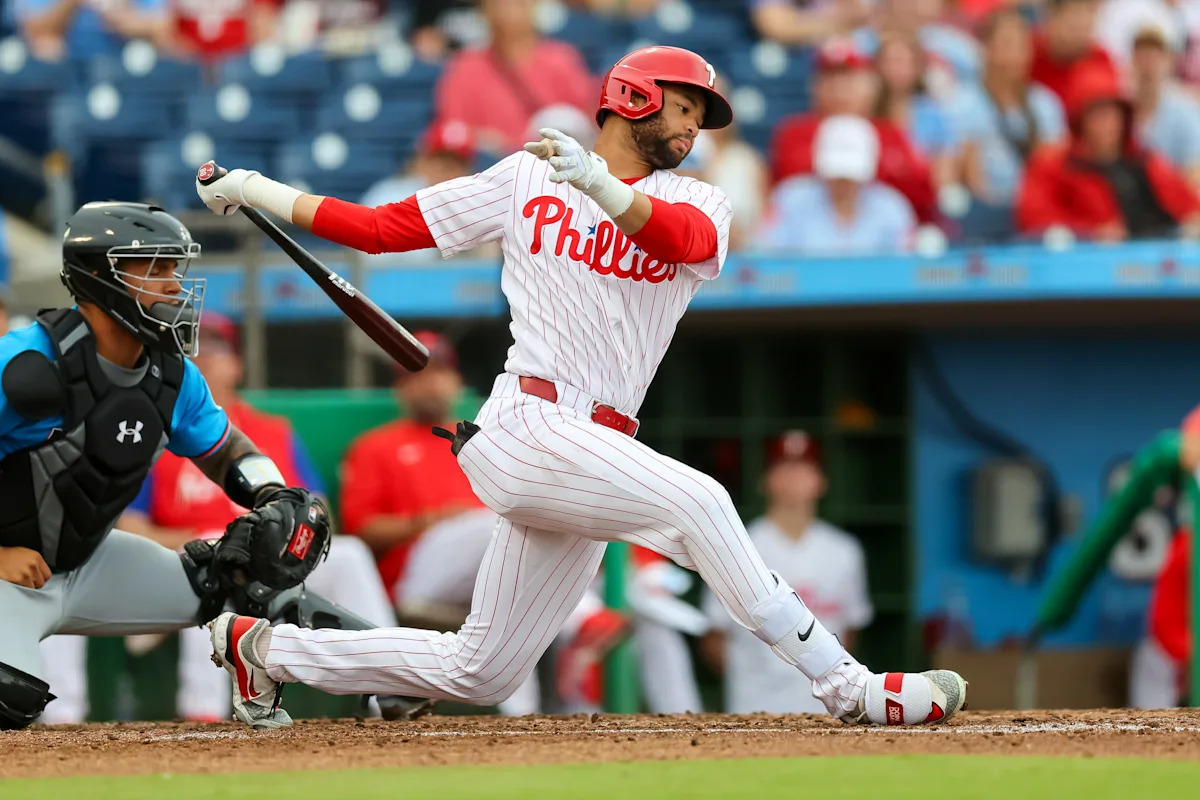
When Justin Crawford started out Grapefruit League games with a few strong games, there was a distinct sentiment that the rookie should not only be in the team’s starting lineup, but he should be batting at the very top of it from day one.
I understand the sentiment, because based on his performance in the minors last year, he is well suited to the leadoff spot. He had a .411 on-base percentage with 46 stolen bases.
Advertisement
The sentiment makes less sense when you remember that the Phillies already have a good leadoff hitter in Trea Turner, who is also very fast and won a batting title in 2025. But the move isn’t really about getting Turner out of the leadoff spot as much as it is getting Alec Bohm out of the cleanup spot.
One of the biggest narratives of the offseason was getting protection in the lineup for Bryce Harper in the three-hole. (This narrative has been partly fueled by Harper himself.) It’s clear that most people do not think that Bohm and his 15 home runs a year power belong in the cleanup spot, even though as has been written, the notion of what a “cleanup hitter” is has changed over the years.
Let’s take a look back to 1998. Back then, lineups were generally constructed as such:
Advertisement
-
Fastest guy on the team batted leadoff
-
Second was a guy without much power but usually put the ball in play
-
Three-hole was the overall best hitter
-
Cleanup was the biggest power hitter
-
Batting fifth was the second biggest power threat
The Phillies of that year had a young shortstop named Desi Relaford. Normally, manager Terry Francona (exhibit A for never hiring a rookie manager) batted Relaford low in the lineup. But Relaford theoretically matched the expectations of a two-hole hitter, so every once in a while, Francona would try him out in that role.
It generally didn’t go well. In 21 games batting second that season, Relaford put up a .144/.179/.189 slash line. I’m not sure if the move caused Relaford’s downfall, or he was always destined to fail. He batted almost exclusively lower in the lineup the following season and continued to hit poorly. (He was eventually moved to help make room for another shortstop prospect named Jimmy Rollins who actually did succeed at the top of the lineup. To his credit, Relaford had a couple of decent seasons as a utility man for the Mets and Mariners a few years later.)
Last year, the Phillies similarly tried to get a new hitter into the mix at the top of the order. From April 11 to the first week of June, Bryson Stott was the team’s primary leadoff hitter. It went well at first, but soon, Stott’s production cratered. He went into a slump that lasted three months, even after he was moved out of the leadoff spot.
Did the lineup switch cause Stott’s slump? On one hand, he hit poorly throughout most of 2024 as well, so it isn’t like a lengthy slump was completely out of character. On the other hand, it’s possible that he was pressing a bit, trying too hard to justify his spot in the lineup? Or maybe he tried to be too patient at the plate, which isn’t necessarily a great strategy for a hitter with proven trouble hitting elite fastballs.
Advertisement
That is why I don’t necessarily want to rush Crawford to the top of the lineup. He’s got enough pressure as a rookie starter for a playoff contender. It isn’t that imperative to get Bohm out of the top four spots in the lineup to potentially harm a young player’s development.
Perhaps Crawford will start off the season strongly and replicate his minor league performance with the Phillies. If that happens, I could see them being tempted to move him up, especially if the Phillies’ offense isn’t doing well overall. But to avoid Crawford being another Desi Relaford, they need to be sure he can handle it, and the leash should be very short.
Read the full article here