




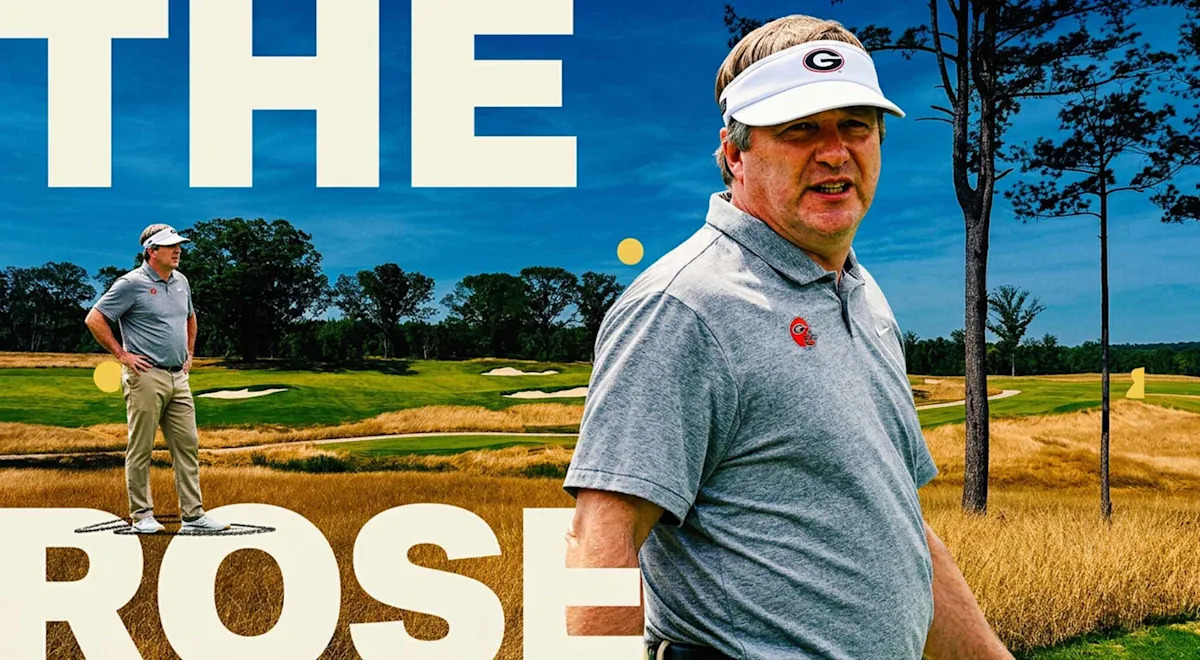
Life’s a beach. Or a highway. Or a journey. Or a mirror. Or a “moderately good play with a pretty bad third act.”
Or maybe, if you’re a Georgia Bulldog, it’s something much simpler.
“In sports competition, winning is everything,” says Kirby Smart, the head football coach at the University of Georgia. “In my life, it’s behind God, family, and football, of course. But winning in general competition? It’s what I’m all about, man.”
Advertisement
Smart can’t really recall when he first realized he loved beating people. Maybe it was when he was a little boy, age 5, aiding his dad’s youth baseball coaching efforts in tiny Rabun Gap, Ga., by setting up shop near the dugout and swinging wildly at bottle caps with a broomstick. Or maybe it was a bit later in childhood, when Smart’s cantankerousness in both defeat and victory led to the creation of a most unusual Smart Family Rule: no board games. Or maybe it was in high school, when his yearbook passage read like a job listing for an apex predator.
“Likes: Winning; Remembered For: Being intense in competition.”
Kirby Smart is wired differently — a fact supported by every millimeter of his adult life in Athens, Ga., where competition is jammed into every couch cushion and under every mattress like he’s worried about a run on the banks. It’s in the hallways of the gleaming Butts-Mehre Heritage Hall (pronounced butt smear without a whiff of irony), where training boards glow day and night to remind players just how much slower and weaker they are than their NFL-superstar predecessors. It’s in the sparkling new weight room, where sensors sit on every squat rack and bench to track the velocity, acceleration and completion of every rep, transmitting data to an enormous LED screen that ranks player performance by weight class. And it’s certainly there on the practice field, the so-called House of Payne, where football is an act of war — an exercise in violence and discipline and strategy and technique — and Coach Smart is the general.
“It’s what my career was built on,” Smart says, chuckling. “I love competing, and I love … love … winning.”
Advertisement
But there are drawbacks to being the general, especially if you’re Kirby Smart. Chief among them is that you don’t get to do the fighting yourself.
Like generations of head ball coaches before him — including his mentor, the legendary Nick Saban — this is what brought Smart to a sport in which strategy and discipline and technique and violence can be acted out well off the gridiron and into retirement: golf.
“Oh, yeah, he’s a competitor,” says Matthew Stafford, the reigning NFL MVP and Super Bowl champion quarterback, with a laugh. Stafford matriculated through Georgia football before Smart was at the helm, part of a program-defining stretch in the mid-2000s that eventually made Stafford the No. 1 pick in the NFL draft. Stafford has become good friends with Smart in the years since Stafford left campus, particularly as Smart stewarded Georgia’s rise to becoming arguably the preeminent college football program in the country, winning back-to-back national championships and four SEC titles.
“We’ve been on some duck hunts together, on the golf course together, and Kirby doesn’t like to lose — at anything,” Stafford says. “But that’s okay, because I don’t like to lose, either.”
Advertisement
Today, Smart is nobody’s definition of a “good” golfer. He hacks it around unpretentiously, and religiously maintains a 12 handicap. But he is ruthless, and obsessed.
“The imperfection — that’s what I love about golf,” he says. “I really believe that golf is a failure sport. It’s so fun to play because you never play a perfect round.”
Athens exists in a prolonged state of obsession over Smart’s football prowess, particularly on Saturdays in the fall, when Smart’s Dawgs cause the city’s population to double. But it’s on a spring Tuesday that Smart’s grander plan comes into view on a dirt lot 10 minutes from campus. It is here, between the peach fuzz of a spanking-new golf course and the bones of a colossal clubhouse, that a new kind of competition steps to the fore in the form of a place called The Rose.
And it is here, in the era of player empowerment and NIL, that Kirby Smart welcomes a surprising new tool into his recruiting arsenal: his 7-iron.
Inside the Georgia Football House of Payne. GOLF | James Colgan
A FOOTBALL FIELD AWAY from Kirby Smart’s office, in the Georgia Athletics Hall of Fame at the lobby level of Butts-Mehre, the Cassini brothers summarize the first part of their golf legacy with an old joke.
Advertisement
“You see that name right there?” Dimitri says with a grin. “Nick Cassini … and look at that next name.”
Nick picks up the punchline.
“Herschel Walker,” Nick says. “I was so good that I beat Herschel freakin’ Walker into the Hall of Fame.”
The two brothers start laughing before Nick explains.
“You can’t get into the Hall of Fame until you have your diploma, and Herschel didn’t finish his degree until after his NFL career,” he says. “I got in before him, but it was on a technicality.”
Still, Nick might be underselling himself. Herschel Walker or not, Nick is one of the best players in the history of Georgia golf. His resume sports the fourth-best scoring average of any player in program history, a 1999 NCAA title and a place on the U.S. Walker Cup team.
Advertisement
A long time ago, Nick and Dimitri dreamt of a life as brothers in arms in golf. At the time, though, they pictured it’d look like PGA Tour superstardom, with Nick following the many high-level Georgia golfers (Bubba Watson, Brian Harman, Chris Kirk, et al.) who have blazed a path on the big tours and millions in earnings.
“I would caddie for him during my summers in high school, his summers in college,” says Dimitri, who is five years younger than Nick. “We spent two and a half months straight on the road, driving around the country. I mean, we didn’t have a choice, we just became best friends.”
The brothers never imagined the road to the pros would eventually bring them here, to Butts-Mehre, where they’d be explaining the journey to a totally hair-brained idea that’s now totally real: a private golf club in Athens, Ga., existing as an (unaffiliated) extension of the university with a national membership of similarly obsessed golf diehards (including approximately 30 percent who have no attachment to the university). The reason all those things can cohabitate together is a golf course the Cassinis have spent the last 18 months fussing over.
The Cassinis never imagined that they’d become perhaps two of the most qualified people on earth to bring such a project to life. Yet here they are, their credentials as world-renowned real-estate developers, world travelers and deeply connected plus-handicappers serving them well for a task as meticulous as developing a golf club, where no detail is too small to care about.
Advertisement
In reverse, though, the dots connect rather satisfyingly. The Cassinis arrived in Athens for the first time at a turning point in their lives. Their father had passed just as his sons were reaching college age, leaving them to find their paths as adults. Athens quickly adopted the brothers, giving them a home base and a sense of community. At first the boys thought they’d honor the Bulldogs through Nick’s life on tour, but soon it became clear their real calling was in development — first as employees of a real-estate company and then as the founders of their own venture.

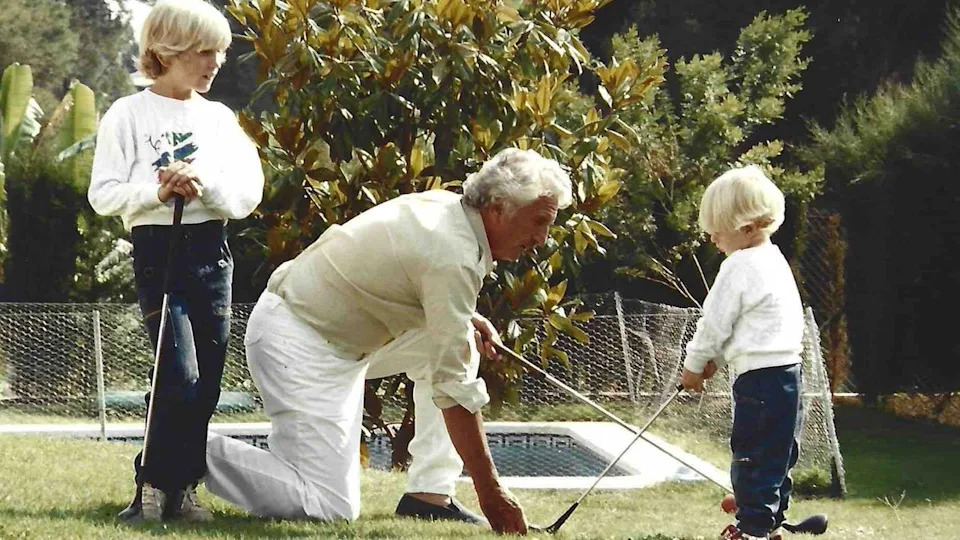
The Cassini brothers, Nick (left) and Dimitri, learned the game from their father. Courtesy, Cassini Family
Golf remained a passion all along, as did their adopted hometown. Eventually, after their travels included trips to many of the best golf courses in the world, the two brothers got to talking about what it might take to build a club of their own. They started looking for property in Athens and, after a prolonged search, found a parcel of farmland just across the county line that looked promising. They went for a visit and wound up on what eventually became the 12th hole — a long, canting par-5 that even then looked etched into the earth. Less than an hour later, they started on the paperwork.
“We knew right away we’d found it,” Nick says now with a grin. “It was just perfect.”
Advertisement
Next came the big decision: a course designer. After several interviews, the brothers settled on Tripp Davis, who — like them — was ready to pour his heart and soul into the project, even getting an apartment in Athens so he could personally oversee every detail of the design. The course came together quickly, routed between rolling hills and a small ocean of native grass as if it had existed on the property forever. The other components of the club came together at a more reasonable pace under the exacting eyes of Dimitri and Nick, who scoured the golf world for an all-star team of maintenance and hospitality experts.
The goal, as they tell it, is total refinement, and the point is to create a great American golf club, not just a place celebrated by Georgia alumni. The evidence of that pursuit is everywhere — from a personalized nicotine-pouch dispenser to a special brand of homemade beef jerky. When their GM didn’t fully understand their goal to serve European-inspired small plates on account of having never visited the continent, the Cassinis booked three plane tickets and spent a week with their colleague eating their way through Italy.
“Every hire we wanted to look them in the eye and see that this was the most important thing in their life,” Dimitri said. “We wanted them to know that this is going to make you what you want to be.”
Those ideals might sound high-minded, but to the Cassinis, they’re the bare minimum required. Not because it suits their egos or bolsters their bank accounts (the club is member-owned), but because The Rose represents their best shot at giving back to the city that has given them so much. And in that effort? Half-assing won’t do.
Advertisement
“Our range? You’ll never have sunlight hit you straight in your eyes, morning or evening,” Dimitri says. “It’s the little things that people will never even know that I’m obsessed with.”
It is not hard to see how this level of obsession pairs nicely with work up the street at Butts-Mehre, where Georgia Football prepares to send another class of stars in pursuit of a national title. The landscape is changing faster than ever in college football, where NIL has upended the traditional world order. Suddenly, universities with well-funded benefactors and enthusiastic alumni bases have been gifted a legitimate competitive advantage. Any environment that brings together those groups and encourages visits to campus? That can’t be bad for football.
“Especially once I’m done playing, it’ll be much easier to get back there in the fall and go to games,” says Stafford, the NFL star. “To have a fantastic place to stay and go play golf and do all that? It’s awesome.”
Of course, the Cassinis are in it for the golf. They’ve enjoyed building The Rose so much that they’ve started their own course-development consulting firm, Cassini and Co., to help other golf diehards build their own dream courses. But they wouldn’t be upset with a national title, either.
Advertisement
“I mean, when we built this place, Saturday afternoons in the fall were one of the first things we thought about,” Dimitri says. “There’s nothing better than Athens during a home game.”
Then he stopped himself.
“Well, actually, hopefully there’s one thing better,” Cassini says with a grin. “A tee time before it.”
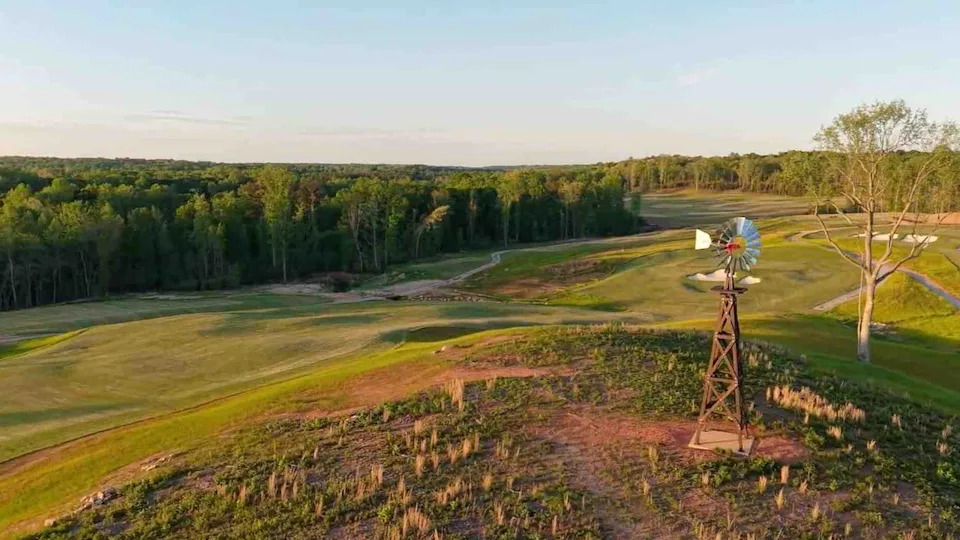
The Rose is only just now growing in, but it’s already turning heads. GOLF | James Colgan
GEORGIA FOOTBALL HAS never strayed far from golf.
The “House of Payne” where Smart spends his practice days? The field owes its name to Billy Payne, ’69 and ’73, an ex-fullback for the Bulldogs who helped shepherd the Olympics to Atlanta in 1992 and, for his efforts, earned a chairmanship at Augusta National. When Georgia put the naming rights to the indoor practice facility up for sale, Payne pledged $25 million to the effort, and named the field for his father, Ronnie, who also played for the Bulldogs.
Advertisement
Payne became much better known for his role as a sports iconoclast than his days as a Bulldog. But the passion he exudes for golf is no less fervent among those who have committed their lives to football first. When Stafford isn’t winning NFL MVPs, he is golf-obsessed, and when Smart isn’t winning national championships, he is golf-addicted.
“I enjoy the challenge of it’s you against you,” Smart says, repeating the words that have brought the competitively obsessed to golf since the beginning of time. “You like to say you’re competing against somebody, but you’re really just playing yourself.”
It’s not hard to understand why Smart might enjoy the prospect of an internal challenge: These days, his life as head ball coach rarely involves such introspection. There are recruits to win and budgets to set and donors to woo and players to coach.
As it turns out, that might prove to be the most useful component of his new home club. The Rose won’t just provide Smart with an escape from his duties as a football coach, but it also will provide him with a new venue to conduct those same duties.
Advertisement
“I think it’s one of those synergy deals, like, we’re constantly looking for facilities that boost the economic impact of our athletic programs,” Smart says. “Football is included in that, golf is included. It’s great when you get a place that people can go out and have fun, enjoy, relax and socialize. Sometimes that ties in more energy, more enthusiasm towards the program, which might also equal more donations and more dollars.”
In Smart’s telling, it’s all part of golf’s old-school playbook of connective tissue — where four hours and a great walk can bridge divides and solidify friendships and close deals.
In other words, if it sounds ridiculous to think an unaffiliated private golf club could benefit a public university’s football program, you clearly haven’t been paying much attention to college football … or private golf clubs.
“The greatest impact I see it having on football is the relationships that I get to form, our coaches get to form, with people that are that are coming back and playing golf,” Smart said. “A lot of business deals get done on the golf course.”
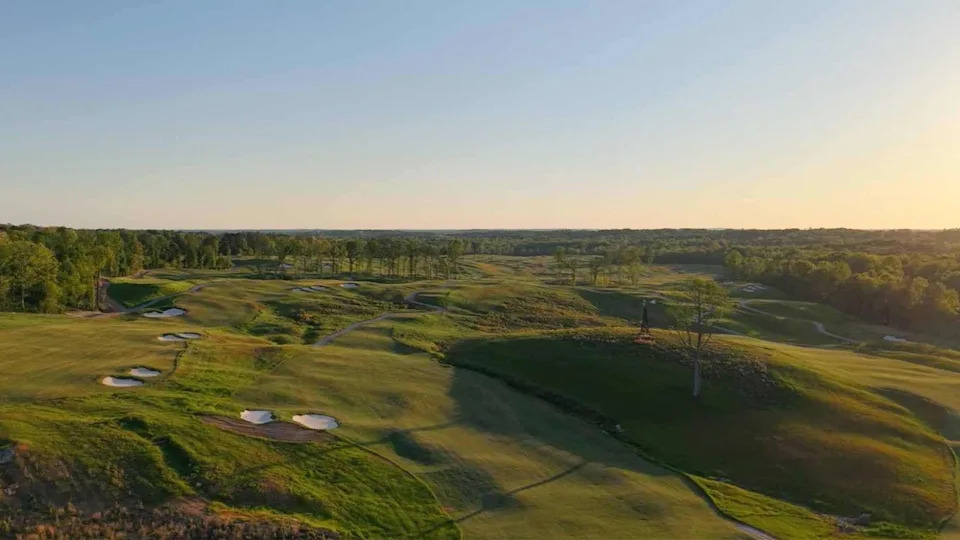
The Rose at sunset. GOLF | James Colgan
At The Rose, those deals will have the benefit of occurring in a unique space: a golf course unlike anything else in Georgia, in a city unlike anywhere else in Georgia, founded a group of golf obsessives with a vision unlike anyone else in Georgia. It’s an ambitious idea, particularly for the two brothers charged with bringing it to life, but there is little doubting its merits.
Advertisement
“I remember [Billy Payne] saying that his favorite part about being Augusta National chairman was changing people’s lives,” Dimitri Cassini says. “He told us, ‘Your life as you knew it is over, and it’s a completely new chapter of your life, and your best friends in five years from now will not be the best friends you have today. They will be a lot of the people from this club.’ We’ve already seen that to be true.”
For the Cassinis, the goal was always bigger than expanding their social circle. It was about giving back to the place that had given them so much, and about building a legacy in a place both brothers could call home. The biggest surprise of the project has been how many fellow golfers — both with UGA ties and without — seem to share their passion.
“I think it’s just a commitment to the area,” Stafford said. “I think it’s a commitment on a national level from a lot of people affiliated with Georgia. Georgia football is such a national power that it’s something people want to go see, and now they have an unbelievable golf course right nearby to go check out as well.”
Stafford made a return trip to The Rose after the Rams broke for training camp in mid-June. He welcomed an old coach, Mike Bobo — now the Bulldogs’ offensive coordinator — alongside a few buddies for a few days of golf and nostalgia.
Advertisement
That was precisely the kind of excursion the Cassinis envisioned in mid-April, when they stopped by the course one evening for a quick site tour. The sun was setting behind the rolling hills, illuminating the land with golden streaks. Soon golfers would fill these fairways and greens, but for the moment it was just Dimitri and Nick surveying the fruits of their labor with childlike grins.
“This is just freaking awesome,” Nick said, the weight of his and Dimitri’s efforts hitting him as he looked out at the course. “This is what it’s all about.”
As the breeze rustled through the trees, Nick put his arm around his brother and looked out at their new home.
“This is what it’s all about.”
You can reach the author at james.colgan@golf.com.
The post Inside Georgia football’s surprising new secret weapon: a golf course appeared first on Golf.
Read the full article here


