




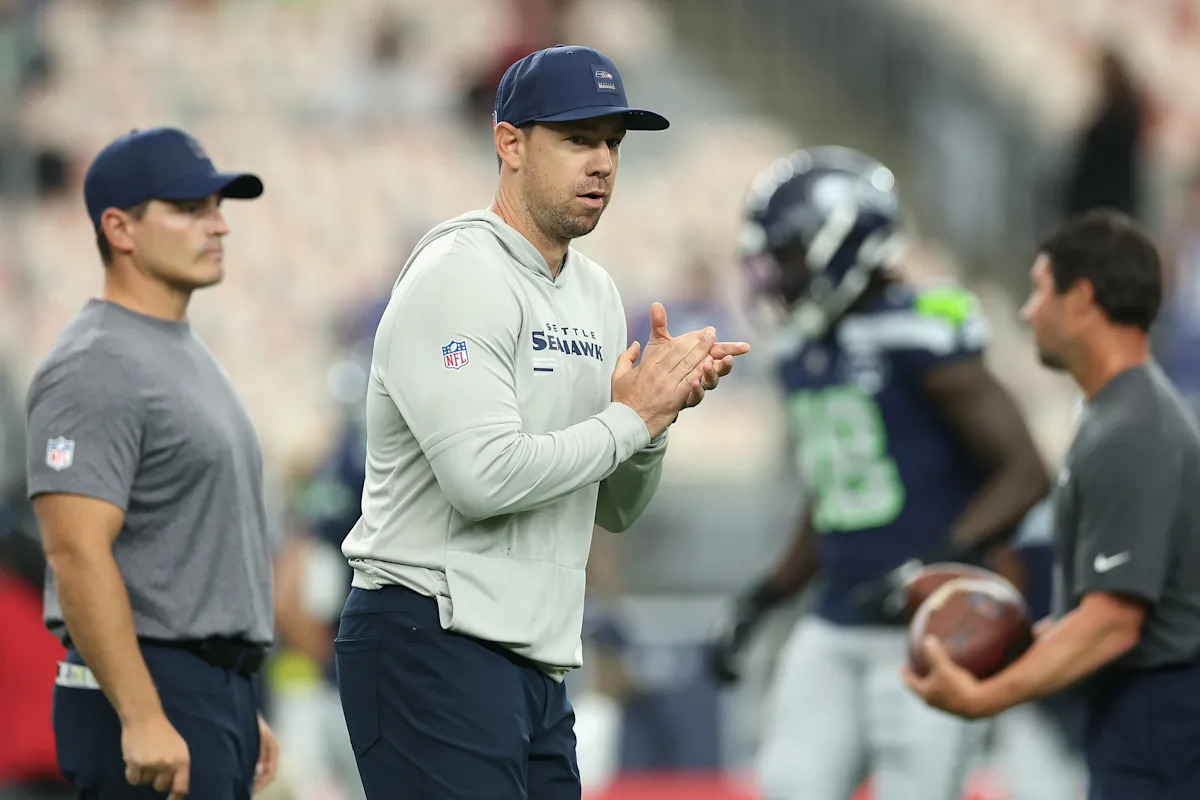
The Las Vegas Raiders agreed to terms with current Seattle Seahawks offensive coordinator Klink Kubiak to be their next head coach because he’s widely considered a brilliant offensive mind in the NFL. The Seahawks’ offense finished the regular season third in points scored and eighth in total yards, and Kubiak’s use of 12 personnel (one running back, two tight ends) is a big reason why.
According to Sumer Sports, Seattle used 12 personnel on 27.4 percent of its plays (11th-highest rate in the league) and had the second-best EPA (56.5) among the NFL’s 32 teams. Additionally, the Seahawks’ 0.37 EPA per pass attempt with two tight ends on the field topped the charts, and a 0.06 EPA per rushing attempt ranked fifth.
Advertisement
Seeing as the Raiders have a pair of young, promising tight ends in Brock Bowers and Michael Mayer, and a running game that could use a boost with 2025 first-round pick Ashton Jeanty in the backfield, Kubiak’s success with 12 personnel is likely a big part of the reason why he got the job.
So, let’s take a look at a few examples from the Seahawks’ games against the Tampa Bay Buccaneers (Week 5) and Houston Texans (Week 7) to see how the play-caller uses 12 personnel to attack defenses.
To be honest, there isn’t anything too fancy about Kubiak’s rushing attack out of 12 personnel from a play design standpoint. What he does is either try to get a numbers advantage or set up a mismatch, and the clip above is a good example of the latter.
Advertisement
Seattle comes out in a balanced formation with a tight end on each side of the offensive line, while Tampa Bay is in base personnel (seven front-seven defenders and four defensive backs) and loads the box with eight defenders. However, that eighth defender is a safety.
Since the offense isn’t tipping its hand by having both tight ends on each side of the offensive line, the safety is on the wide side of the field so that one of the inside linebackers (No. 54) doesn’t have as much ground to cover if it’s a pass. But when the Seahawks run outside to the wide side of the field, that forces the safety to take on a block from the right tackle. A mismatch that favors the offense in the run game.
Also, the right guard gets to the defensive tackle’s outside shoulder, the tight end does a good job of kicking out the wide nine-technique, and wide receiver Cooper Kupp gets involved in the action with a good block on the corner to spring running back Kenneth Walker II.
Kupp’s efforts are especially important on this play, and receivers have to be willing to get their hands dirty in Kubiak’s offense. That should be part of Jack Bech’s role in Vegas.
This time, Seattle comes out in an unbalanced formation and calls a simple weakside zone run. Meanwhile, Houston counters with base personnel and its two strongside linebackers lined up in the A- and D-gaps.
Advertisement
Post-snap, Houston fits the run well on the weakside, and the two strong-side linebackers (Nos. 0 and 45) flow with the play. However, the inside tight end (No. 81) has a good angle for the second-level block on No. 45 with the defense’s pre-snap alignment. Also, the left tackle does a great job of getting to the defensive tackle’s inside shoulder on the backside cutoff block, creating a massive backside cutback lane in the B-gap.
All of that results in an easy eight-yard gain, and manipulating the defense’s alignment by giving the tight end a pre-snap leverage advantage is a big reason for that.
We’ll see the same formation here, but Kubiak changes up the running scheme by going with a gap run on the duo play call to attack the Buccaneers’ even front (four defensive linemen). That creates three double teams in the trenches.
Advertisement
The left guard and center take care of the backside defensive tackle (the Bucs’ best run-stuffer Vita Vea) while the guard picks up the backside linebacker. The right guard and right tackle take care of the 3-technique before the guard peels off to get a body on the blitzing linebacker in the A-gap. The two tight ends help each other block the edge defender and then work up to the second-level, which is where 12 personnel really comes into play because the offense doesn’t have to leave a tight end to block a line of scrimmage defender one-on-one.
As a result of all the double teams, there’s a big rushing lane in the C-gap for a chunk gain on the ground.
Shifting gears to the passing game, Kubiak used 12 personnel as another vehicle to get his No. 1 wide receiver, Jaxon Smith-Njigba, the ball.
Advertisement
Here, the Seahawks have two tight ends on the field, but both are split out wide. Meanwhile, Kupp is at the slot receiver spot in the boundary of the formation, and Smith-Njigba lines up at running back. Then, Kupp motions to the wide side of the field and gets the outside cornerback to widen. After that, Smith-Njigba goes from the backfield to lining up outside of Kupp, getting that cornerback to widen even more.
So, what started as a two-by-one formation with the passing strength to the defense’s right shifts into a three-by-one set where the strength is on the left. That manipulates the defense by forcing them to change the play call and get into the look the offense wants. Also, watch the free safety pre-snap. He moves toward the middle of the field during the first motion, but doesn’t adjust after the second motion since the passing strength didn’t change.
Especially with the tight end/inside slot receiver running a crossing route behind the linebackers to hold the safety, there’s a lot of space between the safety and the outside cornerback to widen the window on JSN’s slant route. That sets up a relatively easy pitch and catch for a touchdown.
This time, having two tight ends on the field gets the Bucs to use base personnel. With the offense in a three-by-one formation where both wide receivers are on the same side, the defense takes the line of scrimmage linebacker (No. 5) off the ball so that it can stay in the two-high look pre-snap. However, that forces the defense to play zone coverage so that No. 5 isn’t in man-to-man with a wide receiver.
Advertisement
So, when Kupp and Smith-Njigba switch release (outside wide receiver goes inside off the line of scrimmage and vice versa) post-snap, the Seahawks have the matchup they want with a safety on their top receiver. Finally, a good pylon route from JSN creates enough separation for an explosive play.
Had Seattle come out in 11 personnel and lined up in this same formation, Tampa Bay likely counters with a nickel package and can play man coverage, allowing its cornerback to cover Smith-Njigba instead of the safety being one-on-one. But Kubiak managed to manipulate the defense into the look he wanted to get a favorable matchup for the offense’s best target by putting two tight ends on the field.
But it’s not just Smith-Njigba for whom Kubiak schemed plays out of 12 personnel. He used it to get the tight ends involved in the passing game, too.
Advertisement
Seattle starts in a two-by-two formation with both tight ends on the same side of the offensive line before motioning one of them (No. 88) to the other side to get into that three-by-one look. That forces the linebackers to slide over since the offense flips the strength from the left to the right, creating some space in the flat to the short side of the field.
Post-snap, the Seahawks run play-action with a split zone run fake in the backfield, where No. 88 works across the formation and into the short side of the field. Simultaneously, that helps sell the run while putting the tight end into the flat after his motion created the extra space mentioned above.
Meanwhile, the other tight end (No. 18) has a vertical release off the line of scrimmage and runs a corner route. That influences the edge defender up the field as he goes to jam the tight end, opening up the flat. Especially for a defender who rushes the passer more often than not, it’s difficult for a player to go from moving backward to opening the hips and running toward the sideline. In other words, the edge is put in conflict and a difficult situation by the offense’s play call.
So, No. 88 has an easy nine-yard catch on first and ten, opening up the playbook for Kubiak on second and one from about midfield.
To wrap up, we’ll look at another example of how Kubiak got a favorable matchup for a tight end.
Advertisement
Again, Seattle comes out in a two-by-two formation. This time, that gets Houston to put one of its three safeties (No. 29) on the field on the two-tight-end side of the formation. However, the Seahawks shift No. 18 again to get into that three-by-one look. The Texans respond by rotating their safeties and widening the linebackers and nickelback (No. 5, Jalen Pitre, who is naturally a safety).
Houston has a decent playcall here where the safety that rotated into the box (No. 2) and the strongside linebacker (No. 0) have an inside-out bracket on the tight end. However, N0. 0 (Azeez Al-Shaair) is known for his run defense rather than his coverage skills, and that’s who Kubiak is trying to pick on with an option route from No. 18.
Al-Shaair bites on the vertical release and head fake from the tight end, thinking the tight end is running an out route and overplaying his leverage. As a result, the tight end wins inside and across Al-Shaair’s face for a first down (nearly a touchdown), and No. 7 becomes irrelevant on the play. Clearly, that was a matchup the offensive play-caller wanted to attack. Expect to see plays like this with Bowers next season.
Read the full article here


