




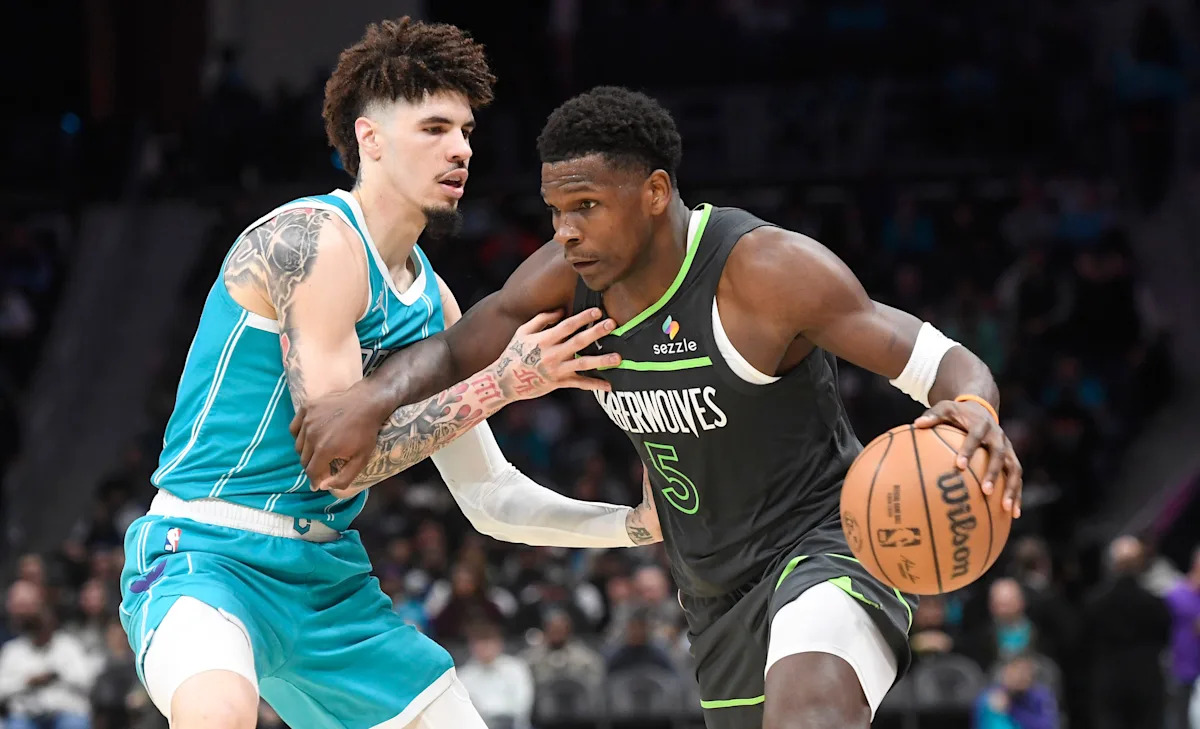
The Minnesota Timberwolves have been bold NBA contenders since drafting Anthony Edwards.
They stunned the league four years ago by trading a 2022 first-round pick (Walker Kessler) and four future first-round draft picks to acquire center Rudy Gobert. They shocked even their own locker room two years later by trading Karl-Anthony Towns to the New York Knicks in a three-team deal that brought back Julius Randle and Donte DiVincenzo. They were at it again in the days surrounding the 2026 NBA Draft, jettisoning Randle and their 2026 first-round pick in a move that helped open the door for the biggest splash of all.
Advertisement
The Timberwolves have acquired LaMelo Ball in a trade with the Charlotte Hornets, creating a backcourt tandem with Anthony Edwards that will combine Minnesota’s pre-existing MVP candidate with a freewheeling, but undeniably talented point guard capable of highlight-reel plays at any moment.
The move resets the Timberwolves’ supporting cast around Edwards after the team fell short of the Western Conference Finals for the first time in three years this past season. But it’s also perhaps the biggest risk yet for this Minnesota front office considering the franchise is in the midst of its best run of seasons ever.
Here’s a closer look at what the Timberwolves roster will look like after the LaMelo Ball trade and the 2026 NBA Draft, as well as how Ball fits with Edwards and the players still on Minnesota’s roster:




BEST NBA FREE AGENTS: LeBron James tops list ahead of ‘tampering’ period
Advertisement
LaMelo Ball trade details: What Timberwolves, Hornets got
Minnesota Timberwolves receive:
Charlotte Hornets receive:
-
Unprotected 2033 first-round pick
-
First-round pick swaps in 2028, 2029 and 2030
-
Second-round picks in 2029, 2032 and 2033
How LaMelo Ball fits with Anthony Edwards, Timberwolves
The Timberwolves have been in search of an upgrade at point guard and a better sidekick for Edwards since he elevated into one of the NBA’s best players. Ball, in theory, could fill those gaps and work interchangeably with Edwards.
Ball can be the playmaker Edwards hasn’t had to relieve defensive pressure in high-leverage halfcourt situations, . Edwards’ strengths as a passer and on-ball defender (and the presence of Gobert) will, in turn, give Ball more open 3-point shots and allow Minnesota to hide Ball on defense.
Advertisement
There are, of course, injury and maturity concerns involving Ball. He played in more than 70 games for the first time since 2021-22 season last year with the Hornets. Perhaps not coincidentally, 2021-22 and 2025-26 are the only seasons in which Charlotte finished with an above .500 record with Ball.
He’s also been fined multiple times by the NBA for his conduct, most recently for tripping Bam Adebayo in Charlotte’s play-in tournament elimination game against the Miami Heat. There’s a reason the Hornets are moving on around other players. Ball’s talent is undeniable, but so are his bad habits and mental lapses.
But Ball also had 30 points and 10 assists in Charlotte’s 127-126 play-in victory, including the game-winning layup in overtime. If Minnesota can rein in Ball’s shot selection and decision-making, he and Edwards are capable of becoming the best backcourt in the league. Maybe Ball is inclined to be more disciplined more often on an established contender.
This could also completely backfire, though, for a couple reasons. For one, the Timberwolves are sacrificing some depth to make these offseason moves work under the NBA salary cap. There’s also the pressure and ego that must be sorted through when two young players who’ve likely never shared the same backcourt with someone this good before come together for the first time.
Advertisement
What the Timberwolves roster looks like now
The trade to acquire Ball, in addition to the trade that sent Julius Randle from Minnesota to the Brooklyn Nets that preceded this move, has restructured the pecking order of the Timberwolves’ roster below Edwards.
Jaden McDaniels and Ayo Dosunmu will join Edwards, Ball and Gobert as the featured players on the team. The Timberwolves agreed to a 5-year, $112-million contract with Dosunmu following the Randle trade. The team acquired Dosunmu from the Chicago Bulls at last February’s trade deadline.
Here’s a breakdown of the Timberwolves roster after the LaMelo Ball trade
Advertisement
*pending free agent^team option for 2026-27 season*^two-way contract**2026 NBA Draft pick
LaMelo Ball contract details
Ball has three years and more than $130 million remaining on the 5-year, $203.9 max rookie extension he signed with the Hornets in 2023. He is also eligible to sign a 2-year extension with the Timberwolves worth an additional $119 million beginning next month.
LaMelo Ball stats
Ball averaged 20.1 points, 7.1 assists and 4.8 rebounds per game, while shooting 36.8% from 3-point range and 40.7% from the floor during the 2025-26 season.
This article originally appeared on USA TODAY: Timberwolves trade for LaMelo Ball: What it means for Anthony Edwards
Read the full article here


