




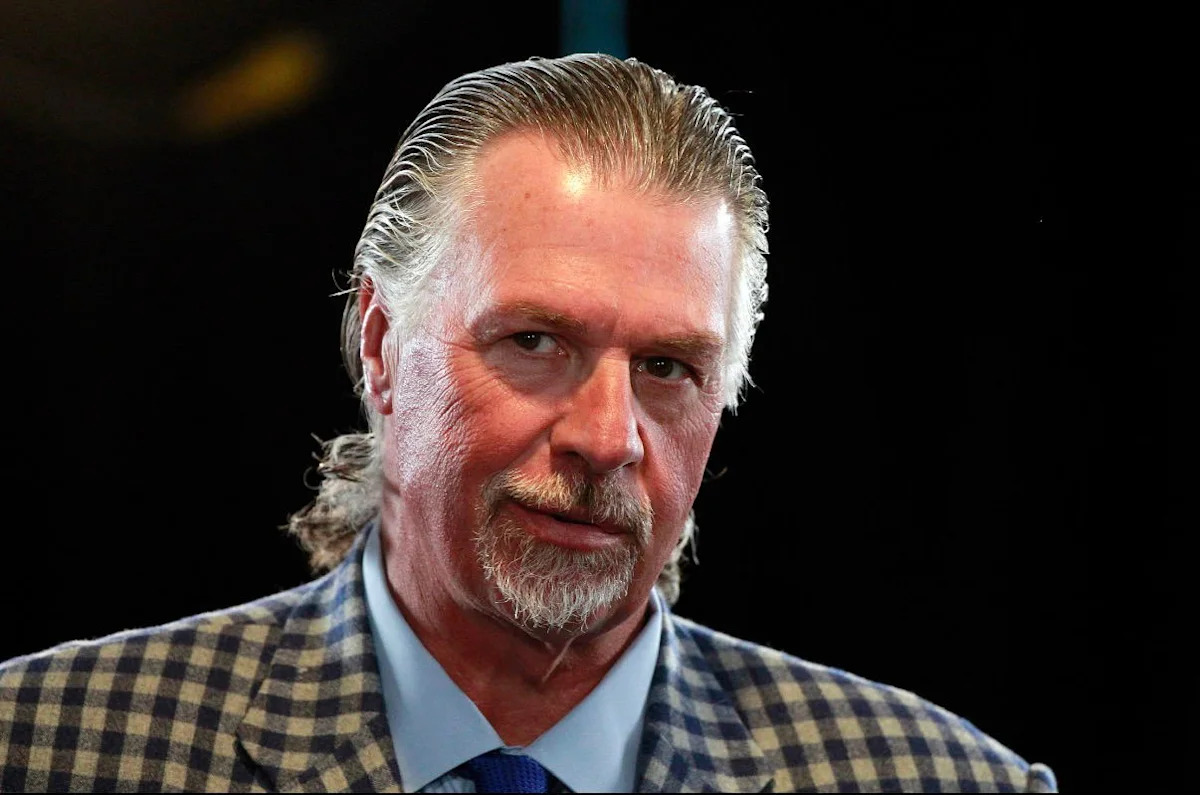
Barry Melrose never needed much introduction.
The mullet, goatee and oversized suits made him instantly recognizable, but it was Melrose’s voice—and the unmistakable personality behind it—that made him one of hockey’s most memorable figures.
Advertisement
The former NHL player, coach, and beloved analyst died on Wednesday, his wife, Cindy, informed ESPN’s Steve Levy. He was 70.
“For decades, Barry Melrose was one of the most distinctive and trusted voices in hockey,” ESPN said in a statement. “His knowledge of the game was deep, his candor was refreshing, and his passion was unmistakable.”
Melrose stepped away from broadcasting in 2023 after being diagnosed with Parkinson’s disease. At the time, Wayne Gretzky described him as being “bigger than any team,” a fitting reflection of the impact Melrose had beyond the bench or broadcast booth.
His path to becoming a television personality was anything but conventional.
Advertisement
Melrose grew up in Kelvington, Saskatchewan, and began his professional career with the Cincinnati Stingers of the World Hockey Association in 1976. He spent three seasons with the club, including one alongside a young Mark Messier, before moving to the NHL following the WHA’s collapse.
He played for Winnipeg, Toronto and Detroit, finishing his NHL career after the 1985-86 season with 10 goals and 33 points in 300 regular-season games.
Melrose subsequently turned his career to coaching.
After leading the Adirondack Red Wings to a Calder Cup championship in 1992, Melrose was hired by the Los Angeles Kings. In his first season behind the bench, he guided a Gretzky-led Los Angeles team on an unforgettable playoff run that ended in the Stanley Cup Final against Montreal.
Advertisement
The Kings ultimately fell in five games, but Melrose had established himself as one of hockey’s most colorful coaches.
Broadcasting eventually became his defining role. He joined ESPN in 1996 and became a fixture on the network’s hockey coverage, briefly leaving television in 2008-09 to coach the Tampa Bay Lightning before returning to the booth.
NHL Commissioner Gary Bettman remembered Melrose as someone who could make people love the sport simply by talking about it.
“His passion was unmistakable,” Bettman said, praising Melrose’s ability to bring humor, personality and genuine enthusiasm to the game.
That may be Melrose’s lasting legacy: He never simply analyzed hockey.
He made it entertaining for everyone.
Read the full article here


