




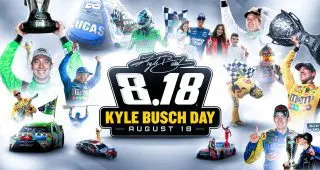
The win that helped launch Kyle Busch’s next step to stardom was the coming-out party that most expected, a welcome into the realm of NASCAR Cup Series winners and a grand-stage moment under the bright lights in Southern California. His older brother, Kurt, had already gone through all those experiences by the time Kyle reached his rookie season in 2005, but the stock-car world was still getting to know the 20-year-old prodigy as a driver and a person.
Labor Day weekend that season made quite the introductory statement.
Advertisement
Nearly 21 years ago, Kyle Busch scored the first of his 63 victories in NASCAR’s top division, driving Hendrick Motorsports’ No. 5 Chevrolet and outrunning a stellar field to win the Sony HD 500 — back in an era when high-definition televisions were relatively new and marketable, and when the 2-mile Fontana race track was still called California Speedway and not Auto Club. It was also before Busch became Rowdy, KFB or the face of the M&M’s No. 18 — one of the sport’s most recognizable car designs.
CLASSICS: Full race replay, 2005 Fontana
The path to get to that breakthrough point, however, was hardly a rosy one. Busch’s competitive nature was tested in his first full season in Cup, and one week earlier, after a sour run at Bristol Motor Speedway — a track that would become one of his favorite haunts — his relationship with crew chief Alan Gustafson had reached a deep frost. Gustafson, who now serves as crew chief for Hendrick’s No. 9 team and driver Chase Elliott, was a Cup rookie that year also, but as frustrations mounted through the summer, their communications went nearly silent.
That standoff only raised the stakes for California as a make-or-break point. Adding to the pressure, Busch had a chance to become the Cup Series’ youngest winner, eclipsing a mark then held by Donald Thomas, who posted his only big-league victory at Atlanta’s Lakewood Speedway in 1952 at the age of 20 years, 4 months, 6 days. A California triumph would give Busch the record by four days. Wait until the next week at Richmond, and the opportunity would vanish.
Advertisement
“He wanted to win everything all the time, and the fact that we hadn’t been able to seal the deal, I think, was starting to weigh on him,” Gustafson says now. “He was very, very aware of the youngest winner record, and he was conscious of that, and I was aware of it obviously through him, and that was something that became a focus for me, too, because that was one of those records that there’s very few opportunities to get.”
Those tensions needed a pressure-relief valve. A driver and crew chief heart-to-heart just days before the California race had helped alleviate the impasse, but Busch’s intensity flared as the 500-mile race transitioned from day to night, with a setting sun beyond the Turn 3 banking casting a striking glare down the backstretch.
With his vision increasingly impaired as he charged into the lead, Busch vented to spotter Jeff Dickerson — now the co-owner of Spire Motorsports — and pleaded for assistance.
“Kyle was getting really frustrated and lashed out at Jeff, and was like, ‘Jeff, you’re gonna have to really start paying attention or something, and the sun’s getting in my eyes into (Turn) Three; I can’t see,’ and he goes on this rant,” Gustafson recalls, “and Jeff super-calmly just says, “OK, cool. I’ll quit drinking now and start spotting.’ It was just like perfect, because Jeff’s that way, you know. He’s just always a little bit off-color, and the fact that he said it, I think, lightened the mood, and everybody kind of laughed.”
Advertisement
Dickerson, speaking from the Cup Series grid last weekend at Richmond Raceway, laughed anew when the story jogged his memory.
“To Alan’s point, it was just like, everybody just needed to chill and laugh for a minute, right, because everybody hated each other, we were all over running as bad as we were,” Dickerson said. “I think he was saying like I can’t see into (Turn) Three because of the sun and then it was just, ‘Oh, thanks. I guess I’ll [expletive] actually start doing my job.’ “
Everyone’s jobs mattered that night, when Kyle Busch checked the last box to fully launch his assault on NASCAR’s national-series record books.
* * *
Advertisement
Busch’s generational talent was only starting to be realized when he came under Rick Hendrick’s employ in early 2003. “To say he has a bright future would be an understatement,” Hendrick said at Busch’s signing, making an even greater understatement in historical hindsight.
Busch had blitzed the competition in what’s now called the O’Reilly Auto Parts Series as a rookie in 2004, winning five times and finishing second in the final standings to Martin Truex Jr. Reaching the Cup Series the following year with Hendrick’s No. 5 team felt like destiny, and he was paired with another first-year standout in Gustafson, who at 30 was still considered young in an era when Cup Series pit boxes were still ruled by veterans.
“Growing up fast,” was the Page 1 headline of a Daytona Beach (Fla.) News-Journal profile of the two that season, when both driver and crew chief were still learning the ins and outs of Cup Series racing and about what made each other tick.
Kyle Busch and crew chief Alan Gustafson talk it over in the garage during the 2006 season
“He had incredible pace,” Gustafson said last week. “I think the most interesting thing is he just was not super-competitive, like he was next-level competitive, right? He was just so hyper-focused on being successful, and that was it. Like, that was really all that existed in his life, so I think that’s what you pick up on right away. Then as we work together, you start to see, I think I saw this throughout his career, too, there’s that part of his personality is so overbearing that that’s what most people see and focus on, but I think as we worked together, you really started to see Kyle, the human being and who he is, that there is more to him than that.”
Advertisement
Carving a niche in the Cup Series was a tall order, and the competition included many established drivers with Hall of Fame-worthy credentials — Tony Stewart, Rusty Wallace, Mark Martin, Dale Earnhardt Jr., Matt Kenseth, Carl Edwards, Greg Biffle, Dale Jarrett and more. Even within the campus borders of Hendrick Motorsports, Busch’s teammates included household name Jeff Gordon and champion-in-the-making Jimmie Johnson.
Still, when the racing press tried to draw comparisons between Busch and Gordon, the youngster who would become Rowdy didn’t exactly shy away from it. “I believe so, and I’m hoping so,” Busch told the Daytona Beach paper. “Alan and I have that attitude that nothing can keep us out of Victory Lane; nothing other than ourselves.”
Dickerson conceded that Busch rarely showed signs of being starstruck or intimidated by the elite company on the grid, even as a highly touted but relatively unproven Cup Series prospect.
“By this point, nobody has any resume, you know what I mean?” Dickerson said. “Like Alan, that was his first Cup win as a crew chief, his first season. I mean, you have to go backwards. It’s like all of us were like lowercase of what we were. Nobody had made it yet.”
Advertisement
The pre-race focus for California was less on Busch’s aspiration than it was on the pursuit of one of the 10 spots available in that year’s Chase. The 500-miler was the next-to-last event of the regular season, and Gordon and Kenseth were on opposite sides of the bubble, fighting for their postseason lives. Busch had long since been eliminated, having shown glimmers of his potential with two runner-ups (Vegas, Dover) but sinking to 22nd in the Cup Series standings once the circuit headed back to California.
An uneven summer stretch helped seal his Chase ouster. Busch finished 33rd or worse in four of five races as July rolled into August, and the winless frustrations grew. The last event in that horrid five-race span was Bristol’s annual night race, where the team’s core relationship turned its most fractious.
Gustafson and Dickerson remembered the race so vividly, both could recall that Busch drove the “Johnny Bravo car,” a paint scheme the No. 5 Chevy sported as a tie-in with primary sponsor Kellogg’s and the Cartoon Network animated series. Gustafson recalled the car bottoming out in qualifying, a suboptimal pit stall and general gloom. Busch eventually wrecked about a third of the way in, spent time behind the wall for repairs, and finished 52 laps off the pace in 33rd.
“So, like, essentially, the last 300 laps of Bristol, they weren’t talking,” Dickerson said. “Nobody was talking. I was just like, ‘I guess we’re pitting. Pit,’ because they weren’t talking. So we were kind of at each other’s throats.”
Advertisement
Said Gustafson: “Yeah, it just came unwound. He came unwound and melted down and ended up crashing, and there was a lot of intensity around that, kind of going back to his competitiveness, his expectation to win. It didn’t happen, and he struggled really at that time to be able to handle failure and things not going his way, and it just got super ugly on the radio.”
Two days later, the two had a lengthy two-hour summit where those heightened emotions all came to a head, followed by a team meeting in which Busch and Gustafson owned up to their immaturity. “We needed to refocus,” Gustafson said then. Growing up fast had reached its next developmental step, with California next.


Kyle Busch
* * *
Advertisement
Busch started in unlucky Row 13 at California Speedway that early September afternoon, but even in 25th place, his bid for a breakthrough had some pop. “Could he get his first win tonight?” NBC announcer Bill Weber said as the starting lineup scrolled. “We’ll see.”
Feeding some of the favor was Busch collecting his first pole position at Fontana that February, setting a youth record in the process. Busch also showed strength at sister track Michigan International Speedway just weeks earlier, foiled when errant trash that clogged his car’s grille overcooked the engine.
Busch’s quest nearly met with early disaster when JJ Yeley spun from the Turn 4 exit on Lap 2 of his first interim start in Joe Gibbs Racing’s No. 11 Chevrolet. Busch instinctually dove to pit road to avoid the tangle. As for the No. 11 ride, Yeley and Hall of Famer Terry Labonte each made four starts in the car after Jason Leffler was replaced behind the wheel. Five races later, Denny Hamlin made his debut in the car that would define his career.
After that early blip, Busch marched forward, breaking into the top 10 in the 33rd of 254 laps. “Man, it’s like it just took off,” Dickerson recalled, and by Lap 82, Kyle Busch passed brother Kurt for the lead, offering a friendly wave after he had roared by.
Advertisement
Gustafson left the car’s handling untouched until the race neared the halfway point, making a key air-pressure adjustment as nightfall approached. But his most pivotal call was about to arrive, just as Busch was asserting himself as a full-fledged contender.
With 10 laps left in the 250-lap scheduled distance, a caution flag flew for debris on the backstretch, erasing Busch’s sizable lead and setting up a final round of pit stops for the majority of the field. Busch, however, carried too much speed entering his pit stall, and the No. 5 Chevy sharply veered to a halt. The car stopped too close to the pit wall, leaving no room for the jack man to operate on the left side. The planned four-tire stop quickly became a two-tire service on the fly.
“I knew we weren’t going to be able to jack it up, so it was just instinct,” Gustafson recalled. “It wasn’t like anything other than that, that we just were going to have to do two. That was going to give us our best opportunity because if we waited for four, it was going to be no chance.”
One more caution period forced overtime, but even with just two fresh tires bolted on for the final stretch, Busch outdistanced Biffle’s No. 16 Ford in a two-lap dash to the end. “Get it, get it, get it!” Gustafson exclaimed at the checkered flag, reminding Busch of his record-setting age distinction.

Kyle Busch celebrates in Victory Lane at California Speedway after his first Cup Series win in 2005
Kurt Busch was among the first of his Cup Series peers to greet him in Victory Lane, tousling his brother’s hair before he exited the car. The younger Busch, however, had a big-picture perspective amid the jubilation. He pulled Rick Hendrick into frame during his post-race interview, asking his car owner to join him in pledging their shares of the night’s winnings to the victims of Hurricane Katrina, which had made devastating landfall on the United States’ Gulf Coast earlier that week. “I saw Carl Edwards do that last night and I thought that was a first-class act,” Busch said, noting Edwards’ generosity after an O’Reilly Series win a day earlier, “and we want to do the same.”
Advertisement
The relief was evident in Busch’s face, and Gustafson said that the No. 5 team planned to use the 10-race Chase as a mock run for next year’s postseason, which they intended to make. They did, entering as the Chase’s fourth seed.
“That’s when it was super hard,” Dickerson says now. “I mean, it’s hard now, too, but you’re racing against all the heroes. That kind of just propelled us, it felt like, where even though Kyle still had to work out some kinks, it’s like the team believed now more in him, and I think he believed more in the team after that.”
The rest of Busch’s career soared from there, with accolades that stacked sky-high in all three NASCAR national series, from his time with Hendrick, his meteoric rise at JGR, and his final chapter as a veteran with Richard Childress Racing. Ten years after that breakthrough Cup Series win, he would become the circuit’s champion — a feat he repeated four years later.
Gustafson noted how he would have relished the opportunity to look back at those days with his former driver, sharing their reflections before Busch’s death from bacterial pneumonia and sepsis on May 21 robbed them of that chance. When weighing Busch’s legacy, Gustafson says the driver was more than the glowing stats, but a firebrand competitor who often cut against the grain.
Advertisement
“I think that his sheer talent and his ability, and the fact his successes (were) really unprecedented through all three series, I don’t know anybody who’s done that or will ever probably do that,” Gustafson says, “but the thing that stands out to me is he — and I saw this when he was young with me — like he was not accepted, right? I mean, he was not accepted really from the fan base, and wasn’t accepted from his competitors, and he wasn’t accepted by NASCAR, in my opinion, and that fueled this … just continued to fuel that bravado, right, or that ‘him against the world’ mentality. I don’t think he wanted to be a villain, or he wanted to be that guy, but no one gave him a choice, and he accepted that.
“He was so confident and so committed, and just was not going to take no for an answer, that he shouldered all that and was an unstoppable force. So that’s what I think made him who he is, or who he was, and that’s why I think that continued to fuel his competitiveness and fuel his desire, and generate that … KFB, right? Yeah, that’s where that persona came from.”
Sixty-two more wins followed that first California triumph, but so did the birth of a racing legend.
“I’m telling you, it’s just like it seems so stupid, but like he was gonna be that guy,” Dickerson says. “I mean, he was just gonna be that guy.”

Kyle Busch and crew chief Alan Gustafson talk it over at Pocono Raceway during the 2006 season
Read the full article here


