
Every September in golf the call seems the same, like a collective scream of “fore!” We are treated to a week – or this year’s case, two weeks – of matchplay and the audience comes away wondering why there cannot be more of this head-to-head drama in the elite professional game?
Why do we have to sit through month upon month of strokeplay – which let us face it, outside of the majors, is a veritable snoozefest for the first three days and sometimes the fourth as well – when the older format is so much more viewer friendly from the off?
Advertisement
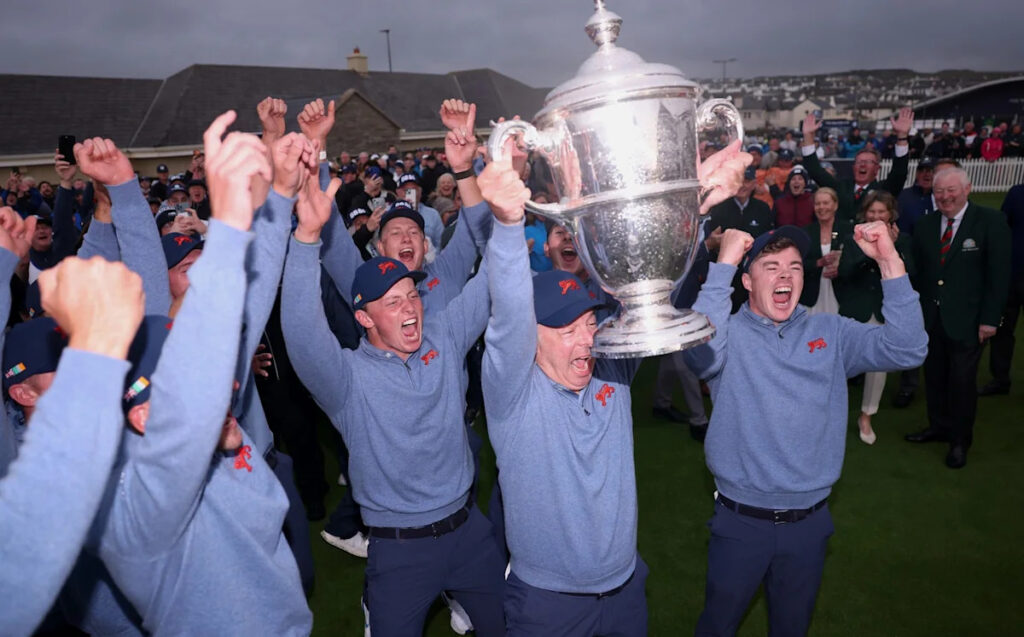
This applies doubly so in the team matchplay events. Last weekend, we witnessed a classic of the genre at the Walker Cup when Great Britain and Ireland came from behind to beat the United States with the final putt of the final match on the final day. The Legend of Lahinch was written.
The Walker Cup finished in dramatic fashion, as Great Britain and Ireland triumphed at the death – Getty Images/Oisin Keniry
This weekend we have the Solheim Cup, the women’s equivalent of the Ryder Cup, which almost always produces tension from Friday through to Sunday.
These two teams are closely matched. In the last four encounters the biggest win was the last one. On home soil, the US only prevailed by three points, which as anyone who has ever sat on the edge of a sofa and tortuously gone through the permutations will know, is but a few matches flipping in the concluding singles.
Advertisement
It can often be an exhausting experience – especially if one’s maths is shoddy – but it can also be one of the most exhilarating in all of sport.
Why the tours are so afraid of matchplay
So why, when there is a delicious option cast in history, at their disposal, is there this fixation with strokeplay on the tours? The answer – when it comes to professional golf this is invariably the answer – is the filthy lucre. In short, the sponsors and TV execs cannot bear the thought of having leading players being knocked out in the first round.
The memory goes back to 2006 when, at considerable expense, HSBC lured Tiger Woods to Wentworth to play in the HSBC World Match Play. It was a beloved event that is alas no more, despite boasting champions such as Jack Nicklaus, Arnold Palmer, Gary Player, Seve Ballesteros, Sir Nick Faldo, Ernie Els and many other household names.
Advertisement
Walking past the hospitality suites on the opening day after Woods had been dispatched by Shaun Micheel was a sight to behold. Blazers flapping, heads in hands. Micheel had won on the 15th green, so the bigwigs and, more importantly, their clients never even got to see Woods walking up the 18th. Micheel made it to the final and the TV figures were a fraction of what they could have been.

Tiger Woods’ matchplay loss to Shaun Micheel in 2006 was not what the higher-ups on the European Tour wanted to see – Richard Heathcote/Getty Images
And therein lies the inherent problem with the mano-a-mano format, although in a sporting sense it should be no problem whatsoever. Matchplay’s strengths, which enable it to create excruciating and rich theatre, are also its weaknesses, when it comes to satisfying the accountants anyway. Matchplay is volatile and unpredictable and respects reputations like Woods respects the Highway Code.
The margins of excellence in the pro game are thinner than a hacker’s three-iron and in that top echelon – which perhaps stretches all the way into the world’s top 500 – anyone can beat anyone on any given day.
Advertisement
Yes, that happens in strokeplay as well, but in matchplay it is almost routine. If you analyse it there are no real “shocks” in individual 18-hole matchplay at that level and to the money men, uncertainty is not a quality.
It is why there are no matchplay tournaments on either the PGA Tour or the DP World Tour this year. There was going to be an event on LIV Golf – remember them? – last month which was to contain a few rounds of hombre-against-hombre, but it was eventually cancelled for reasons that constitute a completely different story.
Otherwise, primetime golf is a head-to-head desert, outside September. The heavyweights simply do not compete in the format, which has always been and always will be the format most employed in casual golf. That is mind blowing and perfectly illustrates the wildly unhealthy obsession that the tours, their backers and yes, the golfers themselves, have with the dollar. To hell with the punters.
A mix of emotion, talent and nous
The sport suffers because strokeplay is producing one sort of professional golfer, who pitches all their focus into being consistent and trains their mind to resist setting off anything that resembles a firework that could land them in quadruple-bogey trouble (it would cost them one hole in matchplay).
Advertisement
Strokeplay across 72 holes is undoubtedly the only method to decide major winners because that is the best way to identify the best. No argument there. But in the non-major weeks, why can it not be mixed up? The matchplay specialists would emerge, the characters would develop and they would be so much more marketable for it.

Ernie Els won the European Tour’s World Matchplay event seven times – Getty Images/Glyn Kirk
Ian Poulter, a copper-bottomed Ryder Cup legend, whatever the LIV haters might claim, was always a courageous and nerveless exponent, as he showed by winning both the World Match Play and the WGC Matchplay (best not to go down the rabbit hole of why the space in one title and not the other).
The Englishman has enjoyed a remarkable career regardless, but had there been more of his favoured format the fans would have seen yet more of his doggedness. And relished it. The same applies to Paul McGinley who, as one scribe wrote, “possesses a doctorate in matchplay”. McGinley was a brilliant Ryder Cup captain, was a consultant at the Walker Cup and is at home when the opponents are Team USA. But he also was in his element when it was just one v one.
Advertisement
“I felt if the world of professional golf was 99 per cent matchplay golf rather than strokeplay, I feel I would’ve had a better career,” he once told Telegraph Sport. “I was good head-to-head, I understand moments, I love the cut and thrust of looking your opponent in the eye, playing with him. In a lot of ways I enjoy playing against an opponent rather than the golf course.
“I found it hard to concentrate for 72 holes and my matchplay record was very good, not just in the Ryder Cup. Even the World Matchplay. I got beaten in the final one year [2005] – the one time I got to it, by Michael Campbell, probably the biggest regret of my career. It’s terrible that there’s not more matchplay. The crowds love it.”

Paul McGinley relished matchplay, especially in the Ryder Cup, whether as player or captain – Getty Image/Mike Ehrmann
More than anyone, McGinley knows that matchplay is that irresistible mix of talent, emotion and nous. Strange things happen but to the initiated they are not odd at all – they are just matchplay. There were instances last week when a player made a five-footer and then, with the glare raging, his opponent missed a three-footer.
Advertisement
Similar will happen in the Solheim Cup, because it is a wondrous part of the format – whether it is a team environment or not. The niggle is amplified when an 18-incher is not given. Grudges have lasted lifetimes when a golfer calls out his or her rival for playing out of turn. Everything is raised a notch, including the entertainment. The automatons suddenly turn into humans.
Give the people what they want
Naturally, this is more noticeable when it is team v team and patriotism is thrown in. The advantage with the Solheim and Ryder Cups is that the leading players are guaranteed to be there for three days. Granted, there have still been blowouts on the Sunday, yet the tills have kept ringing, because of previous humdingers.

The United States will aim to defend the Solheim Cup in the Netherlands this week – Getty Images/David Cannon
That is why the tours should give matchplay another chance. Credit to the PGA Tour for doing just that – and not in any run-of-the-mill week, but in its most lucrative stop of all. The Tour Championship, despite its $10m (£7.4m) first prize, has always been more bore than awe.
Advertisement
It has tried all sorts of strokeplay, even, until recently, the leader of the money list starting on 10 under. Nonsensical. But it asked the fans what they would fancy and they came back in droves with the M-word. They are the M people. So from 2028, the PGA Tour will conclude its campaign with a fortnight of matchplay, based on the football World Cup, and suspense and histrionics are bound to ensue.
We should pray it is a success and that matchplay is indeed making its comeback. For a while there, it seemed to be four down with five to play. Yet, as ever, it is likely to claw it back and deliver when it matters.
Try full access to The Telegraph free today. Unlock their award-winning website and essential news app, plus useful tools and expert guides for your money, health and holidays.
Read the full article here