




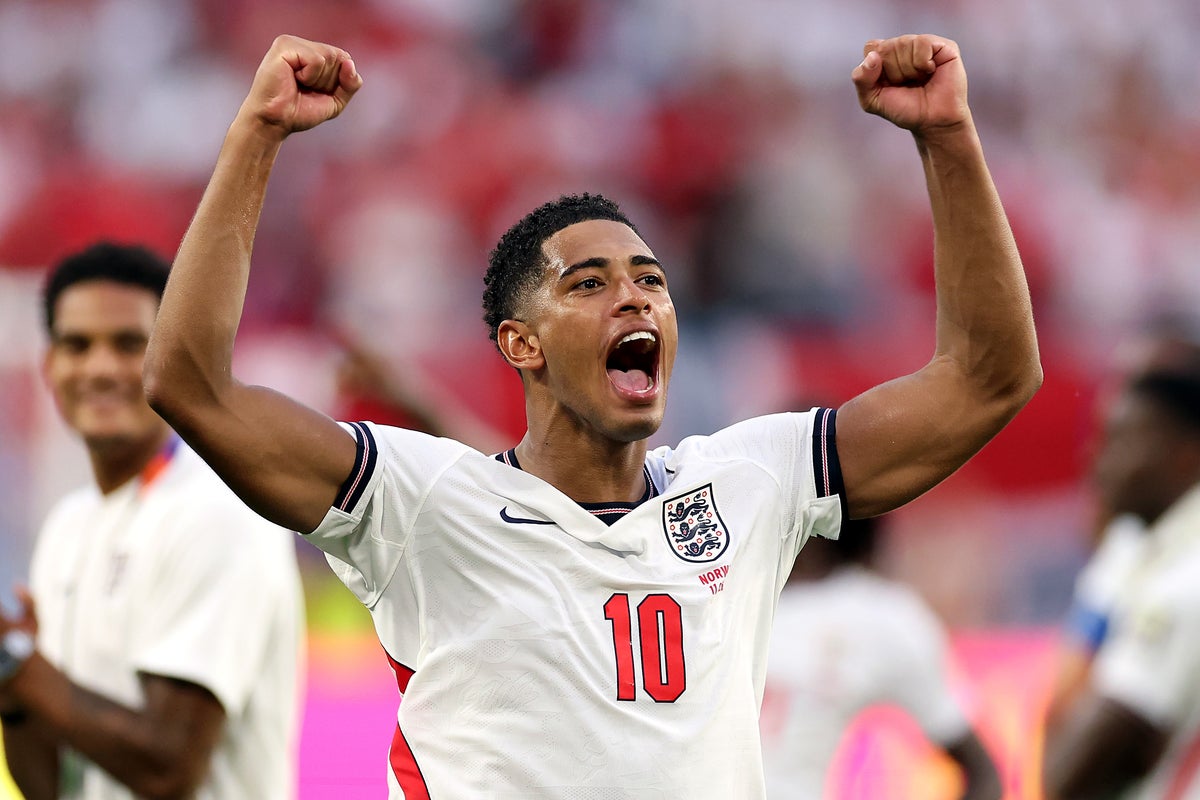
Jude-fever. Bellingham-mania. No one has come up with a catchy name for it yet, but it’s happening. A London train stop called Bellingham station has been renamed “Jude Bellingham”. West Midlands Railway is offering free train rides for anyone named Jude. “Hey Jude” is on the playlist after every England win with “Three Lions” and “Wonderwall”, the only player with his own ballad.
Only a couple of weeks ago, this World Cup felt like it would be Harry Kane’s tournament. It could yet be Kane’s pinnacle at the end of an extraordinary season of 72 goals and counting, a tally bettered only once, by Lionel Messi. If Messi is one of football’s deities, then Kane is the greatest mortal ever to do it. Win the World Cup on Sunday, and he will surely end the year on stage in Paris, wearing a shiny suit and holding a golden orb.
Advertisement
But increasingly, this tournament looks like the World Cup of Jude Bellingham. It was his goal against Croatia that sparked England’s best 45 minutes so far, his goal against Panama that broke the deadlock, his rapid double that briefly silenced the Azteca, a feat in itself. Bellingham’s first goal in the quarter-final against Norway was a moment of elite technical skill amid a shower of incompetence, his second a display of heightened instincts that earned England a victory they scarcely deserved.
A Thameslink station called Bellingham has been given a new forename (Reuters)

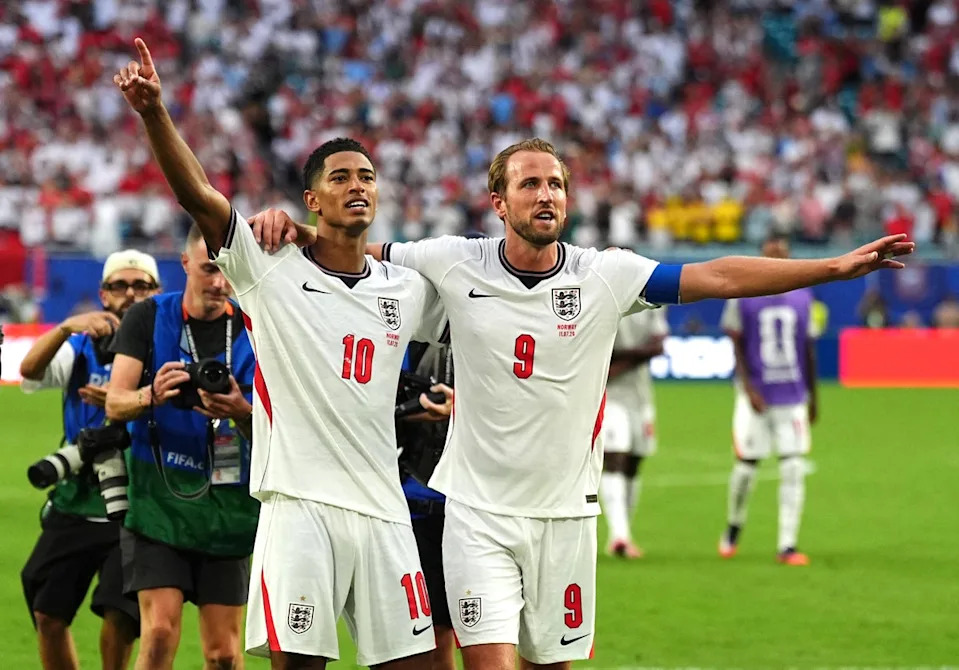
Jude Bellingham and Harry Kane salute the fans after reaching the semi-finals (Martin Rickett/PA)
And perhaps this tournament means even more to Bellingham, a player who has been publicly questioned and privately doubted by his own manager, who has been subjected to outside scrutiny unlike his teammates. “Don’t bring Jude,” ran a headline in the Daily Mail earlier this season, suggesting England would be better off without the “divisive soloist” at the World Cup.
Advertisement
“It’s good to put some of the noise aside, and just show my country and my teammates how committed I am to helping us win football matches,” Bellingham said after scoring in the 4-2 win over Croatia in Dallas.
It seems bizarre now, but one of the decisions Thomas Tuchel stewed over before that opening match – and throughout his 18-month reign – was whether Bellingham or Morgan Rogers should be his No 10 at the World Cup. Bellingham missed last September’s qualifiers after undergoing shoulder surgery, and it was unfortunately timed. England played their best game under Tuchel, winning 5-0 in Serbia, and Rogers was excellent.
Tuchel omitted Bellingham from the following camp despite his return to fitness at Real Madrid. There was also the infamous line about Bellingham’s “repulsive” on-field behaviour, which Tuchel attributed to his mother and a slip of the tongue in his second language, and for which he later apologised.
Tuchel felt England created a “brotherhood” during those September and October camps. Could a powerful personality like Bellingham slip seamlessly into the fold?
Advertisement
Even when Bellingham made the World Cup squad, there was no guarantee he would start against Croatia. Tuchel was asked before kick-off: why Bellingham over Rogers? “It was really close,” the manager said. Was he picked because of his big-game appetite, that knack for scoring when it matters? “No,” said Tuchel. “A 50-50 call,” he called it, as if Bellingham had just beaten Rogers in a game of rock-paper-scissors in the dressing room.

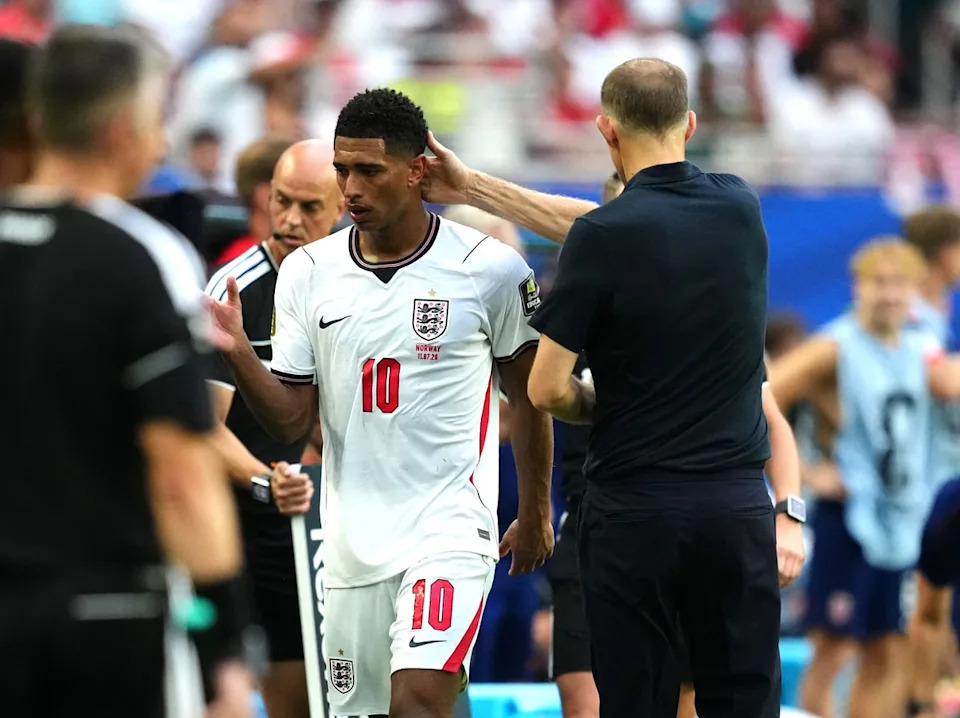
Bellingham is greeted by Tuchel after being substituted against Norway (Martin Rickett/PA)
There were a raft of other No 10s Tuchel could have chosen. Eberechi Eze has played only cameos. Phil Foden and Cole Palmer are watching on TV. But then, really, what is the point of Bellingham’s unique set of powers if you don’t use them? England have a player who Real Madrid bought for €103m aged 19, who won the Champions League at 20, who is at his fourth major tournament aged 22. Steven Gerrard played his fourth at 30. Frank Lampard was 36.
And over the past few weeks, Bellingham has shown why he is not just another piece of England’s puzzle: he’s the piece, the keystone in the entire edifice of this World Cup campaign.
Advertisement
There are the goals, obviously, the assists, the way he bends rigid games to his will. But with Bellingham, it’s also the other bits, the intangibles, like his sheer presence in an England team and what that brings. Already at his age, Bellingham carries an aura that transmits confidence to his teammates, one that makes opponents feel a little smaller as they line up in the tunnel.
Perhaps part of that is the compelling aesthetics, the upright posture, the square shoulders, standing 6ft plenty. The cheekbones, the smile, the twinkle in his eyes. We are not supposed to objectify athletes in this job, but come on now. The Norwegian defence just went weak at the knees and now England are 2-1 up in a quarter-final.


Hey, Jude (Getty)
Then there are the tackles, three in the second half against Croatia alone. They are not just toes on the ball but full slides through his opponent, comprehensive clean-outs taking the man with him as he goes. It is the type of tackle that lifts England fans off their feet, that elicits those low-octave hums of “Juuuuuude”, a tackle that gets his teammates facing forwards, that changes the direction of the wind.
Advertisement
If you delve into Fifa’s enormous suite of World Cup stats, you’ll find Bellingham on top for two categories. The first is sprints – no one left in the competition has made more than his 328, or 55 per game. That’s a sprint every 110 seconds, across six games, one of which was played not far off the altitude of Mount Olympus, another played in heat and humidity that even Amazon tribesmen would describe as stifling.
The second is what Fifa catchily calls “offers to receive in between”, which are those moments when Bellingham stands in a difficult place, where opponents lurk, where defenders are near, and demands to have the ball. If his sprints show endeavour under strain and stress, the latter shows courage and sheer belief in his own ability to take possession under pressure, time and again.
But perhaps just as telling is that on a whole raft of other measures, Bellingham ranks near the top. Distance covered, pressures, turnovers, goals, off-the-ball runs, chances created, headed shots attempted. His work is best displayed in the box, but Bellingham is a complete midfielder impacting every aspect of each game, England’s omnipresent force. It is not that he’s a “soloist”. It’s just that sometimes it takes a virtuoso to elevate the piece.


It is why the comparisons with Steven Gerrard are justified, another player who could thrive in any position on the pitch. Yet Gerrard never produced this level for England, at least not consistently throughout a World Cup. Neither did Lampard, or Wayne Rooney, or David Beckham, or Michael Owen. Bellingham’s individual performance has surpassed Paul Gascoigne at Italia ‘90 and Gary Lineker at Mexico ‘86. It is perhaps the best by an England player at a World Cup since 1966.
Advertisement
There are glimpses of his potentially combustible personality in those moments when he admonishes the referee or bellows at teammates for not reading his mind. His mum repeatedly reminded him not to get a yellow card in the days before Norway in order to avoid a suspension.
The snipes at Tuchel in post-match interviews perhaps revealed Bellingham’s frustrations at his battle for his place, using his position of undoubted power to get certain things off his chest. But that edge has been channelled into performances full of commitment and purpose, delivered with an energy that has set England’s tone. Tuchel might even take some credit for that, provoking a little motivation and inspiration.


Bellingham celebrates in front of England’s fans (Getty)
Perhaps a career path outside the Premier League’s gaze has stymied Bellingham’s appreciation in England. Perhaps it doesn’t help that he is so hard to define, a No 10 who isn’t really a typical No 10 at all. His youth coach at Birmingham City famously marvelled at how he could play three midfield roles at once – numbers 4, 8, and 10 – so added them together and assigned him No 22.
Advertisement
But his talent cannot be ignored this summer. Belli-monium is in full swing. Some time after the end of the Norway game, thousands of English fans belted out “Hey Jude” with feeling as he stood on the grass below, alone, drenched in sweat, allowing the adulation to wash over him. What an extraordinary experience that must be. And for the first time at this World Cup, Bellingham looked like didn’t know what to do with himself.
Read the full article here


