





Golf Digest senior writer Alex Myers is on a one-year mission to see how good he can get at golf through daily training, practice and playing. Read more from his “Late Scratch?” series here.
As I struggled around the beautiful, but difficult CC of Darien during my second official tournament round of the year, I couldn’t help but think of something Scottie Scheffler had said the day before following the final round of the U.S. Open.
Advertisement
“Being in the arena is not for everybody.”
The World No. 1 was talking more about the crowds at Shinnecock that had largely turned on his Sunday playing partner, Wyndham Clark, but his words hit home with each poor shot I hit without a gallery watching. When my qualifier round for the Met Amateur Championship was over, I turned to my caddie and coach, Quaker Ridge head pro Mario Guerra, and said, “I’m just not a tournament golfer.”
“Not yet,” Mario said encouragingly. “Not yet.”
Mario had plenty of thoughts about my performance, but there were a few things he emphasized throughout that he’s certain can help me the next time I decide to go back in that arena. Hopefully, they can help you as well.
Advertisement
Don’t overdo the warm-up
As I hit balls on the range ahead of the round, I was a bundle of emotions. After my first tournament round of the year the previous month, I thought I would feel more comfortable when I got to the course, but that wasn’t the case. Maybe it was the unfamiliar surroundings. Maybe it was seeing hordes of really good players. Regardless, my heart was definitely pounding. It’s crazy how different tournament rounds feel.
/content/dam/images/golfdigest/unsized/2026/1/260625-ls-practice.jpg
My urge was to hit as many golf shots as possible, and with Mario watching, to analyze each one. My urge was wrong.
“The goal of the warm-up is to warm up,” Mario, one of Golf Digest’s best in state teachers told me. “It’s time to play golf. It’s not time to play golf swing.”
Advertisement
Remec Carlson, AKA the “CEO of Golf,” had told me something similar when we played together at the Golf Digest Open earlier in the year, but I needed to hear it again. Instead of pounding drivers over and over again, Mario had me constantly switch between clubs and change up my targets. This got me loose while better simulating playing mode. It also didn’t burn me out. Which leads to his next point . . .
“Be dead out there.”
Mario could sense my nervous energy bubbling over, resulting in me acting as both a play-by-play announcer as well as an analyst as soon as I made contact with each shot. After a few minutes of that, he told me that I needed to “be dead out there.” And that we were going to use the rest of our practice time to work on short game and putting and to try to get my heart rate down as much as possible by the time I was called to the first tee.
Mario prompted me to take deep breaths in through the nose, and it reminded me of the breathing exercises I had done with Dr. Josh Brant at the Golf Performance Center a few years back. I had settled on breathing in through the nose for a three count and then breathing out through my mouth for another three count, and I had rehearsed that so much that spring that I played my best pressure golf ever on that year’s buddies golf trip. But I had largely abandoned the practice since then. Why? Good question!
Advertisement
RELATED: How different is tournament golf? Here are 7 mistakes I made
Anyway, I tried to steady myself with better breathing, but there were other things Mario picked up on that I had no clue were possibly detrimental to my play. Using some body language to beg for a putt to drop on the fourth hole. Talking to my golf ball in the air. Talking to myself in between shots.
Obviously, I know that harping on the negative and saying things like, “I suck” isn’t advised. But—intentionally or not—some of the things I did generated positive vibes. It didn’t matter. While Mario had wanted me to conserve my physical energy on the range, he said I needed to conserve my mental energy on the course. We did fist bump a few times when things went well, but overall, he wanted me to stay calm. The overall thought is that if you deplete your mental energy, then you’re more likely to make bad decisions.
The topic of golfers spending energy in reaction to nerves is one Sam Weinman has explored, and it’s something I’ve talked about with mental coach Josh Nichols as well. He advises that you start practicing the process of trying to slow down in the rounds leading up to a tournament because you can’t just flip a switch and start doing things differently in competition. Just like a particular shot you’re working on at the range, the more reps you do of it, the more likely you’ll be able to do it under pressure as well.
Advertisement
Be ready to make mid-round adjustments
Tournament golf has a special way of exposing your weaknesses. And on this day I was reminded of my nasty block-slice with the driver that shows up under pressure. I tend to spin my shoulders up too much and too early from the top and that move is compounded by me dragging the club through impact instead of releasing.
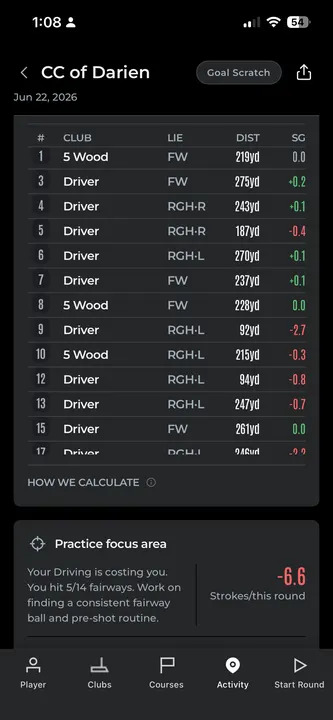
I did the second part on a bunch of approach shots as well, but it was the worst with my driver as my stats showed I lost 6.6 shots off the tee to a scratch golfer despite being positive on the stat through eight holes (The latest Arccos update is fantastic, by the way):

/content/dam/images/golfdigest/unsized/2026/1/260625-ls-stats.jpg
Once I got in a rut with the big-right miss (a few so bad I wouldn’t be able to replicate them on a driving range if given 100 tries), it was difficult to get out. But the good thing is that you can learn from this and that you can get out of it, if you’re willing to actively adjust and not just assume you’ll get your range swing back. As Mike Tyson famously said, “Everyone has a plan until they get punched in the mouth,” and tournament golf will punch you over and over again. But by focusing on keeping my back to the target longer at the start of the downswing, eventually, I turned a few drives over on the final few holes like this one:
Advertisement
Your browser does not support the video tag.
It was too little, too late, but now I know what to expect the next time nerves creep in. And I better know how to adjust.
Keep your focus on the task at hand
Taking one shot at a time is a well-known golf mantra and I equated this to how the New York Knicks maintained a “Zero-zero” mentality throughout their recent NBA title run no matter what the score in their series was. But doing that becomes increasingly difficult on both a given hole—particularly after you hit a tee shot onto the range you didn’t realize was OB . . . sigh—and on a back nine when you know you’re headed towards a terrible score.
Advertisement
There are other ways, though, to stay in the moment. As I waited to attempt a four-foot putt, Mario caught me rehearsing a full swing and said, “We’re putting now.” After hitting a good recovery shot on another hole, I continued to talk about how poor the tee shot was when Mario advised, “Treat this as if this was where you hit your drive and let’s hit a solid approach.” And after a decent drive on the par-5 18th, he challenged me to “finish with a couple good shots.”
RELATED: Why is pace so important for putting? Two words: ‘Capture size’
I actually responded to that last one by laying up and then hitting a 9-iron to two feet for a birdie putt that even I couldn’t miss. After adding it all up, it was a (gulp) 87, albeit from the tips at nearly 7,000 yards. But it probably would have been a 97 without Mario on the bag. “You need more tournament reps,” Mario told me after. “And you need to work on your mental game.”
This was encouraging to hear because Mario has seen me hit a lot of good shots—just not as many under pressure—and he thinks I have the swing to become a scratch player. Still, this was the most difficult article I’ve written since I started this “Late Scratch?” series. I felt deflated. I felt embarrassed. And I felt like I let down Mario and others helping me.
Advertisement
“You’re not a professional golfer,” Mario reminded me. “You’re a golf writer. It doesn’t matter what you shoot.”
It was hard not to get caught up in the result, but he was right. And despite the struggles, I did see some improvements from my first tournament round. It had also been a pretty fun workday with Mario, who was so gracious with his time and positive spirit. Plus, I enjoyed my two playing partners, Bob, who holed out for eagle on 18, and Michael, who remembered me from nearly two decades before when I covered him as a high school golfer for the local newspaper before he went on to play college golf. It was a good reminder that although he’s much younger than me, he’s a grizzled veteran of tournament golf.
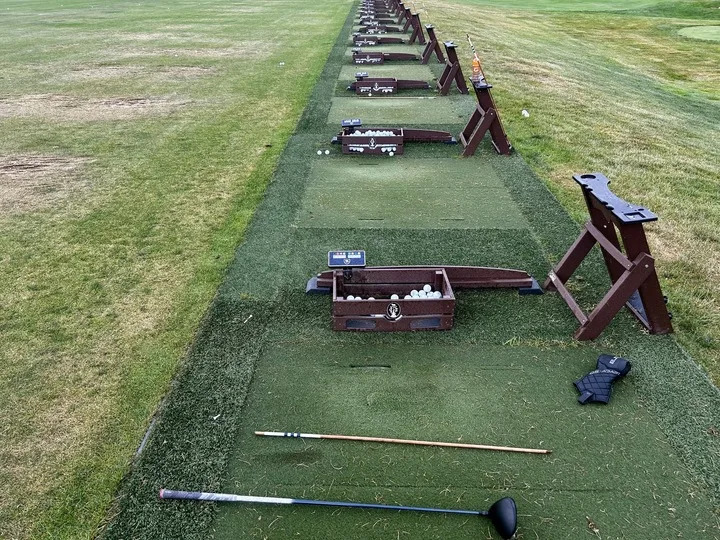
I’m not sure I’ll ever be able to say that about myself, but that’s OK. As I’ve written, the goal of entering these events is to make my normal rounds—and even my rounds playing for our group’s green jacket—feel easier. Being in the arena might not be for me, but that doesn’t mean it can’t help me. After the round, I headed back to a much quieter range and hit balls until the heavy rains came that stopped play.

/content/dam/images/golfdigest/unsized/2026/1/260625-ls-range.jpg
“Keep working hard and getting better,” Mario texted me after. “That’s the only option.”
That’s been my plan throughout the entire year. And this speed bump won’t change it.
RELATED: The mental exercise you should go through after every round
Read the full article here


