






While most of the attention in camp has focused on players battling for the final spots on the major league roster, several prospects have quietly stood out in small samples. Spring Training results are noisy, but traits like strike throwing, approach, and batted-ball profile can still signal meaningful development – especially when viewed in the context of a player’s track record.
RHP Alex Cook
Cook was added to the Rays 40-man roster in December to protect him from the Rule 5 Draft. Given his blend of plus strike throwing and above average stuff, it’s easy to see why the Rays wanted to allocate a valuable roster spot to him.
Advertisement
Cook has posted plus strike rates at every professional stop, but he’s taken it to another level this spring with a 71.1% strike rate (ML average sits around 63%). While it’s unrealistic to expect Cook to continue throwing strikes at over 70%, it’s another data point that suggests Cook is ready to face more difficult competition in AAA.
In addition to his solid control and command, Cook has above average stuff. His fastball is a clear plus pitch. It’s a cut-ride shape with solid velocity that plays up due to his low release height. His breaking ball is a two-plane slider in the mid 80s, and he’s got an average cutter in the upper 80s to keep hitters from sitting on either of his other two pitches. Cook can throw all three weapons to both sides of the plate.
He looks ready for a high-leverage role in Durham to begin the 2026 season, and I expect him to have an opportunity to pitch in the majors at some point despite all the quality depth ahead of him in the ML bullpen. Given his platoon-neutral arsenal and strike throwing ability, Cook could even be a candidate to stretch out as a starter later in his career – something the Rays have not been shy about experimenting with.
SS Gregory Barrios
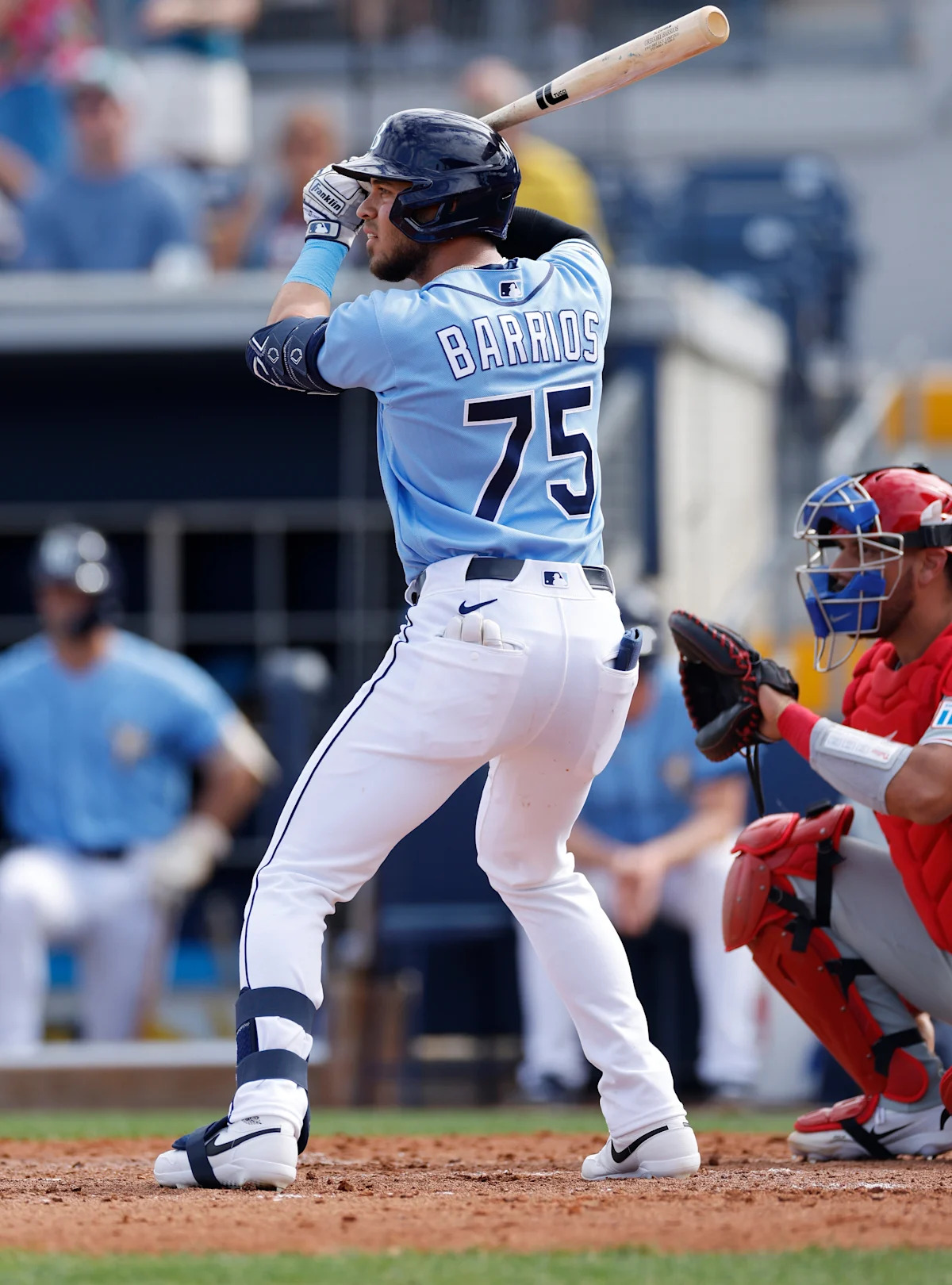
On the position player side, Barrios has put together a nice camp so far, taking advantage of playing time opportunities with Taylor Walls having a slow start this spring.
Advertisement
Barrios has always been a guy with plus speed, contact ability, and defense at SS. He’s got pretty average plate discipline too. So, what’s the catch? Why is Barrios not considered a top prospect? He has nearly bottom of the scale power. His 90th percentile exit velocity (the industry’s preferred proxy for raw power) sits at just 101.1 mph this spring, well below the typical MLB average of roughly 105 mph.
Rather than chasing power, Barrios appears to be leaning fully into a contact-and-speed offensive identity. Below are his LD+GB rates for each of his domestic professional seasons, and what he has done so far this year in Spring Training:
-
2026 Spring Training: 87.5%
It’s still early, so the exact numbers aren’t stable, but the trend is what matters. His glove and speed will give Barrios plenty of opportunity to stick in a lineup, and leaning into his offensive identity is what can help make him productive.
I expect him to return to Montgomery to begin the season, likely getting work at both middle infield spots with Adrian Santana. Barrios should have an opportunity to advance to AAA later in the year – an impressive trajectory for a 22-year-old whose value comes from defense, contact, and speed rather than power.
Advertisement
C Dom Keegan
Keegan’s 45.6% framing strike rate places him in the 71st percentile among catchers with 50 framing opportunities so far this spring. Keegan is regarded as an above average receiver, but he’s still working on the other defensive parts of his game.
Solid framing combined with his average hit and plus power combo should earn him a cup of coffee at some point this season if his blocking and throwing continue to improve, or at least not be a detriment to his overall profile.
C Caden Bodine
A recent draftee acquired in the Baz trade, Bodine really hasn’t played much this spring, but he did hit a ball at 106.1mph, just below his collegiate max exit velocity of 106.6mph — which he did with a metal bat. There may not be plus power given his size and physicality, but a new professional max exit velocity is still noteworthy even if it is just spring training.
Advertisement
Bodine’s plus defensive skills and solid hit tool give him a chance to be an everyday ML catcher, and getting to even just average power could make him the franchise catcher the Rays have been searching for.
RHP Luis Guerrero*
*While he technically exceeded his prospect eligibility with the Red Sox last season with 17.1 IP, it’s hard to ignore what Guerrero is doing as someone who has yet to establish himself in the majors, so he’s getting a shout out here as well.
After going unclaimed through waivers in November, the Rays cleared a 40-man roster spot by trading INF Tristan Gray to Boston for the non-rostered Guerrero. Given his lack of a need to be on the 40-man, he will likely begin the year in AAA with a chance to impact the ML bullpen later this season.
Advertisement
Now under the Rays tutelage, LG is showing a harder, more cutter-ish breaking ball shape than last season. The new shape creates a more optimal tunnel with his fastball, which also might have a slightly different profile — with a little less run and a little more ride than what it had in 2025 thus far.
The change in both pitch shapes appear to be a result of Guerrero raising his arm slot just a bit. His ability to throw strikes will dictate whether he can crack the 40-man roster at some point this season, and so far it’s been roughly average this spring, which is good enough when you’ve got plus stuff like Guerrero does.
Spring Training numbers rarely tell the whole story, but developments like these often hint at what might be coming next in the Rays’ player development pipeline.
Read the full article here


