





Alan Kulwicki wasn’t always the easiest guy to get along with in NASCAR.
Kulwicki could be stubborn and difficult to work for, leading several employees/team members to have short tenures – some worked only a few weeks before they left (either voluntarily or were outright fired) with AK Racing.
Advertisement
Known as a perfectionist who didn’t tolerate mistakes, Kulwicki may have been a difficult man to work for. But when you’re the driver, car and team owner, employer and chief salesman, not to mention having an extreme competitive nature, it’s understandable if you wanted things done your way – particularly with the way he spent several seasons as a proverbial underdog.
But there was more that contributed to Kulwicki’s demeanor. When he first came to NASCAR in the mid-1980s, he was an outlier on many levels. First, he was a dreaded “Yankee” from “up north” – suburban Milwaukee, Wisconsin – while most other NASCAR drivers were good old boys primarily from the Southeastern U.S.
Kulwicki once said if he had a dollar for every time he was disparagingly called a “Yankee” by fellow competitors or NASCAR fans in his early days in Winston Cup, he could have actually bought Major League Baseball’s real-life Yankees of New York.
Second, the lifelong bachelor who had several nicknames, including “Special K”, was at the time the only Cup driver to have a college degree, earning a Bachelor’s Degree in Mechanical Engineering from the University of Wisconsin-Milwaukee.
Advertisement
Third, because he was the boss who had to keep track of every part, piece, and penny, he was extremely serious in and around the racetrack. Not only was his name on the car, but it was also on the outside and inside of the team’s shop in suburban Charlotte. After all, the buck stopped with him.
Nobody outworked Kulwicki, who typically survived on only 3-4 hours of sleep per night. Not only was he the only driver to walk around the garage with a briefcase full of notes, setups and ideas, wherever he was at, be it on his bedside nightstand or in the pocket of his firesuit while driving around the track, he almost always kept a pad of paper and pen nearby, ready to write ideas or thoughts that would come to mind that he hoped would help him and his car go faster and be better and more successful.
But to hear some of his closest friends tell the story, there was also another side to Kulwicki, one that kind of got lost in his larger reputation as being tough to work or deal with. He could, surprisingly, be the life of the party at times, and had a wry sense of humor when he allowed himself to let his always well-coifed hair down, with not one strand out of place.
That’s why when Kulwicki was honored in December 1992 after winning the Winston Cup championship, the theme song that was played as he was introduced and honored with the championship trophy during the NASCAR awards ceremony at New York City’s famed Waldorf Astoria Hotel, and the credo he lived his life by, was Frank Sinatra’s “My Way.”
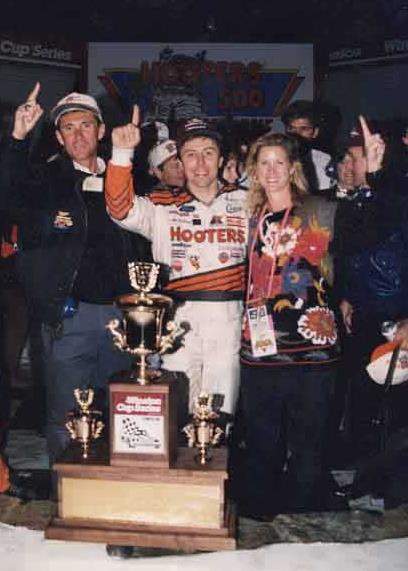
Alan Kulwicki (right) celebrates his 1992 NASCAR Winston Cup championship with Tom and Joni Roberts. Photo courtesy Tom Roberts.
Shortly before 9 pm on Wednesday, April 1, 1993, a small plane took off from Knoxville, Tennessee, en route to Tri-Cities Regional Airport in Blountville, Tennessee, just a few miles from Bristol Motor Speedway, site of that weekend’s Cup race.
Advertisement
Sadly, the flight with Kulwicki, two executives from his primary sponsor, the Hooters restaurant chain, and the pilot never reached its destination, crashing into a hilly area, tragically killing all four men on board.
The well-respected Tom Roberts, who spent more than four decades around motorsports in various high-level roles in public relations, marketing and administration, working with several superstar drivers including Rusty Wallace, Bobby Allison, Kurt Busch and several years as Kulwicki’s PR person, decided to skip the flight so he could get to Bristol sooner, as Kulwicki had a sponsorship appearance that Thursday night at a Hooters in Knoxville.
It was a decision that would save Roberts’ life.
A day rarely goes by that the now-retired Alabama resident doesn’t think about his friend, the so-called “Polish Prince,” and the times they had together.
Advertisement
But those memories that come flooding back are always the hardest around April 1. Wednesday marks 33 years since Kulwicki and the others perished in a crash that investigators determined was due to both pilot error and icing that had accumulated on the wings of the plane, even though the flight was a short 90-mile hop, skip, and jump that would have lasted maybe 45 minutes in the air, tops.
After 20 years in racing, Kulwicki was barely able to enjoy the fruits of his labor and his reign as Winston Cup champ, living only 136 days (just 4 ½ months) after taking the championship-winning checkered flag at Atlanta Motor Speedway on Nov. 15, 1992.
Roberts sat down recently with EssentiallySports.com and talked about who Kulwicki was, what he was like, and some of Roberts’ favorite stories about his friend and boss. Here are some excerpts and vignettes from that interview:
Roberts: First Meeting With Kulwicki Didn’t Exactly Go to Plan
“Our friendship first began back in the day when I was working at the track in Nashville. We had ASA (American Speed Association) shows, off-road shows, and then at the end of the year, we started the All America 400, which was a combo event.
Advertisement
“So, in traveling, supporting races at Nashville, I went to quite a few ASA shows, and one of them was in Winchester, Indiana, for the 1981 Winchester 400.
“Of course, I’d heard of Alan Kulwicki, but we had not met, and we were at dinner at the Old Holiday Inn in Muncie (with the Winchester track owners), and we were talking about the cast of characters that they had that were racing with ASA at the time.
“In addition to selling tickets and stuff, I was always looking for something to write news releases on in an effort to try to generate publicity and sell tickets.
“So, I made it a point that I was going to go down and try to introduce myself to Alan, maybe get something relative to editorial content for a news release. Well, I got down there, and he was on the car, in the car, under the car. There was just no way that I could fit in. But I also got the first good glance of the way that he operated, even back then. Even in the pits and at a short track in Winchester, Indiana, that was his workspace. I did not want to be a nuisance, and I certainly didn’t want to bother him in his workplace.
Advertisement
“So, anyhow, that Sunday, my wife and I were selling tickets, and I managed to meet his dad, Jerry Kulwicki. He was very low-key, and he finally let me know that he was Alan’s dad. I told Jerry what had happened, and if you’re talking with your son, just let him know that I’d love to be able to talk.
“As it turned out, I never interviewed him, never did anything with him that weekend. But everyone I talked to, they all echoed the same thing: that Alan was just brilliant, just very smart.
“So I wound up putting together a release, and I sent it out from Nashville, and it was supporting the All-American 400 that year (that Kulwicki was racing in). A bunch of newspapers and trade papers utilized the release. Out of the blue, I’m back in my office in Nashville, several weeks later, but still prior to the All-American 400, and I get a call out of the blue, and it was Alan, and he asked, ‘Why did you do that?’ I asked him, ‘What are you talking about?’
“I had all the background information, but we never got to talk before then. I told him what all happened, and he was interested in meeting face to face because I guess he felt like he owed me that, what had occurred (missed connecting at Winchester).
Advertisement
“So we had this barbecue the night before the track actually opened for competition, and he shows, we met, go up to my office at the racetrack, and we just sat there for an hour or so, just talking, and him telling me his background, and we seemed to have something in common.
“He had his college degree, and from my standpoint at that time, most of the PR people at racetracks had been sportswriters for daily newspapers. That sort of was the common thread, and it just led to us having a personal friendship, and when it was time for him to make the move south to race in NASCAR in ‘85, he asked me if I would help him.
“I was working for Miller (Beer) at the time, and that was always the first priority, and then Alan gave me the best tribute or best compliment ever paid me when he told me he’d rather have what little time that I could give him in his effort supporting him than he would full-time from someone else. That really hit home, and that really forged the kind of relationship that we enjoyed from that point on.
“Alan and I became friends, and as time went on, I’d often tell him he was too smart to be a race car driver.”
Advertisement
College Minor Helped Lead Guys like Rusty Wallace, Bobby Allison, Kurt Busch, and Kulwicki
“I got my college degree in communications and minored in psychology, and I think that really helped me in dealing with people like Rusty, realizing what Alan’s background was from his family standpoint of his mom dying (when he was in second grade), his brother dying (five years later), and I think it allowed me to try to put myself in other people’s shoes, and sort of understand a little bit more of why they were the way that they were.
“It was a relationship that lasted all the way until his untimely death.”
How Roberts Missed Being on That Fateful Flight
“Because two Hooters executives wanted some quality time with Alan to get together and chat about some things, I changed my plans. Instead of flying to Bristol (Tenn.) and hooking up with him, I flew to Johnston City (Tenn.), and I was at the hotel where we were supposed to meet up with him after he landed.”
Advertisement
What Were You Doing When You First Heard of What Happened?
“My wife got a phone call from Bill Brooks, who was Rusty’s (Wallace) pilot, who thought I was on the plane because I was supposed to be on it, and there was room for another person still on it. God gave me the opportunity not to be on that plane that night, when I just as easily could get killed walking to the post office. I’m the lucky guy who’s still here to tell the story.
“So when I first heard of (the crash), I was sitting in the bar at the Sheraton in Johnson City, Tennessee. I’d already checked in at the hotel, and we were all waiting for Alan to come to get a beer together. I fully expected to run into Alan sometime that night.
“But then Rusty comes in with Bill Brooks, and they’re the ones that tell me what had occurred. We wound up going to the (airport) and I reached out to Paul Andrews (Alan’s crew chief at the time) and he spread the word to all the team guys and we were there like holding and waiting, and I was still trying to do media stuff, trying to tell people what I knew because I had direct contact with the sheriff.
Advertisement
“Finally, it was probably two o’clock in the morning, the sheriff comes in and gathered us all in the office there. He gives us all a visual of what the crash site looked like, what the details were, how it was fatal, and how final everything was.
“He explained what he saw in graphic detail. That really put me in a deep state of shock and maybe even denia,l and it took, I don’t know, I can’t answer when it finally fully hit me that he’s gone. We were all totally devastated.
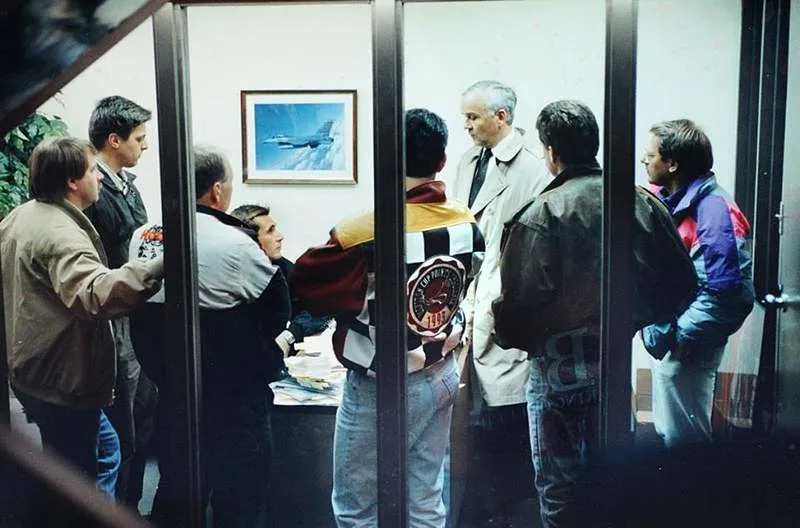
Tom Roberts (seated), media and law enforcement officials, during a briefing on finding the site of the plane crash. Photo courtesy Tom Roberts.
“The next day, I was at the track at 8 in the morning and worked until the track closed at 6 pm. By then, the news was everywhere, and everybody knew about what had happened. I remember how Kyle Petty said it was the saddest racetrack he’s ever been at.
Advertisement
“I operated the rest of that weekend just off of adrenaline. It was all a fog. Then, come Sunday, Rusty wins from the pole. I think about meaningful wins I’ve been part of, like Bobby (Allison) winning the 1988 Daytona 500, but from the standpoint of what all occurred and all the background story and everything, Rusty’s win in that ‘93 Bristol race (and doing the backwards Polish victory lap in Kulwicki’s honor) will always be my favorite.”
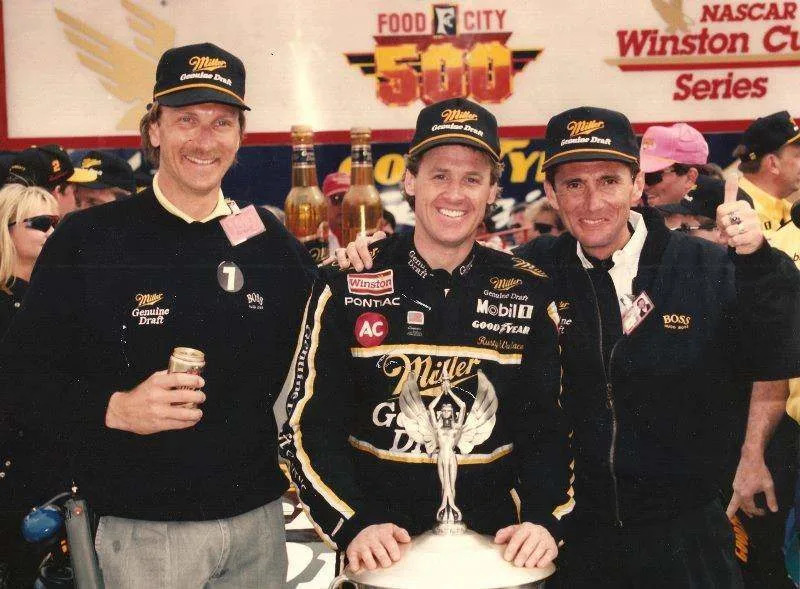
Rusty Wallace (center) celebrates his win at Bristol, dedicating it to Alan Kulwicki, who was killed in a plane crash three days earlier near Bristol, Tenn. Photo courtesy Tom Roberts.
The Impact of Alan’s Death On His Team
“All the folks and everybody that knew him, there was devastation, but me personally, I was blessed because I still had a livelihood (with his work for Miller Beer). I still had a job. But those poor fellows on that number 7, suddenly, they didn’t.
Advertisement
“Not only had they lost their friend and their hero, but they lost the boss man too. I knew where my next paycheck was coming from, and I knew I was going to have bread on the table. But for them, it was pure devastation. I went through all the stuff of Felix (Sabates) intervening and (Hooters president Bob Brooks) wanting another kid to fill the shoes of the driver and for the team, wanting Jimmy Hensley (as Alan’s replacement). I was there for all of that. It just made me feel even deeper sympathy for all of the employees of Alan’s team.”
What Kind of Person Deep Down Was Alan?
“If you talk to any of his true friends, long-term friends, they would tell you that he could be the life of the party. He was the life of the party. His workplace was the race track, but if things had turned out as I expected the night of the crash, I would have seen him at the Sheraton in somewhat of a relaxed mode.
“But still, in the back of his head, he was already thinking about setups and everything else. There’s a lot of truth to that. I mean, he could have a good time. I guess it’s evident that his post-champions party at the Waldorf was as good as it was. Everyone had a great time. I mean, there was a conga line, Richard Petty drinking out of a woman’s slippers. It’s true.”
Advertisement
Kulwicki’s Own Days of Thunder-Like ‘Race’
“We were in Atlanta one time at a restaurant downtown. And this was just how competitive Alan was. There was a parking garage that had a spiral driveway up and down. So we were parked on the eighth floor. We finished our dinner and were leaving when we came back, got in the car, and Alan was driving down from the eighth floor. I said to him, ‘Man, slow down a little bit.’ He’s driving down this thing, just hauling ass. So we got down to the ground floor, and he didn’t go to the main road. Instead, he went back to the entrance. I asked him, ‘What are you doing?’ He’s going to do it again. And that’s just what he did, went all the way back up and then back down again. That was Alan.
“With him, it was all about competition, trying to get faster. But I think it was also amusing for him to see the reaction of myself and the people. He got a kick out of it.”
Kulwicki Was Always Looking Over His Shoulder at the Competition
“I was blessed in that I knew more from the short track days of him racing in ASA. Back in ‘85 and ‘86, when his first time in Cup didn’t work out, Mark (Martin) came back to ASA and drove for (Milwaukee-based team owner) Jerry Gunderman.
Advertisement
“Well, Alan actually shared the same shop with Jerry and Mark. It was in Franklin, Wisconsin (a suburb of Milwaukee). The competition between them was intense. It even got to the point where one of them was always trying to outdo the other.
“There was a wall that was built between the shop to separate the two operations. Then there was a door. And then the next thing, there were padlocks that were put on (the door), and there were holes that were drilled in the door so they could spy on each other. It was something else. But there was always such a tremendous level of respect between that group.”
Kulwicki Soaked Up Technical Info From Others, But Never Shared His Most Valued Secrets
“I used to get irritated (back in the ASA days when they all ran together) because Rusty (Wallace) and Mark (Martin) and Alan would get together and Mark and Rusty would share a lot of their technical information. They sort of got this from Dick Trickle, who would tell all the kids – Rusty, Mark, Alan, he didn’t care – what his setup was, what shocks and springs that he had. He got the greatest pleasure out of telling them all of his secrets and then going out there and still beating them.
Advertisement
“After practices, they would be talking, and Rusty would have him a barley pop or two, and he would sit and tell Mark everything, all of his shocks and springs. It surprised me that Mark would then tell what he had, but it was like Trickle rubbing off on him. Now Alan, he would ask, and he would contribute, but I don’t think he just told them everything. I think he had more ears than he was mouth. He didn’t give away the store.”
What Might Have Been If …?
“I’ve heard people ask and wonder what might have happened to Alan if he hadn’t passed away. At Daytona in ‘93, I did see an element during that period that (all the attention on him of being the defending Cup champion) was wearing on him to keep on doing what he was doing. I think he would certainly have tried to defend his championship and might have very well done it. But I also think he may have just gone on to become only an owner, but the question is, who would have driven for him? So I don’t know. I certainly appreciate hearing other people’s thoughts, like for Mark (Martin) to say something like Alan would have won multiple championships.”
MORE: Exclusive: Mark Martin Will Never Forget Alan Kulwicki, Whom We Lost 33 Years Ago
Hard-Fought Battle to Get Kulwicki For the NASCAR Hall of Fame
“Alan was finally elected to the NASCAR Hall of Fame in 2019. But to get him into the Hall of Fame was a very difficult deal. A lot of people said he didn’t deserve to be a Hall of Famer because he’d only won five races. My contention was Alan deserved to be in the Hall of Fame, not only because he was a champion, but it’s how he went out and won the championship, coming from so far back in the points with just a handful of races left in the season (Kulwicki was 278 points out of first place with six races left, but rallied to beat Bill Elliott by 10 points for the championship). It was like doing the impossible. But it must not have been impossible because he was able to do it.”
Advertisement
On Being One of the Founders of the Alan Kulwicki Driver Development Program That Supports Up-and-Coming Young Drivers
“I’m retired now, but I still cheer for the Kulwicki Driver Development Program (KDDP). When I was first setting it up, back in its early stages (2015), setting up awards banquets and trying to find good featured speakers, I had Rusty for the very first one, Kyle Petty for the second, and Mark (Martin) for the third one. None of them would take a dime for coming to be the featured speaker.
“It was like they were doing something not only for us, but they were also doing it for Alan. I remember I picked Mark up at the Concord (N.C.) Airport, and even after the fact, he wouldn’t let me chip in to try to pay for his jet fuel or nothing. He just came in to do it. That’s the level of respect that those guys had for him, even after all the years he had been gone from us. It was so enjoyable to see.”
EDITOR’S NOTE: Alan Kulwicki was only 38 when he was killed on April 1, 1993. He made 207 starts in his NASCAR Winston Cup career, earning one championship (1992), five wins, 38 top fives, 74 top tens, and 24 poles. His final race was a sixth-place finish at Darlington on March 28, four days before his tragic plane crash, and he was ninth in the standings at the time of his death.
Read the full article here