




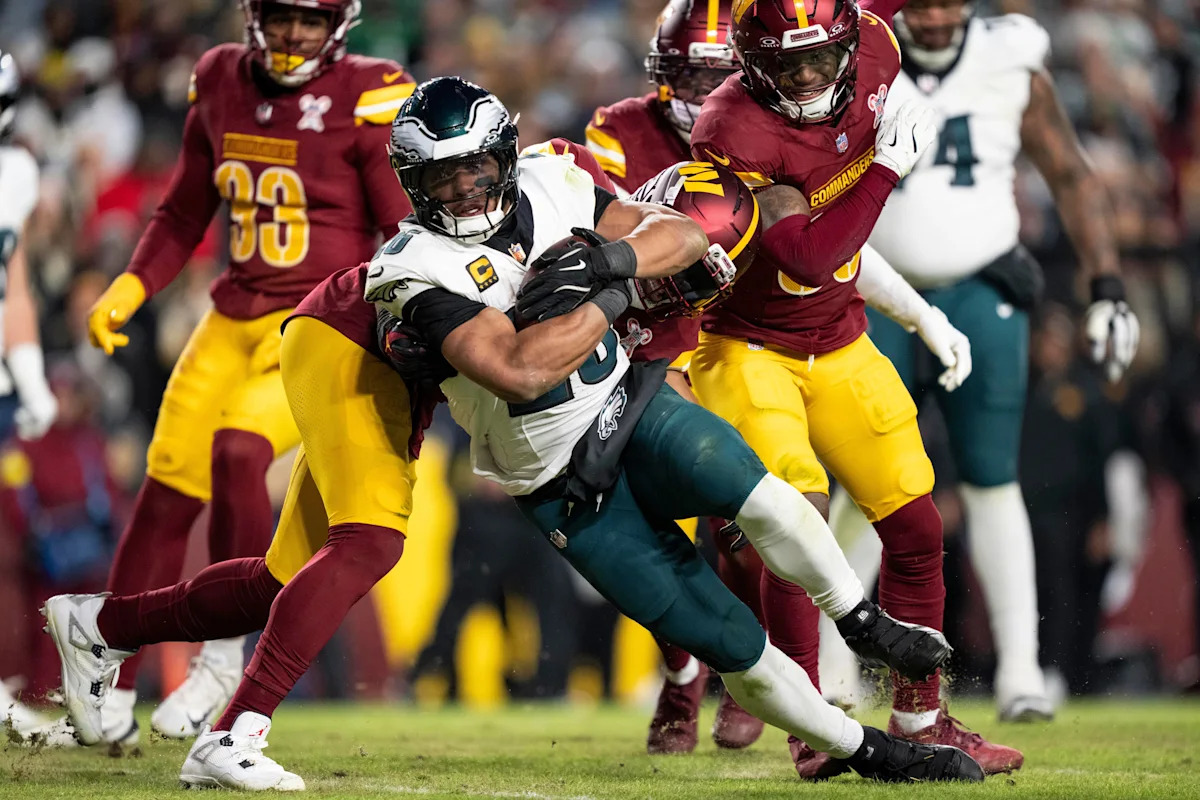
Hello! I’m back this year with BGN, as always, and I’ll have two review articles and two preview articles every week. Last year was the first year I’ve ever previewed games. There are a lot of statistical previews out there, but this one will always be film-based. I think my previews improved as the year went on, and it was cool to see stuff on Sunday that I had seen during the week. Hopefully we can hit the ground running this season.
However, Week 1 makes this article a little different from the usual preview. Let me know what you think of the position breakdowns. Normally, I can watch around three recent games and get a pretty clear idea of what the Eagles will face. That isn’t really possible here. Washington has a new defensive coordinator in Daronte Jones and has kept plenty hidden throughout the preseason, while the Eagles are also entering the season with a completely new offense under Sean Mannion. So this is less a traditional matchup preview and more an attempt to understand what Washington is building, which players matter, and what the Eagles are likely to see.
Advertisement
Overall, I still favor the Eagles. Washington is installing a complicated new defensive system with a number of new starters, while the Eagles have far more continuity within the roster even if the offensive structure has changed. The obvious concern is that Jones’ entire defensive philosophy is built around making quarterbacks and offensive lines second-guess what they are seeing. That is probably not ideal for an offense playing its first meaningful game under a new coordinator. However, Washington also has to execute all of that complexity, and I’m not convinced the defensive personnel is good enough right now.
Daronte Jones and the new scheme
Jones is a fascinating hire as DC because his background includes many different influences. He has coached defensive backs for much of his career, was LSU’s defensive coordinator in 2021, and has worked under coaches including Mike Zimmer, Vance Joseph, Lou Anarumo and, most recently, Brian Flores in Minnesota. I wouldn’t simply describe this as the Flores defense moving to Washington, but the Minnesota influence is clearly the most relevant when projecting what we are likely to see.
The Vikings’ defense under Flores was one of my favorite units to study last season because the pre-snap picture often meant nothing. They would crowd the line of scrimmage with six or seven potential rushers, threaten Cover 0, then rush four and drop several linebackers into coverage. On the next snap, they might present almost the same look and actually send the blitz. The whole structure was designed to slow the quarterback down. Jones has spoken about disguising coverage, using multiple fronts and building the scheme around his players, and Washington has clearly added defenders who fit that philosophy.
The biggest personnel change is speed. Washington’s defense looked old and slow at times last year, whereas this group has been rebuilt around athleticism and movement. Odafe Oweh, K’Lavon Chaisson and Joshua Josephs give them explosive edge speed, while Frankie Luvu and Sonny Styles can line up in multiple spots at the second level. Jones wants to dictate to the offense rather than simply react to it, and this collection of athletes gives him a much better chance to do that.
Advertisement
This could create some early problems for the Eagles because Mannion is installing a new offense. We know the Eagles want to use more motion, under center offense, and play action, but we don’t know how comfortable the whole operation will look right away. Hurts could turn his back to the defense on a play-action fake, then turn around to find two defenders have dropped and the coverage has completely rotated. That is a difficult picture for any quarterback, let alone one working within a new structure.
Minnesota made this style work because the defense was incredibly well coached and rarely busted assignments despite all the movement. Washington has not earned that level of trust yet. Jones is installing a complicated system with a secondary that has plenty of uncertainty, so the Eagles should force the Commanders to prove they can communicate for four quarters rather than assuming every disguise will be executed perfectly. The Eagles should not play scared on offense.
It is also worth noting that Jalen Hurts played exceptionally well vs the Vikings last year. He handled a lot of the disguised coverages well and looked as comfortable as anyone that I watched go up against the Vikings’ defense.
Defensive Front
Daron Payne remains the best player in the group, while Javon Kinlaw, Tim Settle, and Charles Omenihu give Jones a number of different body types to move around. Johnny Newton’s injury is significant because it removes one of their most talented young interior defenders, but this is still a group with enough depth to rotate heavily.
Advertisement
Minnesota frequently used three-man fronts and trusted its front to survive with two safeties deep, while the Commanders already had players such as Payne who could move around and align as heavier defensive ends. Washington also has several linebackers who can walk down onto the line, so I expect the distinction between defensive line and linebacker to become pretty blurry at times. The picture could change constantly even if the personnel does not.
However, this is not a collection of edge defenders I would want playing endless snaps against heavy personnel and taking on Jordan Mailata and Lane Johnson in the run game. I watched Chaisson for the Scouting Academy this year, so I have an excellent read on him. He does not play hard vs the run. He wants to get up field and rush the QB, so I would get after him in the run game.
This feels like a week where the Eagles should trust the offensive line. If Washington wants to keep both safeties deep, move linebackers around, and create uncertainty before the snap, the Eagles should be willing to run directly at those looks. Saquon Barkley doesn’t need endless schematic creativity if the box is light and the offensive line has favorable numbers. I want to see the Eagles establish the run early on.
I feel like Washington wants speed coming from everywhere, and the edge room reflects that. They can be extremely disruptive on passing downs, but the Eagles should make those defenders prove they can handle the physical demands of the run game.
Advertisement
Linebackers
This is probably the most interesting position group on the defense. Luvu plays with incredible aggression (borderline over the top at times) and can be used almost anywhere. He can line up as a traditional off-ball linebacker, rush from the edge, or threaten an interior gap before the snap. He feels like a near-perfect fit for the type of defense Jones wants to build.
Styles makes the group even more interesting. Washington used the seventh overall pick on him after his transition from safety to linebacker at Ohio State, and his athletic profile gives Jones an enormous amount of flexibility. At 6-foot-5 and around 240 pounds, he can play as a normal linebacker but still has the movement skills to be used in coverage or as part of these simulated pressure packages. Leo Chenal adds another physical downhill player, so Washington has assembled a group capable of creating very different pictures without constantly substituting.
This is where the Eagles’ communication will be tested. Imagine Washington putting Payne and Kinlaw inside, walking Luvu onto one edge and mugging Styles and Chenal in the A-gaps. The offensive line suddenly has six potential rushers to account for. If two of those linebackers drop after the snap and somebody else loops into the pressure, the Eagles need to pass everything off cleanly without panicking. Minnesota was excellent at creating free runners without actually sending an extra defender, and I would expect Jones to try to replicate some of those ideas.
Advertisement
However, there is another way to handle all this movement as I’ve mentioned before. Force the linebackers to play the run! Styles is an extraordinary athlete, but he is still a converted safety playing his first NFL game. That is exactly the type of defender I would want to test with downhill football. If Washington wants him constantly attacking gaps and threatening pressure, I want the Eagles running directly at him and forcing him to come downhill. His athleticism gives Jones enormous freedom on passing downs, but the Eagles have the personnel to ask whether he has enough size and play strength to survive against this offensive line.
Secondary
This is the part of Washington’s defense I would be most interested in attacking. Mike Sainristil is a good young player, while Rasul Douglas gives the Commanders useful size and experience outside. Amik Robertson is fine, but the depth behind the starting group is a major question after Trey Amos landed on injured reserve. The late additions of Douglas and Fabian Moreau tell you Washington knew this position needed help heading into the season.
Advertisement
The safety group is equally difficult to project. Nick Cross is an intriguing athlete and probably the player with the most upside, but Quan Martin is coming off a disappointing season, and Jeremy Reaves is being asked to take on a larger defensive role than he has previously handled. Jones may want to use three-safety packages and big nickel looks, as Minnesota frequently did, but that structure only works if the players involved can communicate through all the rotations and pattern-matching rules. I’m not convinced by this secondary at all.
Washington has a lot of smaller, competitive defensive backs. The Eagles can use condensed formations, stacks, and heavier personnel to force these defensive backs into traffic and make them tackle. If Washington wants to remain light to preserve its disguise and coverage flexibility, Barkley and the Eagles’ bigger offensive personnel should make them pay for it.
This is also the risk of building a defense around disguise. Match coverage is difficult because defenders are not simply dropping to a landmark and waiting. Their responsibilities change depending on the routes they see, which means communication has to be excellent. If the Eagles use motion, stacks, bunches, and reduced splits, they can force Washington’s secondary to make those decisions over and over again. One mistake can turn into an explosive play. Especially as a lot of these guys haven’t played in this style of defense before (assuming it is a bit more like the Vikings from last year).
I would still be careful about attacking the short area of the middle of the field, too. When I studied Minnesota last year, one of the biggest dangers was throwing quick routes (such as a slant) into linebackers who were showing pressure before dropping directly underneath them. Hurts cannot assume a linebacker threatening the A-gap is definitely coming. If Washington wants to make the middle of the field muddy, the Eagles need to use motion or play-action to try and get the defense to reveal their hand early.
Advertisement
Final Thoughts
If Washington uses anything close to the Minnesota structure, there will be snaps where the defense wants to play with two safeties deep and rely on movement up front to handle the run. That works when the front is disciplined and physical, but it becomes a problem if defensive linemen get moved or linebackers are caught attacking the wrong gap. The Eagles should test that immediately. If the Commanders want to create chaos by moving bodies around, the Eagles can use that aggression against them.
I think Washington’s defense will be much more interesting this year than it was last season. Jones has a fascinating group of linebackers, enough versatility up front to create unusual looks, and a philosophy that should make quarterbacks work much harder before and after the snap. The front is faster, and they now have the athletes who can make simulated pressures and late movement much more dangerous.
However, I still think this matchup favors the Eagles’ offense because I think Washington’s run defense is going to struggle. Washington has prioritized speed and athleticism, but I have real questions about whether this front has enough size and physicality to consistently handle the Eagles’ offensive line. The secondary is also thin and learning a demanding coverage system. The Eagles need to run the football, trust the offensive line, and target the weakened secondary on the outside.
Advertisement
Thank you for reading! I’d love to hear your thoughts, so feel free to comment below and ask any questions. If you enjoyed this piece, you can find more of my work and podcast here.If you would like to support me further, please check out my Patreon here! We are running a 50% sale until the end of Week 1!
Read the full article here


