




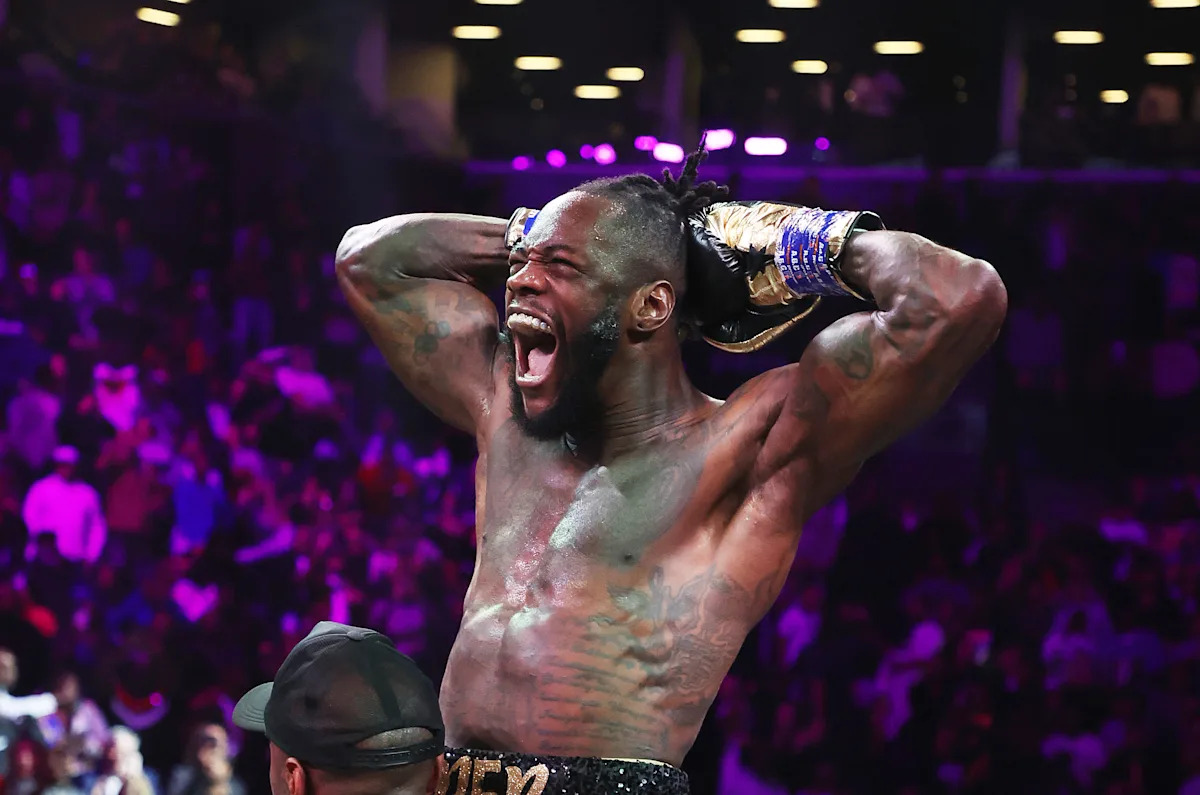
Deontay Wilder grew his fan base throughout his championship career with electric, terrifying, fight-finishing power, yet continually attracted criticism for being too one-dimensional — too reliant, they said, on his concussive right hand.
For a while that right hand was enough to floor every opponent he ever faced, if not knock them out them entirely. It was referred to as a touch of death for good reason.
Advertisement
But several years ago against Tyson Fury, Wilder showed he has attributes you just can’t teach in boxing gyms: His fight-or-flight response. In the ring, it’s a matter of heart. It’s something Wilder has shown time and again he has an abundance of. Because it didn’t matter how many times Fury toppled Wilder in their all-time great trilogy, the American heavyweight kept trying to get up from the canvas until he couldn’t. While Fury gets credit for going 2-0-1 in that series, the three-fight rivalry wouldn’t be revered as one of heavyweight boxing’s very best if it wasn’t for the testicular fortitude Wilder displayed.
Deontay Wilder celebrates winning against Derek Chisora at The O2 in London.
(Adam Davy – PA Images via Getty Images)
And, once again, we’re left to consider Wilder’s warrior instinct in the aftermath of Saturday night. Because in the build-up to the 50th fight of his pro career, the 40-year-old was once again counted out. Derek Chisora may have been washed, many said, but the Brit had learned to adapt to his declining abilities and was believed to be far less shot than Wilder, who showed in recent losses to Joseph Parker and Zhilei Zhang that he couldn’t even pull the trigger on his punches anymore.
Without those power punches, it was as if Wilder had nothing.
Advertisement
But the critics, myself included, forgot the former WBC world champion has another attribute more powerful than his punching. Wilder still has heart.
He is one of his country’s ultimate warriors and had to show it all again when he fought hometown hero Chisora in London, as well as British referee Mark Bates, whose decision-making throughout Saturday’s contest led to multiple controversies as he lost control of the fight. Bates overlooked Chisora’s corner risking disqualification losses in the opening round when one coach bafflingly entered the ring, and then again in the eighth, when they appeared to help Chisora up after he got punched through the ropes.
The old saying that an American fighter has to score a knockout just to leave Britain with a draw never seemed as true as it briefly did this past weekend, as fans, media and the industry awaited the official verdict between Wilder and Chisora, expecting a robbery.
Advertisement
One judge scored it 115-112 to Chisora, but was thankfully overruled by sounder minds to award Wilder with a split decision in a fight he arguably deserved more from.
But it wasn’t just beating Chisora against the odds that created headlines for Wilder, as he won something far better — and something that felt nearly impossible as recently as two years ago: An even bigger payday going forward.
Suddenly, after lighting up The O2 Arena in front of a packed house of British fans, Wilder is a proposition now more lucrative to Anthony Joshua, who rectified his own status stateside by fracturing Jake Paul’s jaw in a knockout win in December, eight years after his own humiliating loss to Andy Ruiz Jr. in Joshua’s big U.S. debut in New York City. Suddenly, Wilder vs. Joshua is a box-office bout again in London, Riyadh or Las Vegas.
Joshua’s career-long promoter, Eddie Hearn, told The Stomping Ground post-fight that he “absolutely” remains interested in booking that bout, adding: “It’s a big fight.”
Advertisement
Wilder himself even made a play for it when walking backstage, eyeballing and fist-bumping Joshua, before saying, to his face: “Let’s do it.”
Wilder landed right hands on Chisora’s jaw, after all, in a sloppy, no good, very bad but fun, feral, fire-fight, scoring knockdowns in Rounds 8 and 10, loading up on power shots, and landing 99 of them from 341 thrown in total, according to Compubox data.
But, as fellow Uncrowned reporter Darshan Desai pointed out, the way in which Joshua crumbled under pressure from Daniel Dubois in late 2024 is perhaps suggestive that such an onslaught from Wilder could still present problems for him.
The Tuscaloosa tornado may be too great a risk for Joshua at this point, as a loss would no doubt scupper a possible two-fight series with Tyson Fury bankrolled by the sport’s chief financier, Turki Alalshikh.
Advertisement
Timing, again, may not be right for this long-awaited superfight.
Regardless, Wilder should have other options available to him now with the safety of crossover spectacles against the likes of the internet sensation Jake Paul, or the former UFC heavyweight king Francis Ngannou, should Ngannou return to boxing following a Most Valuable Promotions-organized MMA bout against Philipe Lins on Netflix in May.
Speaking in 2025, Wilder said it “was time to settle the debate” over who had the greater power between himself and Ngannou. Maybe the question will be resolved in 2026. “I think that would be an intriguing fight,” he told me in 2023. “It would be a fight that would bring a lot of interest.”
All three of those prospective fights are winnable for Wilder, and he needs only one victory over any of them to bring his unlikely late-career comeback to three wins in a row — potentially enough to lure Oleksandr Usyk to the ring.
Advertisement
It was little more than a year ago when veteran promoter Tom Loeffler pushed for the fight when speaking to me. Loeffler, after all, knows Usyk well — K2 Ukraine, which represented Usyk, was a subdivision of K2, the promotional entity Loeffler helped build and run alongside Klitschko brothers Wladimir and Vitali.
“Deontay Wilder is always in exciting fights, whether he’s knocking someone out or getting knocked out,” Loeffler told me in 2025.
““There’s some good matchups for Usyk out there” including Wilder, he said. “I would always like to see the [Usyk vs.] Wilder fight.”
Maybe he still gets to see it.
Advertisement
Because while Wilder came to win in England, he now returns to America with something more valuable — relevancy in a red-hot division, and a reminder to the rest of the boxing world that, even in his advanced years, his warrior’s spirit remains as powerful as his feared right hand.
Read the full article here


