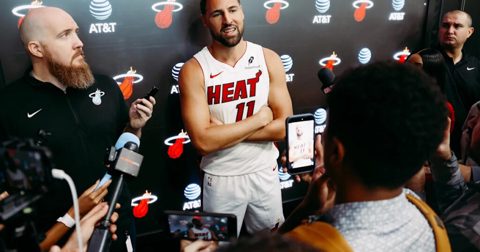

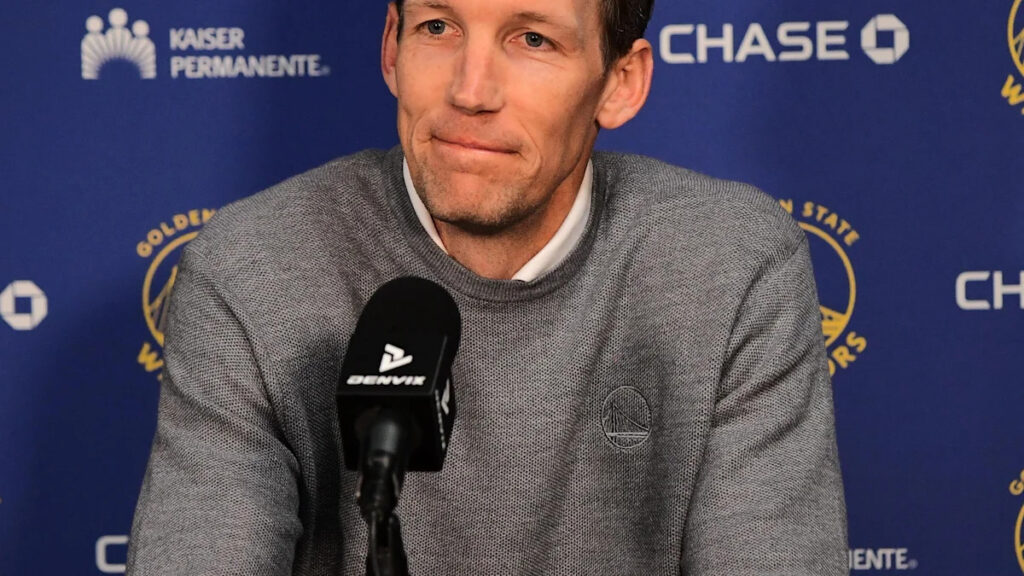
Media day at Chase Center is usually a fashion show with microphones. Guys roll in with fresh earrings and promises about being in the best shape of their lives, and we write it all down like we haven’t heard it every September since dial-up.
Steph Curry walked in Monday with a new contract. Two years, $116 million, signed late last week, with enough optionality built in that he could be in blue and gold through the 2028-29 season. He was eligible for the max, which topped out at $136.7 million. Pull out your phone and do the subtraction, folks. You get roughly $20.7 million that Steph thought about for five months and then slid back across the table toward Mike Dunleavy. They probably won’t engrave that number on a plaque in Curry’s wing of the Naismith Memorial Basketball Hall-of-Fame. But it matters plenty to Curry, who has no interest in spending the twilight of his career playing meaningless basketball.. NBC Sports Bay Area’s Dylan Grausz reports:
Curry was eligible to sign a maximum extension, worth up to $136.7 million, but instead opted to leave some money on the table in order to give the Warriors some cap space flexibility. Curry, a four-time NBA champion, wants to see the Warriors return to being contenders and be competitive, and by taking less money, he hopes it can lead to more avenues for the franchise to take down the line to reach that goal.
“Without knowing the answers to the test, it was my best way to study for it, if that makes sense,” Curry said about taking less money. “Again, it’s about for us to have a chance this season as we get started tomorrow to play basketball and hoop. We all have to do our jobs to win. We all know that, myself included. I’ve got to be healthy and available.
The discount guarantees nothing besides Warriors owner Joe Lacob and Dunleavy having an extra $20 million of room to work with when the crucial roster decisions show up.
Which brings me to the Black Mamba, rest in peace, who had zero patience for any of this. In 2013 when Kobe was 35 and coming off a torn Achilles, he signed his two-year, $48.5 million extension. Although it came in under what he could have gotten on a max and was the highest-paid player in the league, he was still adamantly against players sacrificing dollars:
“It’s the popular thing to do,” Bryant said after the Los Angeles Lakers’ shootaround prior to Friday night’s 140-106 loss to Nowitzki’s Dallas Mavericks. “The player takes less, blah, blah, blah, blah, blah. I think it’s a big coup for the owners to put players in situations where public perception puts pressure on them to take less money. Because if you don’t, then you get criticized for it.
“It’s absolutely brilliant, but I’m not going for it. I know the new head of the players’ association ain’t going for it, either.”
Kobe’s point is something I think about when I look at Curry’s monster contract, because even at $116 million he’s probably underpaid considering how much value he brings to the franchise. And what if the team doesn’t use that money wisely? That $20.7 million doesn’t vanish into team chemistry. It stays off the Warriors’ books, and what happens with that flexibility is up to Dunleavy and Lacob.
Advertisement
The Mamba school of thought is that the whole thing becomes a morality play where the billionaire gets to feel clever and the player gets graded on how much he gave back. Kobe looked at that and wasn’t about to play the nice guy in somebody else’s business model. I can dig it!
But the Strength in Numbers school of thought is that Curry has already been the bargain superstar once, and it paid off in rings.
His four-year, $44 million extension in 2012 got signed when his ankles were the biggest question in the building. He outplayed that contract by the length of the Bay Bridge. When the salary cap exploded in 2016, Steph’s bargain deal was a big reason the Warriors had room to go get Kevin Durant. You can call that a coup for the owners, but Steph would probably call it two more parades.
Kobe’s final years showed what the other side of that bargain could look like, as the Lakers spent the rest of his career near the bottom of the West. You can argue forever about how much that contract had to do with it, and I won’t pretend his salary alone sank those teams. But the Warriors’ rise coincided with beating the hell out of those late-Kobe Lakers teams.
Advertisement
What got me Monday was one line near the end where Curry talked about finishing the story the right way and said he knows the short list of guys that have been able to do it. He means one franchise, start to finish.
That’s where Kobe Bean walks back into this for me.
The Lakers legend spent 20 seasons in purple and gold. He showed up in 1996 as a teenager, won three titles next to Shaq, survived the breakup, and won two more as the undisputed face of the franchise. He tore that Achilles, ground through the ugly years on the wrong side of contention, and then walked off the floor at 37 after dropping 60 in his last game the same night those Dubs clinched 73 wins.
Advertisement
Steph wants to finish in Warriors colors, but he wants to finish competing for championships. He’s trying to do that by handing some back and trusting the people upstairs to spend it. Two of the greatest guards who ever lived, walking the same road to the same place, with completely different ideas about what the toll should cost.
“This is home,” Steph said. “This is what we’ve built.”
If Dunleavy can’t turn $20 million into something real by next summer, the Warriors will have built a gilded retirement home for one of the greatest to ever do it.
Read the full article here