




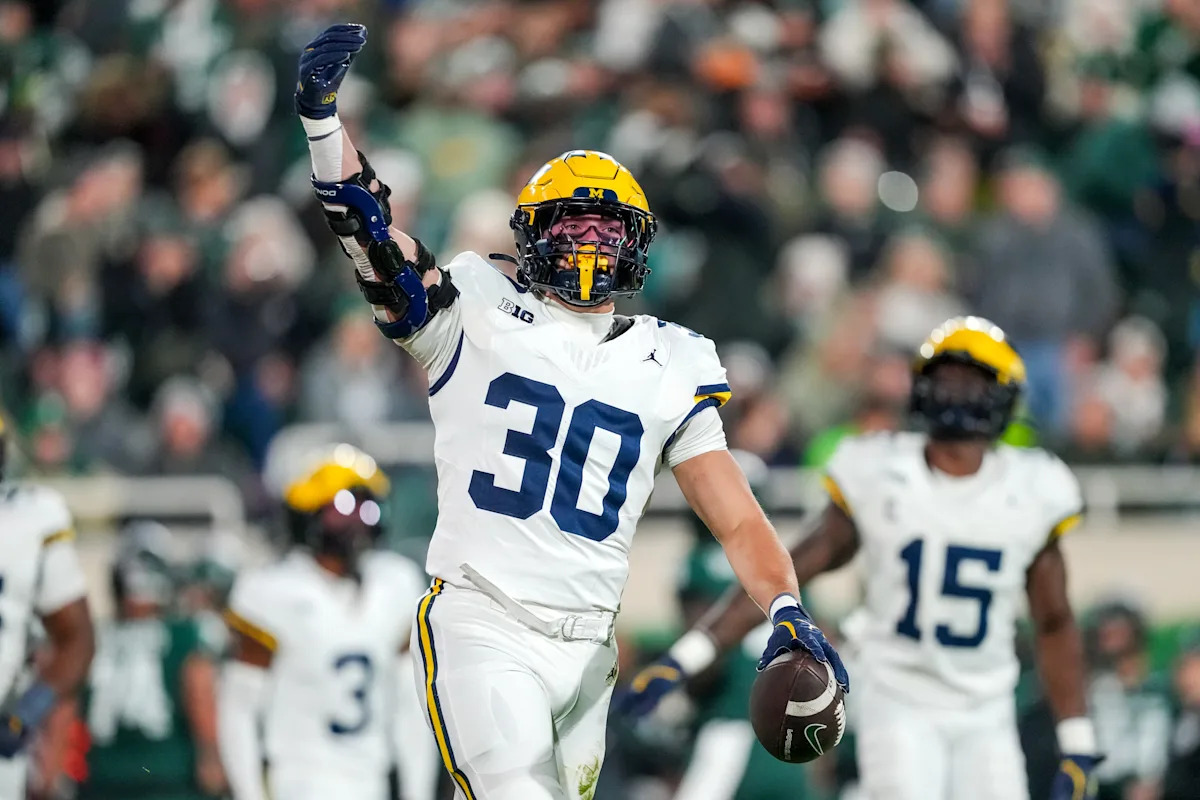
Dallas could get their guy at a very reasonable price.
Why Jimmy Rolder is a perfect fit
Ideally, anyone the Cowboys add in the front seven will be able to both rush the quarterback and play against the run, as Dallas had just 35 sacks last season and finished bottom-10 against the run.
Coverage ability would be great to have, also, as the Cowboys sported the league’s worst pass defense in 2025.
Kiper notes that Rolder has the tools to get after the quarterback with his speed, and the Michigan product showed his run defense prowess last season with a Pro Football Focus grade of 80.1.
Checking two more boxes, Rolder has experience wearing the green dot, and he’s not a liability when asked to drop into coverage.
Again, the ideal scenario is the Cowboys land a linebacker earlier in the draft, but if Day 3 rolls around and that need hasn’t been addressed, Dallas could do a lot worse than Rolder.
The trade benefits Dallas on several fronts.
2. Potentially Helpful At 12: Giants Unlikely To Double-Dip, Leading To Defender Falling
The natural reaction from many Cowboys fans was “this is terrible,” and I understand why you may think that right away.
New York has been heavily connected to both Ohio State superstars, Sonny Styles and Caleb Downs. Those two guys are dream options for Dallas, but it always seemed inevitable that one would join John Harbaugh in the Big Apple.
So, with two top-ten picks, won’t they just draft both? Not necessarily.
I think the Giants are highly unlikely to double-dip on offense or defense with these two picks. I think you will see either a WR/OT at 5, and Styles/Downs at 10, or the opposite. That means, considering the Bengals were likely to go defense, Dallas’s odds of getting a top defender to 12 rise.
Dallas has seen success at #20.
3. Marcus Spears, DE, 2005
Before his current career as one of the many talking heads for ESPN’s NFL coverage, Marcus Spears was taken 20th overall by the Cowboys in the 2005 draft following a stellar collegiate career at LSU.
Spears was solid at times, but he ultimately never lived up to his first-round status, tallying 226 total tackles and 10.0 sacks during his eight-year run with the Cowboys. He closed out his playing career with one season for the Baltimore Ravens.
2. Ebenezer Ekuban, 1999
Six years before Spears, the Cowboys used the 20th overall selection in the 1999 draft on defensive end Ebenezer Ekuban, who’d earned First-Team All-ACC honors and a Second-Team All-American selection at North Carolina in 1998.
The hope was that Ekuban, who they actually traded up two spots to get, would come in and start opposite his former UNC teammate Greg Ellis, who Dallas drafted a year earlier at No. 8 overall. But things never really worked out that way.
Ekuban had a solid rookie campaign with 2.5 sacks, and he upped that total to 6.5 in 2000. But an injury limited him to just one game in 2001, and he just wasn’t the same player over the next two seasons, recording just 3.5 sacks.
He regained his form after signing with the Cleveland Browns, posting a career-high 8.0 sacks in 2004, and then racked up 16.0 sacks in three seasons with the Denver Broncos before calling it a career.
Two big blockbuster DT trades involving an NFC East team seems worthy of a quick side-by-side.
So when talking about the trade value of this year’s No. 10 pick, the projected quality of player the Giants will get is downgraded a bit because the class is seen as lesser than. 2027, even though prospects are a long ways from declaring, is perceived as having a deeper pool of talent.
So perhaps this comparison should bake that in, and narrow the gap between the two. It doesn’t close it completely though.
Conclusion: Cowboys, Giants both seem to be on winning end
The Cowboys seem to have paid less for their acquisition than the Bengals did, without having to dole out a new contract, for the slightly better player. The Giants seem to have gotten a much better return for a similar or ever-so-slightly lesser player. Using the two trades to counter each other, the NFC East teams both seem to have landed on the winning end of the initial compensation comparison.
As always, though, time will tell how it works out for all involved.
Read the full article here


