







The very first article I wrote for CelticsBlog was titled, “Is Baylor Scheierman a viable starter for the Celtics?” I started that article with a confession: I wasn’t a Baylor believer at the beginning of the season.
That was probably too simple of a take. Looking back, I don’t think I disbelieved in him as much as I had absolutely no clue what drawer to put him in.
Advertisement
With most players, even the imperfect ones, your brain is able to find a quick label. Jordan Walsh is the lanky chaos wing. Hugo González is the endless motor who looks more natural in a locked-and-loaded defensive stance than upright. Sam Hauser is the shooter.
Baylor didn’t give me that kind of shortcut. He came into the season with leftover Summer League shine, a shaggy haircut that inspired strong feelings online, and a game that seemed to change shape depending on the possession. Sometimes, he looked like a shooter. Other times, he looked like a defensive stopper. Most of the time, he looked like someone who had been dropped into an NBA game after spending the afternoon playing pickup at the Y.
By the end of the season, the lack of a clean label stopped feeling like a problem, and more like the point.
Scheierman did not become one of the central stories of Boston’s season, nor did he make some gargantuan leap that forces the Celtics to redesign their plans to account for him. But he did something that matters a whole lot for a team with very expensive stars and very little room to waste cheap contracts.
Advertisement
He made himself harder to ignore.
The weirdness started to work
Scheierman’s season numbers won’t make anyone spit out their coffee. 5.5 points, 3.5 rebounds and 1.5 assists in 18.6 minutes per game. But the year-over-year jump tells the better story.
As a rookie in the ‘24-’25 season, he shot 35.5 percent from the field and 31.7 percent from three. This year, those jumped to 45.3 percent and 39.9 percent. His true shooting climbed from 49.0 to 61.6. His minutes went from 12.4 to 18.6 per game. That is the difference between “maybe he’ll figure it out” and “oh, he might actually be figuring it out right now.”
The improvement didn’t arrive in one giant, obvious burst. It felt more like a slow drip over the course of the season. 10 points and 13 loud rebounds versus the (I’m sorry to even be mentioning them) Knicks on February 8. Another double-double in the form of a 16-point, 10-rebound effort on March 8 versus the Cavs. A career-high 30-point night on the last day of the regular season in a feel-good bench-mob victory over the Magic on April 12.
Advertisement
In his exit interview, Scheierman described his season as “a constant level of growth throughout the entire year,” which is exactly the kind of quote that sounds boring until you realize it’s probably the most accurate way to describe what actually transpired. Baylor just kept getting a little more comfortable until the Celtics were using him in real games and nobody had any issues with it.
That matters because Scheierman’s game can be kind of a trust fall. He plays with confidence that occasionally arrives before the justification. I respect it. I fear it. I understand why Joe Mazzulla sometimes looks like he is doing long division in his head before subbing Baylor in.
The funny thing is, the Celtics started trusting him too.
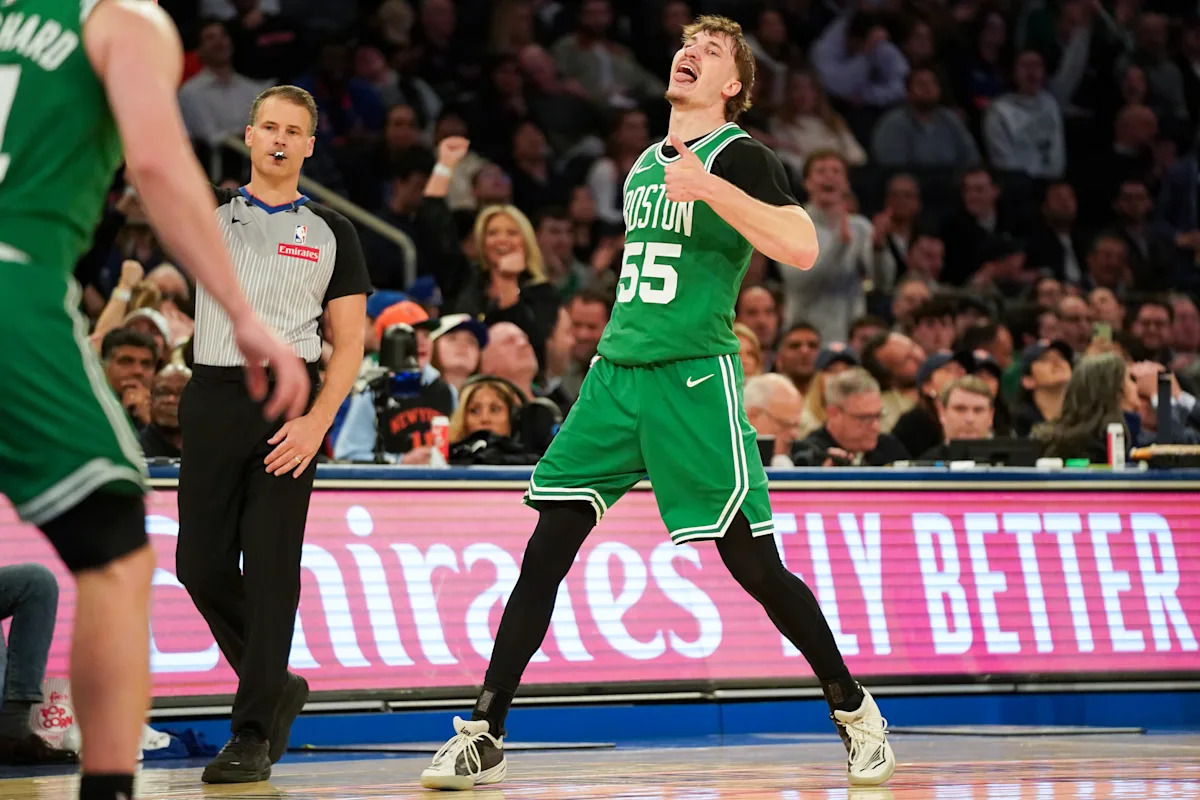
After Scheierman fractured his thumb, his whole celebration package boiled down to a good ol’ fashioned thumbs up. Looking back, there’s something perfect about that. Baylor’s season was not especially loud. It was not smooth enough to be boring or explosive enough to be obvious. It just kept flashing a thumbs up at you until you finally had to acknowledge the play was working.
Advertisement
He gives the Celtics a different kind of wing
The easiest way to undersell Scheierman is to call him another wing in Boston’s pile of wings.
That pile is getting crowded, to be fair. Walsh, Hugo, Hauser, Scheierman, Ron Harper Jr. hovering around the edges. At some point, Brad Stevens may have to decide how many “interesting but imperfect” wing types one roster can reasonably hold before the locker room turns into an airport terminal.
In my opinion, Baylor brings things to the table that the other wings do not, at least not yet.
Walsh and Hugo are more obviously disruptive defensively, but with clear offensive limitations. Hauser has real shooting gravity, but looked a step slower after the championship run. Baylor’s best value might be that he gives you a little bit of everything, all of the time.
Advertisement
He can rebound and push. He can throw the hit-ahead pass. He can come off a pindown and see the next read. He can pump fake, take two funky lefty dribbles and find a pass that wasn’t there half a second earlier. The handle can still get loose. The finishing needs work. There are possessions where his creativity and his body seem to be negotiating in real time.
That last part is what the offseason is for.
In his exit interview, Scheierman said he wants to keep building his strength, quickness and change of direction. He also mentioned finishing at the rim, floaters, slow steps and finding angles. That sounds less like a player trying to reinvent himself and more like one who knows exactly where the loose screws are.
The most interesting part came when he talked about becoming a secondary or third playmaker.
Advertisement
Boston doesn’t need him to become a diet point guard. Nobody is asking Baylor to bring the ball up against playoff pressure while Payton Pritchard stands in the corner wondering what crimes he committed. But if Scheierman can become a wing who hovers around 40 percent from three, rebounds well for his role, and gives you just enough ball handling and passing to punish a rotating defense, that is a very useful player.
Especially on his contract.
Cheap only matters if playable comes with it
Scheierman is set to make $2.74 million next season, with a club option just under $5 million the year after.
Advertisement
Boston already has a massive amount of money tied to Tatum, Brown and White. Pritchard’s next contract conversation is coming. Hauser’s salary makes him both useful and potentially relevant in trade math. Every offseason idea sounds fun until you remember the tax line exists and Brad Stevens and Bill Chisholm are certainly mindful of it.
That is why Scheierman’s season matters beyond the box score.
Cheap contracts are easy to celebrate when you’re looking at a spreadsheet, but they only help if the player gives you more than the number suggests. I looked up NBA players making similar money to what Baylor is earning right now, and you tell me whether you’d rather have Scheierman or these other guys:
-
Yanic Niederhauser, Clippers, 4-years, $14.1 million
I’ll be honest, I watch a lot of NBA basketball, and there are names on that list that I had never heard before. Perhaps some of you may argue for Thanasis because of who his +1 would be. I respect the hustle, but we’re not going there in this article.
Advertisement
Ultimately, Baylor is a guy who can survive in games that actually matter. Let’s not forget, he started Game 7. When he was asked about that wacky starting lineup after the season ended, he said the group was “super excited” and “super confident” because the Celtics had done it all year. That’s a very Baylor answer. No hand-wringing. No “Gee whiz, what an honor to have started Game 7 against Joel Embiid and Paul George.” Just confidence and on to the next rep.
That approach probably explains part of why Mazzulla trusted him in the first place.
Scheierman said the coaching staff did a good job detailing how the team wanted to play, which allowed him to play freely because he understood what was expected of him. He described himself as someone who has always tried to play hard and do whatever it takes to win. Usually, that kind of quote would be easy to toss into the athlete-speak drawer.
Advertisement
With Baylor, it actually matches the film.
He is not always pretty. In fact, part of the appeal is that he often looks like he’s making basketball look more difficult than it needs to be before suddenly making the right play anyway. But he competes, sees things early, and annoys people on a nightly basis. He has enough swagger to take shots that make you briefly check the score and situation to make sure you didn’t miss something.
The question now is whether the Celtics clear enough room for that to keep growing.
Scheierman does not need to be treated like a future star. That would be unfair to him and slightly stress-inducing for the rest of us. But he also shouldn’t be treated like a random cheap wing who happened to have a decent year. Boston needs low-cost players who can give Mazzulla real minutes. Baylor spent this season proving he might be one of them.
Advertisement
Back in February, I wondered if he could be a viable starter.
I’m less interested in that label now. The better question is whether he can become the kind of rotation player who makes the roster math easier around the stars. After the season he just had, it’s a much easier case to make.
Somewhere along the way, I became a Bayliever. Or a Schei Guy. Still hate my nickname ideas. Still very much workshopping.
Fortunately, the player now makes more sense than the potential nicknames.
Read the full article here


