




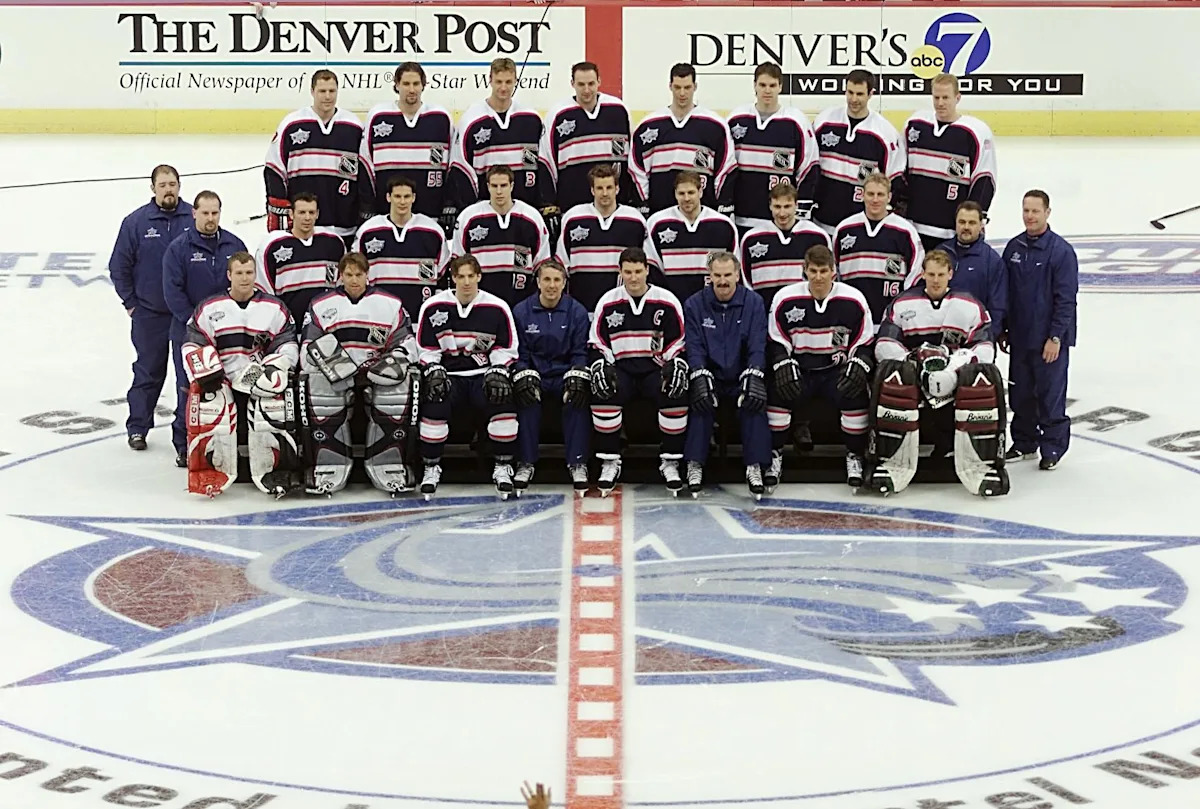
The past thirty years of Avalanche hockey have featured incredible highs, and some very, very dismal lows.
As an avid fan of The Simpsons, I’ve witnessed plenty of “best of times” moments, but also been subjected to a smattering of unpleasant “blursts” of times. In this first of an ongoing off-season series, I take a look back through the past thirty years, highlighting one moment that stands among the best, and comparatively, the worst (or blurst, if you will) each season.
Advertisement
Here are the best and blurst moments from the second five years of Colorado Avalanche history.
2000-2001
The Best: Mission Accomplished (June 9, 2001)
The Avs knew the clock was ticking coming into the 2000-2001 season, and they didn’t let a second of it go to waste. They set franchise records in regular season wins (52) and points (118), clinched their second Presidents Trophy, and secured the top seed in the playoffs.
The motto for the Avs entering the postseason was as sharp as a skate blade: Mission 16W.
A four-game sweep of the Vancouver Canucks set the stage for a dramatic seven game series against Los Angeles. The Avs would emerge victorious, but at a significant cost (more on this later). An overtime victory over the St. Louis Blues in Game Five sent the Avs to the Stanley Cup Final, where they would face the defending champion New Jersey Devils, who finished as the Eastern Conference’s top seed.
Advertisement
The Avs certainly didn’t make things easy for themselves. Trailing in the series 3-2, they won a pivotal Game Six in New Jersey to tie the series and set the stage for a dramatic Game Seven back in Denver.
Alex Tanguay became a household name for Avs fans everywhere upon scoring the first two goals of the game. Joe Sakic added an insurance goal on the power play, and that was all the Avs needed to complete their mission, defeating New Jersey by a 3-1 decision to claim the franchise’s second Stanley Cup.
After being summoned by NHL Commissioner Gary Bettman, Sakic paused for the traditional pose, then without missing a beat, made the finest pass of his career, handing the Stanley Cup to Bourque.
All of you reading this are probably hearing ESPN’s Gary Thorne’s legendary call in your head right now: “And after twenty-two years…Raymond Bourque!”
Advertisement
Patrick Roy would win his fourth Stanley Cup (and a record-setting third Conn Smythe trophy as playoff MVP), but the fondest memories of this Stanley Cup Final—and the undisputed best moment of the season—are of the one player who waited twenty-two years to win his first.
The Blurst: Peter Forsberg Ruptures Spleen (May 4, 2001)
The Avs seemingly exorcised their Game Seven demons by clinching a berth in the Western Conference Final after being taken to the limit by Los Angeles. Unfortunately, the euphoria of this victory would soon evaporate, as news broke that Peter Forsberg had ruptured his spleen and was rushed into emergency surgery mere hours after the game.
Advertisement
According to ESPN, Forsberg had begun noticing a mark near his ribs after the Avs lost Game Five in Denver, but it would take an additional six days before feeling any pain. He was bleeding internally and the procedure to remove his spleen was performed. As a result, he would not return for the remainder of the Stanley Cup Playoffs.
The loss of Forsberg was certainly a major blow to the Avs, especially after their second round victory. Avs fans began to wonder if Forsberg’s absence could derail yet another shot at the Stanley Cup. These worries would eventually subside, as the Avs cruised past the St. Louis Blues and emerged victorious over New Jersey in the Stanley Cup Final.
Although he didn’t play another game in the postseason, the now-spleenless Forsberg returned for the postgame ceremony after the series-clinching victory to raise the Stanley Cup with his teammates.
It’s not often that a blurst has a happy ending. This is one of them.
Advertisement
2001-2002
The Best: The Return of Peter the Great (April 18, 2002)

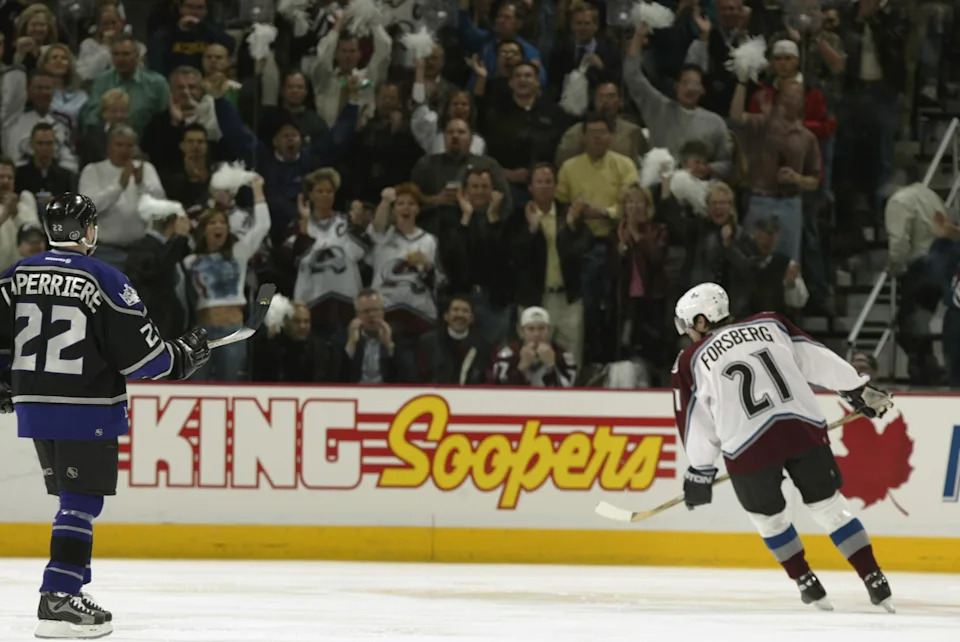
The news that Peter Forsberg would miss the entire season cast a major pall over the Avs as they began another defense of the Stanley Cup. However, on the cusp of the 2002 Stanley Cup Playoffs, the news that Forsberg would be activated in time for start of the Western Conference Quarterfinals immediately boosted the Avs’ hopes for another extended playoff run, one that could produce a second straight title.
After an absence stretching over eleven months, Forsberg returned to action against the very team the he last faced in the playoffs a year earlier: the Los Angeles Kings. Both teams would again go the distance, with the Avs emerging victorious in another Game Seven finish.
Advertisement
In the Western Conference Semifinals against the San Jose Sharks, both teams traded victories through the first six games, but Forsberg proved to be the difference-maker in Game Seven, scoring the game’s only goal to send the Avs back to the Western Conference Final, where they would meet the Detroit Red Wings.
Despite coming up short against Detroit, Forsberg’s return cannot be understated. In twenty postseason games, he led all skaters in assists (18) and points (27)—both career highs—while finishing second in goals scored (9, tying Joe Sakic). Only Brett Hull scored more goals (10) than Forsberg during that postseason.
Peter the Great’s best, unfortunately, wasn’t enough for the Avs to defend their Stanley Cup title.
The Blurst: Patrick Roy’s Statue of Liberty Gaffe (May 29, 2002)
The Avs led their Western Conference Final series 3-2 over Detroit going into Game Six, and had a chance to clinch their second straight appearance in the Stanley Cup Final. With time winding down in the first period, Detroit pressed hard offensively, but had not yet broken through Roy.
Advertisement
Roy, who was notorious for his “Statue of Liberty” pose after making an emphatic save, pulled out the trademark maneuver after making a point blank save on Yzerman. However, Roy failed to secure the puck in his glove, and unknowingly dropped it to the ice. Brendan Shanahan immediately pounced on the puck, jamming it into the unguarded net behind Roy.
The gaffe was not just the turning point in the game, but of the entire series. The Avs would lose Game Six by a 2-0 decision, following this effort with an utterly humiliating 7-0 loss to Detroit at Joe Louis Arena in Game Seven.
Plenty of fingers can be pointed to a lack of scoring (how does a team this talented go scoreless for two whole games, especially against your most hated rival?), but Roy’s baffling blurst is where the series was truly lost.
2002-2003
The Best: Patrick Roy Plays 1000th Regular Season Game (January 20, 2003)
Whether it’s scoring fifty goals in a season, iron man streaks, or breaking franchise records, milestone moments in a player’s career deserve recognition.
Advertisement
Reaching a milestone that no one has ever achieved before? Now, that’s special.
Patrick Roy accomplished that feat in this game, as he became the first goaltender in League history to appear in 1000 career games. The Avs hosted a special pregame ceremony celebrating Roy’s achievement prior to facing off against the Dallas Stars. He received a silver stick and a commemorative gift, with his children on hand at ice level for the occasion.
As for the game itself, the contest ended in a 1-1 draw (remember those?), snapping a five game home losing streak.
Three other goaltenders (Martin Brodeur, Marc-Andre Fleury, and Roberto Luongo) have since eclipsed the 1000 game mark, but St. Patrick will forever be known for reaching it first.
Advertisement
The Blurst: A Game 7 Meltdown Against Minnesota (April 22, 2003)
Haven’t we seen this movie before? (Yes, five years earlier.)
The powerhouse Avs, poised for another deep run in the Stanley Cup, held a 3-1 series lead against an upstart Minnesota Wild club who had reached the Stanley Cup Playoffs for the first time in franchise history.
The Avs hosted Game Five with their eyes on a second round appearance. Minnesota, however, took the fight to the Avs, having scored the first three goals of the contest. Despite battling back, the Avs would lose by a 3-2 decision, sending the series to St. Paul for Game Six.
Advertisement
Both teams didn’t budge for the first two periods, but Minnesota scored a pair of goals to take the lead in the third period. Colorado rallied to force overtime, but Minnesota scored the game-winner in the overtime session, winning by another 3-2 decision.
In Game Seven, both teams traded goals in the second and third period, but this game wouldn’t be decided in regulation. With just under five minutes played in overtime, Andrew Brunette had room to make a move on Patrick Roy uncontested, and his backhand effort in the crease eluded Roy, giving Minnesota its third straight 3-2 victory to win the series.
This blurst sent Patrick Roy into retirement, and with him, the Avs’ halcyon days were now in short supply.
2003-2004
The Best: Paul Kariya and Teemu Selänne Flock to Colorado (July 4, 2003)

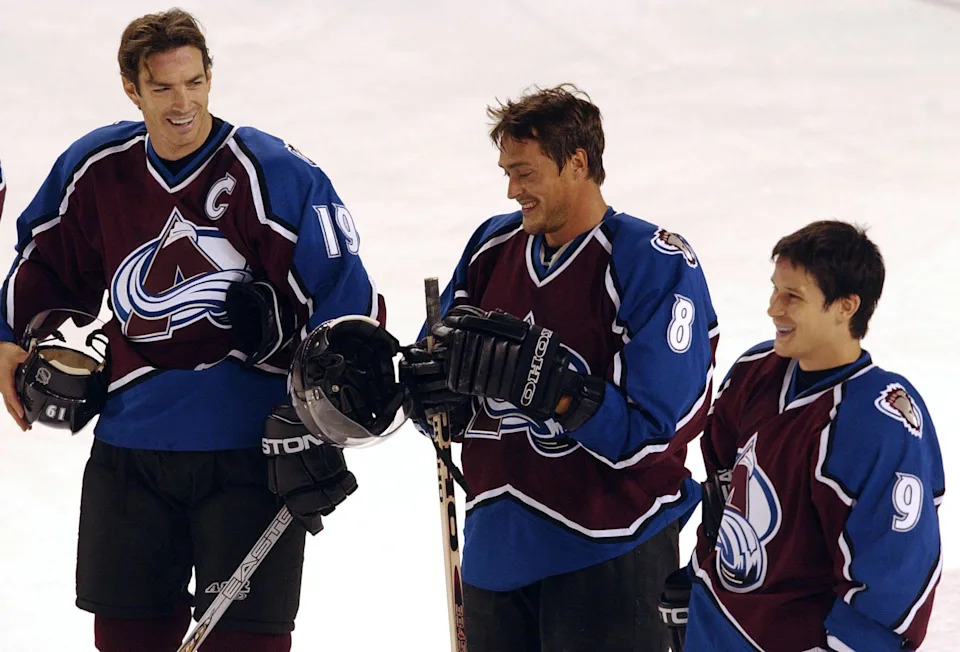
This one might be a bit of a reach, since this technically took place prior to the season.
Advertisement
When news broke that both Paul Kariya and Teemu Selänne had negotiated sweetheart contracts to play together in Colorado, the buzz was as high as ever leading up to the first game of the 2003-2004 season. The Avs were immediately christened as the favorites to win the Stanley Cup.
After the signings were announced, Avs GM Pierre Lacroix told the Associated Press, “Over the last 36 hours, these two athletes expressed their strong desire to come to Denver and play for the Avalanche,” Lacroix said. “Obviously, we were stunned.
“We were able to do all of this without changing any of the (salary) structure that we have for the coming season.”
The hype machine was in full swing, as the Avs prepared for one last hurrah in the final season under the then-current collective bargaining agreement between the NHL and the NHL Players Association, and both had very different viewpoints on what the future would hold (spoilers).
Advertisement
Unfortunately, neither Kariya or Selänne were able to provide the offensive impact that many expected when the contracts were announced. Injuries hampered Kariya’s production, as he mustered a paltry 11 goals and 25 assists for 36 points in 51 games with the Avs. Despite playing with nagging knee issues, Selänne scored 16 goals and added 16 assists for 32 points over 78 games, all while his role was diminished by head coach Tony Granato. The pair mustered four assists combined (Kariya had three, Selänne only one) during the Avs first round loss to the Nashville Predators.
While the signings definitely gave off vibes of being a best, they may as well have been a blurst, had something much worse never taken place that season.
The Blurst: A Violent Night in Vancouver (March 8, 2004)
March 8, 2004, is one of the darkest dates in franchise history.
Advertisement
When the Vancouver Canucks hosted the Avs that night at GM Place (now Rogers Arena), all pretense of gamesmanship one comes to expect during a hockey game were dropped, showcasing something far more perverse.
After Steve Moore had injured Canucks captain Markus Näslund three weeks earlier on February 16, comments of retribution from members of the Vancouver roster were aimed at Moore, vowing to even the score with him. No penalty was assessed to Moore for his hit on Näslund, which incensed Canucks head coach Mark Crawford.
“That was a cheap shot by a young kid on a captain, leading scorer in the League, and we get no call. We get no call! That is ridiculous!” Crawford said in postgame comments that night.
Other, more inflammatory remarks were directed at Moore. Brad May bluntly said, “There’s definitely on [Moore’s] head,” while assistant captain Todd Bertuzzi said, “That kid is a piece of shit.”
Advertisement
The rhetoric grew to such incendiary levels that NHL commissioner Gary Bettman personally attended the next meeting between the Avs and Canucks at Pepsi Center on March 3. Playing to a 5-5 draw, both teams made nice in front of Bettman. careful not to draw any unwanted attention.
Five days later in Vancouver, all niceties were left at the door.
In front of packed house, Steve Moore and Matt Cooke fought each other early in the first period. The bout was brief, with Moore getting the better of Cooke. Both received fighting majors.
The “code” had been upheld, and that’s where this tale should have ended. It didn’t.
Advertisement
After Moore’s fight with Cooke, the Avs would score five consecutive goals—four on goaltender Dan Cloutier, and another on Johan Hedberg—in the balance of the period. Moore scored the fifth and final goal in that period.
It would be the final goal of his professional career.
With the Avs holding a commanding 8-2 lead in the third period, Bertuzzi skated behind Moore, pulled on the back of his sweater, then unleashed a hard punch to the back of Moore’s head. The blow sent Moore face first to the ice, defenseless, with Bertuzzi still holding onto him.
Bedlam ensued. Avs forward Andrei Nikolishin immediately raced to Moore’s defense, punching Bertuzzi and attempting to pull him off the defenseless Moore. Canucks forward Sean Pronger and defenseman Mattias Öhlund entered the picture to go after Nikolishin. May fought with Avs defenseman Kurt Sauer. Hedberg beckoned to Avs goaltender David Aebischer, who refused to indulge him. Meanwhile, Avs head coach Tony Granato unleashed a verbal tirade against Crawford, who ignored him while smirking behind the Vancouver bench.
Advertisement
The damage had already been done. Moore was unconscious and bleeding on the ice, requiring medical intervention. He would later be taken to a local hospital, where he would be diagnosed with three cervical vertebrae fractures, facial cuts, and a concussion. The injuries stemming from Bertuzzi’s attack eventually forced him to retire.
“The Vancouver Canucks vowed they were going to get Moore,” the late Peter McNab said on the Avalanche broadcast that night, shock and anger in his voice, to stunned viewers who watched the attack unfold in real time. “They got him.”
As for Bertuzzi, he offered a public apology to Moore in a press conference held in Vancouver on March 10. The next day, the NHL suspended Bertuzzi indefinitely. The IIHF followed suit, effectively banning Bertuzzi during the lockout that wiped out the 2004-2005 season (spoilers). Upon the NHL’s return to action for the 2005-2006 season, Bertuzzi was reinstated. He would play another ten years in the NHL before retiring.
A settlement was reached between Moore and Bertuzzi in 2014. The terms of the settlement remain confidential.
Advertisement
A courtroom may have seen a settlement, but this sordid situation will always feel unsettling.
This event deserves to be called something infintely more damning than a blurst.
2004-2005
The Best: The 2004 World Cup of Hockey (August 30-September 14, 2004)
After an eight year hiatus, the World Cup of Hockey returned to the international stage. While this technically didn’t occur during the course of a standard NHL season (the reason why is below), it is the brightest spot in an otherwise bleak hockey landscape that year.
Eight countries participated in the event. Canada, Slovakia, Russia, and the United States made up the North American group, while the Czech Republic, Finland, Germany, and Sweden comprised the European group.
Advertisement
Several pre-match games were played prior to the preliminary rounds for both groups. Canada won the North American preliminary round, while Finland narrowly edged out Sweden for the top spot in the European preliminary round.
In quarterfinals play, Finland and the United States advanced to a semifinal match by eliminating Germany and Russia, respectively. Canada shut out Slovakia to face the Czech Republic, who handily defeated Sweden. Finland and Canada would meet in the final at Air Canada Centre (now Scotiabank Arenea) in Toronto on September 14. Joe Sakic would score the opening goal for Canada, and Adam Foote would assist on Shane Doan’s game-winning goal, defeating Finland by a 3-2 score.
Seven players for the Avs participated in the event: Foote (Canada), Sakic (Canada), Milan Hejduk (Czech Republic), Ossi Väänänen (Finland), Peter Forsberg (Sweden), Steve Konowalchuk (United States), John-Michael Liles (United States).
Unfortunately, this would be the best that hockey would get as summer began to wind down.
Advertisement
The Blurst: Bettman Cancels Season (February 16, 2005)
Two days after Canada’s victory at the World Cup of Hockey, and one day after the expiration of the collective bargaining agreement between the NHL and the NHL Players Association, NHL commissioner Gary Bettman announced that the League’s Board of Governors unanimously voted to lock out the players, citing the Players’ Association unwillingness to come to terms on a finanical framework for a new collective bargaining agreement.
Both sides would continue negotiating throughout the work stoppage, but were unable to find any common ground. As months ticked by, the prospect of saving the season grew more and more remote. The lockout forced players to sign contracts in other professional leagues across Europe and Russia. Finally, in a press conference held on February 16, Bettman announced the cancellation of the 2004-2005 NHL season. In the wake of the cancellation, the Stanley Cup would not be awarded for the first time since 1919.
Advertisement
On July 13, nearly five months after the season was cancelled, both parties agreed on a new contract, ending the stalemate. The new bargaining agreement, which saw the implementation of a $38 million dollar salary cap, was signed on July 22. Now with cost certainty in place, difficult decisions loomed on the horizon for many teams throughout the League, and the Avs were no exception.
Changes were about to sweep across the roster, some more shocking than others.
Was there a best (or blurst) from the second five years of Avalanche hockey that was overloooked? Share your thoughts in the comments below!
Read the full article here


