




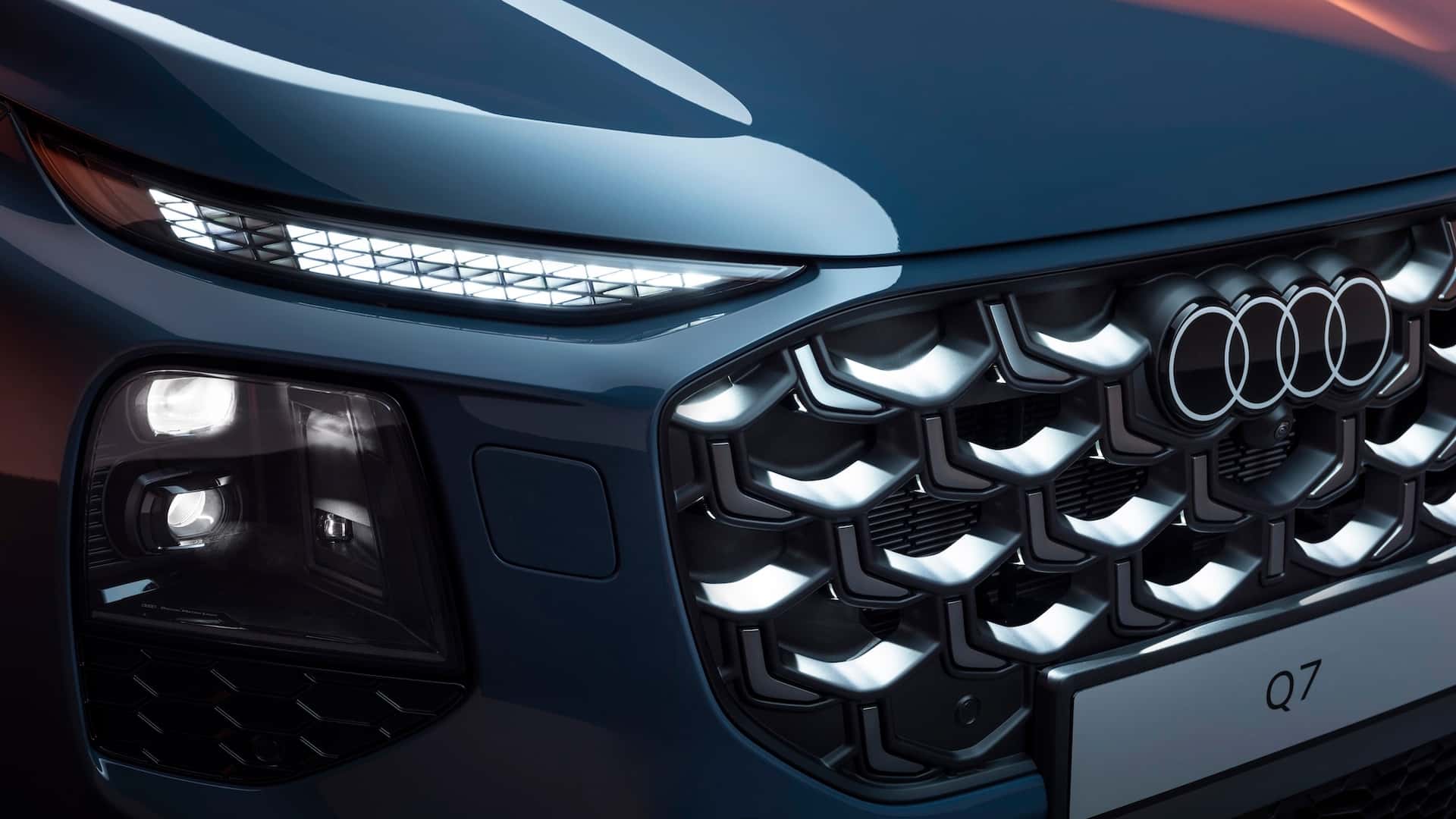
- The third-generation Audi Q7 will be available at launch only with a turbodiesel 3.0-liter V6.
- The luxury SUV has V6 and V8 gasoline engines in the United States.
- Audi will expand the European model’s lineup with a plug-in hybrid and a gas-fueled V6.
When Audi launched the third-generation Q7 yesterday, there was a huge discrepancy in the engine offerings between the European and North American versions. On the Old Continent, customers don’t get to choose because the luxury SUV is available at launch exclusively with a turbodiesel 3.0-liter V6 featuring mild-hybrid technology. In the United States, the Mercedes GLE rival comes with twin-turbo V6 and V8 engines.
We were just as surprised as you (probably) were to see Europe’s Q7 limited to a single engine, a diesel one at that. Diesel is on its last legs on the continent, having fallen dramatically from its popularity peak in the mid-2010s, when it represented more than half of all new car sales. Through the first four months of the year, diesel accounted for 6.7 percent of total registrations.
Naturally, we decided to ask Audi why the all-new Q7 carries only a TDI badge at launch in Europe. Although diesel is clearly on a downward trajectory, a company spokesperson said the powertrain was prioritized because it’s expected to be the most popular choice among buyers.
Photo by: Audi
‘Based on customer demand, we start with the most important engines per market or region. In Europe, this is the V6 TDI with 295 hp and 241 hp output. Both engines have MHEV plus technology with an additional 24 hp.’
Diesel First. Gasoline And Plug-In Hybrid Later
If you feel diesel is past its prime, Audi plans to expand the lineup with a V6 gasoline engine in Europe between late 2026 and early 2027. A plug-in hybrid powertrain will also join the range around the same time. An electrified version is no surprise, given that the Volkswagen Group already offers plenty of six- and eight-cylinder PHEVs across its vast portfolio.
There’s no word yet on whether Europeans will ever get the V8-powered SQ7, which is available at launch in North America, where the 4.0-liter engine produces 591 horsepower. Audi aficionados may remember that the Four Rings once sold the SQ7 with a V8 diesel in Europe before switching to a gasoline engine a few years ago. Strange times.
Since its launch in 2005, the Q7 has served as Audi’s largest SUV, but that’s about to change. The first-ever Q9 debuts later this year, and we’ve already seen its high-end interior. Predictably, the two luxobarges are cut from the same cloth, but the Q9 will add an extra dose of luxury and space.
In the meantime, the Q7 starts at €87,900 in Germany for the lower-powered version. There’s a good chance the V6 TFSI arriving in roughly six months will undercut the diesel.


57
Source: Audi
Motor1’s Take: Diesel may be gradually disappearing from Europe, but it remains fairly popular at the upper end of the segment. Its decline has been accelerated by increasingly stringent emissions regulations, which have forced many automakers to drop the fuel type from their smaller vehicles.
Diesel’s market share likely wouldn’t have fallen as sharply if mainstream brands had continued offering these engines in their smallest cars. Audi is still committed to TDI power, offering diesel engines in everything from the compact A3 and Q3 to the new Q7 and, likely, the upcoming Q9.
Read the full article here


