






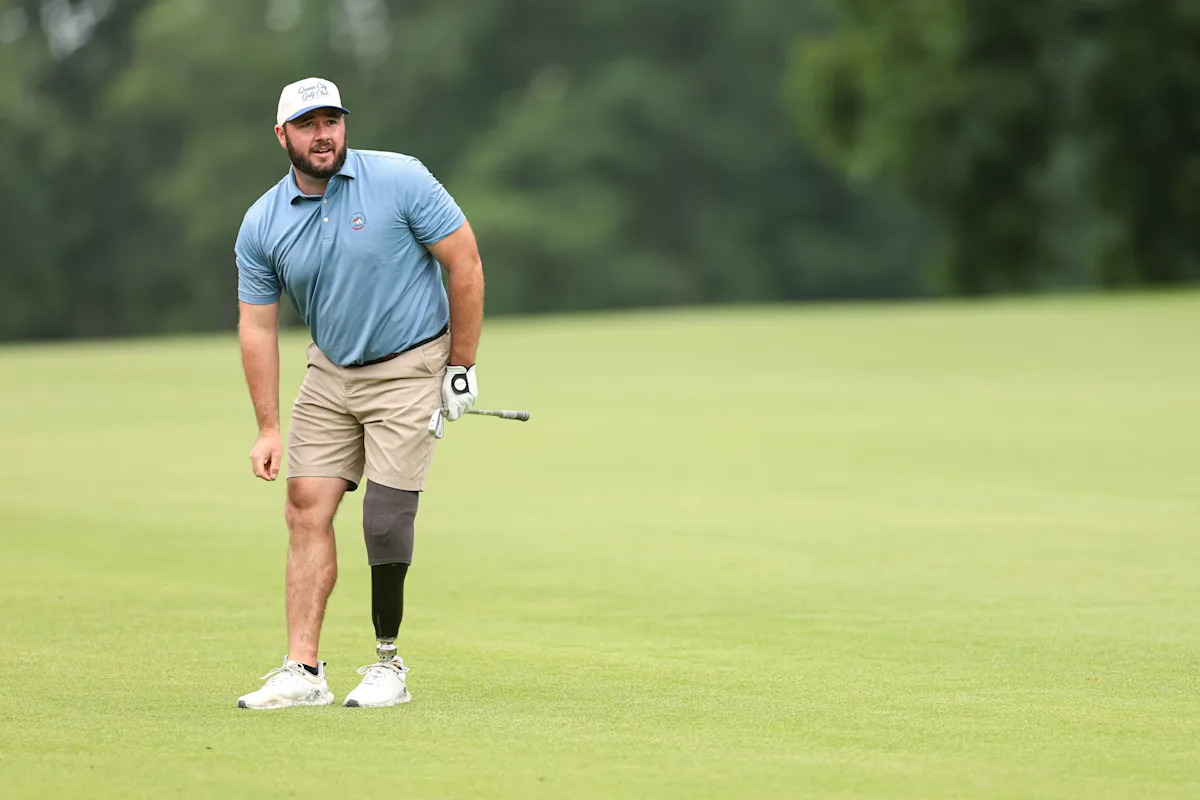
When the USGA announced the addition of the U.S. Adaptive Open to its list of championships, Zach Larose started playing golf again. He played his first adaptive golf tournament in 2023 and qualified for his first U.S. Adaptive Open in 2024.
Larose lost part of his left leg in a lawnmower accident nearly 32 years ago when he was 3 years old. Growing up in St. Albans, Vermont, a small town of less than 10,000 known for its annual maple festival, Larose was the only kid around with a physical disability.
Zachary Larose plays his shot on the 13th hole during the second round of the 2026 U.S. Adaptive Open at Woodmont Country Club (South Course) in Rockville, Md. on Tuesday, July 7, 2026.
At the Shriner Children’s New England in Springfield, Massachusetts, Larose was fitted for his first prosthetic and, during a month-long stay, learned how to walk for a second time. It was at Shriners that he first met other kids facing similar challenges.
Advertisement
Growing up, Larose played adaptive hockey and baseball. Golf became a staple in his mid-teens.
This week the father of two who works in finance is one of 96 players in the field at the fifth edition of the U.S. Adaptive Open. The 54-hole event is once again being held at Woodmont Country Club’s South Course in Rockville, Maryland. There were 250 entries for the championship, and qualifying took place at eight sites across the U.S. between April 22 and May 26.
Larose, a 3 handicap who shot 79-75, is competing in the lower limb impairment division, one of the championship’s eight categories.
“The people you meet, I mean, the talent that’s there is unbelievable,” said Larose of his first Adaptive Open. “Watching some of these other competitors play, it’s kind of your jaw hits the floor type moment.”
Over the winter at his home club, Verdict Ridge Golf and Country Club in Denver, North Carolina, Larose decided to do something different on Instagram (@the_iron_golfer). At the suggestion of a friend, he took off his prosthetic and hit a golf shot for the first time on one leg.
Advertisement
“I had started social media and was trying to find something creative to showcase, you know, not just myself, but what we’re capable of,” he said.
Larose first gave it a try on a par 3, and then decided to create a challenge. Could he make a par without his prosthetic on a par 3, par 4 and par 5?
“It was a challenge that I really wanted to conquer,” said Larose. “It was all new to me, in the sense that the first time I swung without my leg on was December of last year.”
Much has changed about the inaugural Adaptive Open since it began in 2022. There’s now a live television component to the event (Wednesday, 1-4 p.m. ET on Golf Channel). There are regional qualifiers (introduced in 2024). Last year, a cut was added to the championship and a partnership with Deloitte provided travel stipends for every player in the field.

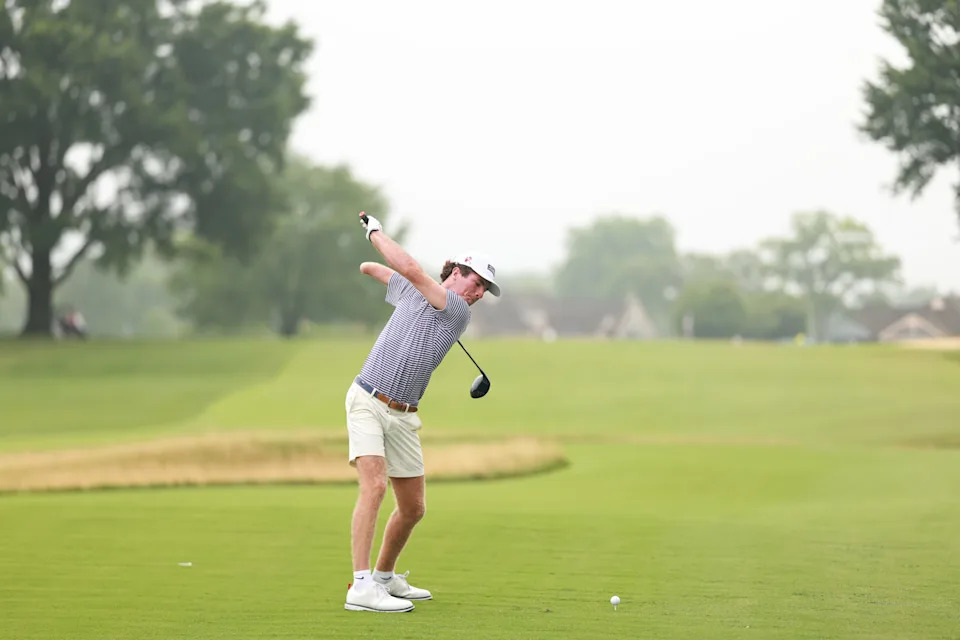
Tommy Morrissey plays his tee shot on the ninth hole during the second round of the 2026 U.S. Adaptive Open at Woodmont Country Club (South Course) in Rockville, Md. on Tuesday, July 7, 2026.
Ages this week range from 76-year-old Dennis Walters, winner of the 2022 U.S. Adaptive Open men’s Seated Players category and a member of the World Golf Hall of Fame, to 15-year-old Tommy Morrissey, who was born without the lower part of his right arm. Morrissey, who has more than 100,000 followers on Instagram, is one of 11 newcomers in the field.
Advertisement
“I mean, this means so much to me,” said Morrissey, who shot 79-76. “I knew about the U.S. Adaptive Open when I was seven, and I knew I wanted to be a part of it. To make it at such a young age, and especially qualifying for it my first attempt, means a lot.”
Larose, a former scratch player, has a goal of becoming a top 10 player in the world among adaptive golfers. That will take a little more dedicated practice, he admits, but raising awareness and meeting new people at these events ranks high for him too.
“I was telling a friend about this the other day,” said Larose, “when you show up to an adaptive golf tournament, I don’t think people who don’t see it day in day out, I don’t think they understand how inspirational it can be to others.
“I have a pretty minor disability in the grand scheme of things, probably one of the easiest you could have. So me seeing some of these other individuals go out and do what they do is really fun and just inspirational to myself.”
This article originally appeared on Golfweek: At U.S. Adaptive Open, the talent and athleticism is ‘unbelievable’
Read the full article here


