




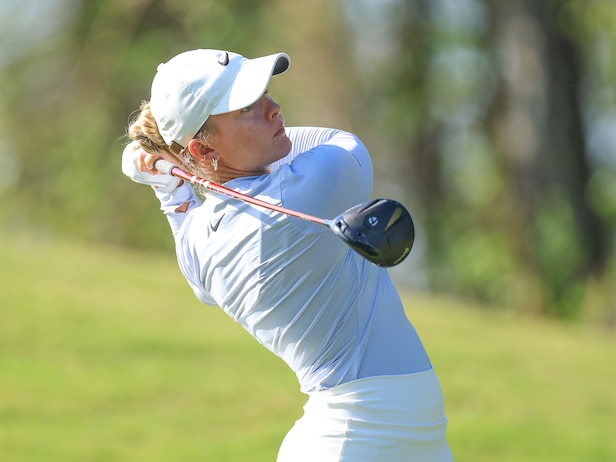
The clock was ticking. Ten seconds went by. Then 20. One near pull of the trigger. More seconds. A waggle this time. It kept ticking, and when the Golf Channel camera had stayed on Bailey Shoemaker for more than a minute, it was fair to wonder if she would ever hit her shot in the Augusta National Women’s Amateur.
Shoemaker, a junior at USC who was profiled by Golf Digest on Tuesday, eventually would make seven swings or waggles before hitting her tee shot on the par-3 eighth hole at Champions Retreat, and the time spent on the stopwatch manned by those staring at the TV came to about 1 minute, 16 seconds.
Advertisement
Predictably, social media almost instantly went nuts, with derogatory remarks, and comments like “brutal” and, “This is a major problem in the woman’s game. They need to fix this.”
Anybody who plays golf at any level knows that slow play is one of the game’s biggest problems, and also one of its toughest to solve because there is no shot clock. And when it happens at an elite level, the belief is that it only serves to validate deliberate play for everyone.
Of course, when someone takes more than one minute to hit a shot, there has to be a deeper explanation, and that’s the case for Shoemaker, a bright and personable 21-year-old who aspires to work in the national intelligence field someday. Right after the ANWA last year, Shoemaker felt unbearable pain while swinging. She was diagnosed with cubital tunnel syndrome—in which the ulnar nerve gets irritated or compressed at the inside of the elbow.
“Once I’d get to the top of my swing, I’d get a shooting pain down my arm, and then in my ring and pinkie finger they’d come up off my club,” Shoemaker told Golf Digest this week. “I lost motor control of them. I didn’t have any function over them, which was scary. It was bleeding into my sleep and just sitting, which was kind of tough. Very scary for a while.”
Advertisement
Rest and pressing on to try to play didn’t help, and Shoemaker eventually had surgery last October that has freed her of the pain.
“It took a while after surgery to fully set in because my nerve was re-adjusting, but now I’m 100 percent,” said Shoemaker, who fired a 66 in the third round of the 2024 ANWA to finish second.
The problem is that Shoemaker played long enough with that pain that she told Golf Channel’s Brentley Romine recently that she is still enduring a “mental battle” when she readies to hit a shot. That was evident on Wednesday, because at times, when she took the club back, it appeared that Shoemaker would follow through with the shot.
“Just trying to reassure myself that there isn’t pain anymore,” Shoemaker said. “I’ve been struggling with it for the last four months, just being fully committed to hitting the ball.”
Advertisement
Reached on the phone by Romine on Tuesday after her round, Shoemaker, sounding disappointed, said of her mental battle, “That’s what it looks like.”
Understand, slow play is not a career-long issue for Shoemaker. She is “one of the fastest players I’ve ever coached,” USC head coach Justin Silverstein told Golf Channel.
“It’s not easy what she’s going through as far as being able to swing comfortably and confidently,” he said. “She’s taking it back and her brain is still firing like it’s going to hurt, and that’s how she played all last spring.”
Despite dealing with that, Shoemaker has notched an impressive five top-10 college finishes in the spring. She shot one-over 73 on Wednesday to stand T-40 heading into the second round. The top 30 and ties will make the cut and play the final round at Augusta National on Saturday.
Advertisement
There is every reason to believe that Shoemaker will eventually trust her body again. Already, the injury gave her a new view of what’s important.
“I am just glad to be here right now,” Shoemaker told Golf Digest. “I have a new perspective on the game for sure, knowing what can happen if I don’t end up playing and it’s taken away from me. I love this game.”
Read the full article here


