




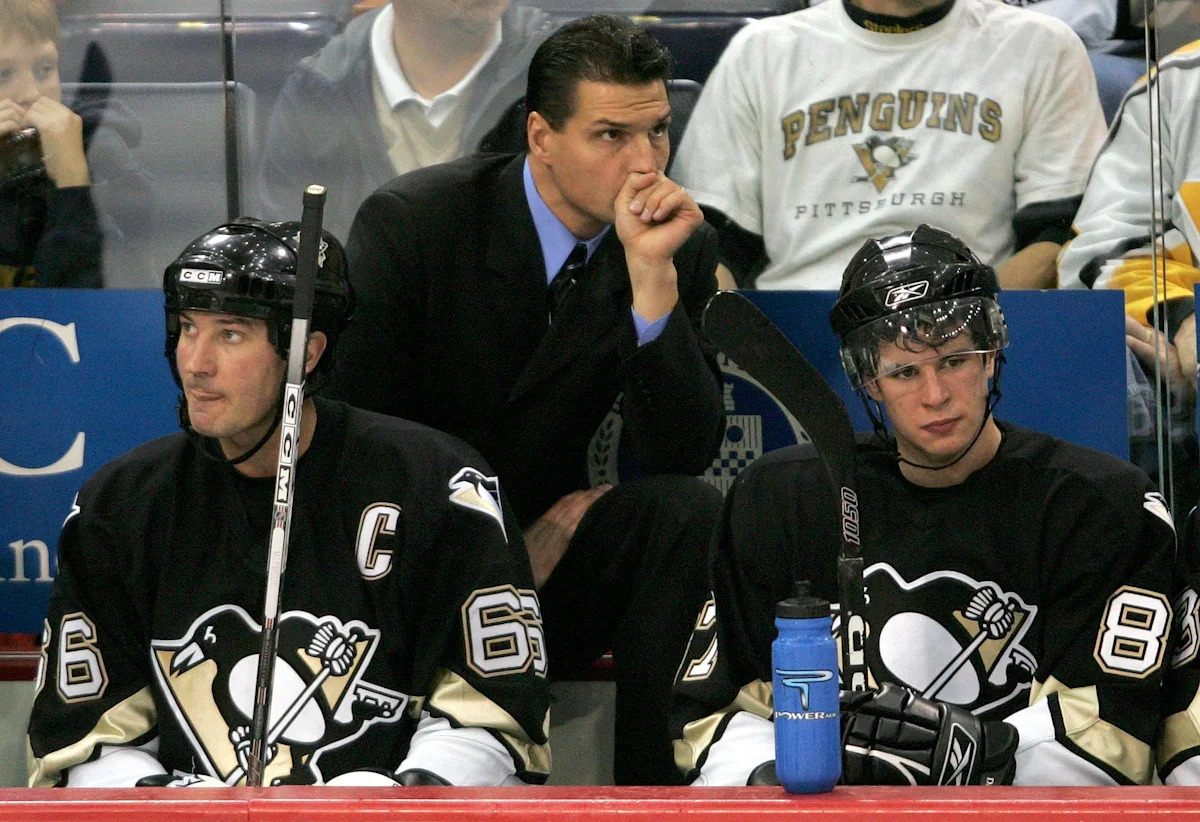
The swirls of player movement of this off-season reminded me about a crucial, unique time for the Penguins back in 2005 with just how extraordinary that summer was as far as pieces shuffling around the board.
The lockout that wiped out the 2004-05 season was over. There was a salary cap in place to stop teams like Toronto and the New York Rangers from spending $65+ million on player salaries, a fraction of the budget the Pens could afford. To make matters even better, Pittsburgh won a 30-team lottery to secure the rights to draft Sidney Crosby. Mario Lemieux was in the twilight of his career. Due to the lockout lasting a full year, there was an unbelievable amount of free agents looking for work.
Advertisement
It was such a swirl of activity. The Pens had a lot they needed to build, the 2003-04 version of their team was one of the worst in franchise history. They went 23-47-4 with eight ties, a record that belies just how bad they were. The Pens conceded 303 goals, a country mile ahead of the next highest scored upon team (Chicago at 258), while only scoring 190 of their own. Pittsburgh’s 58 points were last in the NHL, making it completely fitting that they got the 2005 first overall pick – it was surely earned and needed.
The addition of Crosby, plus a young core of players that did well in Wilkes-Barre during the 2004-05 lockout season (including Marc-Andre Fleury, Colby Armstrong, Ryan Whitney, Rob Scuderi, Michel Ouellet, Tomas Surovy, Max Talbot and Erik Christensen) had optimism abounding in Pittsburgh for a quick turnaround. Others like Ryan Malone, Brooks Orpik and Konstantin Koltsov were rejoining that core as well.
With all that young talent, the team needed sought and found some veteran anchors. Sergei Gonchar was given a rich contract in free agency after establishing himself as one of the top offensive defensemen in the game. Mark Recchi was signed up as well to rejoin the Pens. Maybe shockingly enough, a player known for his time with the Flyers and as one of the top power forwards of the 1990’s, John LeClair was also signed to Pittsburgh. The Pens added Zigmund Palffy, a player with then nine-straight point per game seasons. Jocelyn Thibault, a solid goalie from the early 2000’s, was added as a veteran partner for Fleury in the net.
Just like that the once dreadful team that limped off the ice in April 2004 was given a complete make-over by the fall of 2005 with all the individual talent and upgrades made up and down the lineup.
Advertisement
It all looked great in theory and on paper, which made the end result incredibly surprising. Almost everything went wrong.
Because just as dramatic as the flurry of additions, the subtractions started coming on much more than a normal year. Coach Ed Olczyk was fired early on as the train-wreck unfolded. Palffy took a hit so hard that he quit the team on the spot, never to play in the NHL again. An irregular heartbeat led to a hospitalization that ended Lemieux’s storied career. Recchi was traded at the deadline to Carolina, where he would win a Stanley Cup that year. The team by the end of the season was far different than the one that carried so much optimism and hope.
Other vets like Gonchar and LeClair performed in what looks like a decent manner statistically 20 years later but struggled to varying degrees with their new team. Most of the young players other than Crosby had uneven seasons, some had their moments like Armstrong finishing the year with 40 points in 47 NHL games, mostly a product of being propped up from playing with Crosby.
In the end, the 2005-06 Penguins finished with 58 points – amazingly the same exact total as they had in their prior year with a much more bare bones lineup in terms of talent, giving up 316 goals along the way in a more wide-open style of hockey without two line passes getting called and more penalties in the post-lockout world.
Advertisement
At that point, more changes were on the horizon. General manager Craig Patrick was relieved of his duties, the Pens would turn the page and try again. Jordan Staal was drafted and Evgeni Malkin was signed to further lean into a youthful build. From there, the Penguins were on their way to being one of the best teams in the cap era. Crosby would win the scoring title and league MVP at age-19 in his second season in 2006-07. The Pens would make the playoffs in 2007, go all the way to the Stanley Cup Final in 2008 and win the whole thing in ’09.
None of that was assured in 2005, and looking back it’s wild to see just how disjointed a team could be in the spring of 2006 and eventually put together a championship pedigree in seemingly no time at all. The very first attempt of team-building in the Crosby era, centered around Palffy, LeClair, Gonchar, Recchi and Thibault had more misses than hits, though it ultimately only served to briefly delay and not completely detail the Pens’ ascent.
There could be a bigger lesson about attempting a shortcut to force in marquee players to a team, which sometimes plays out in hockey. Nashville somehow got worse immediately after adding Steven Stamkos, Jonathan Marchessault and Brady Skjei in more recent times. In short, it just didn’t work out. Olczyk never was a head coach again and was arguably out of his depths. The team’s cohesion levels, especially defensively, never matched the ambition shown by adding a handful of top players who didn’t help them where they were already weak. It’s hard to knock the Penguins for being aggressive since that type of player acquisition made them great under Patrick in the ’90s. It just didn’t work out this time around.
Read the full article here


