





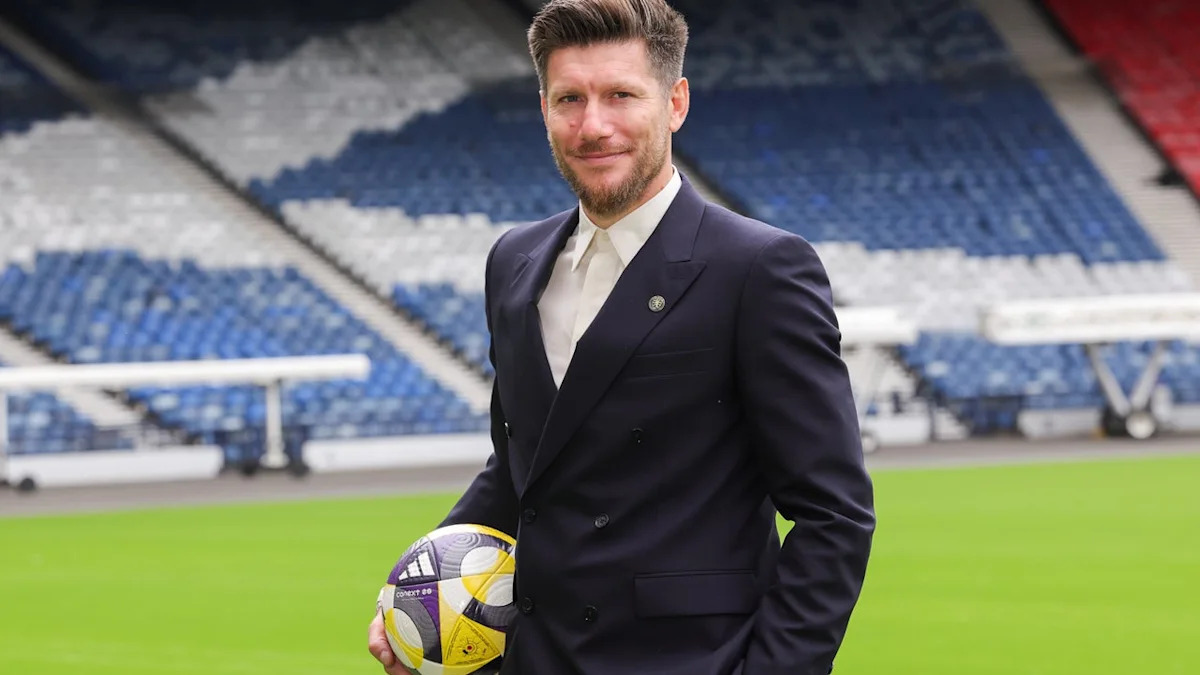
Other appointments may have attracted more attention across the increasingly star-studded realm of international managers. It is hardly Sebastien Pocognoli’s fault, though, that unlike Jurgen Klopp or Zinedine Zidane or Thomas Tuchel or Carlo Ancelotti he is not yet a Champions League winning coach, armed with a CV that contains titles and trophies at Europe’s biggest clubs. At 39, the Belgian is at the start of his managerial career, rather than approaching the end, having overseen just 107 senior games in spells at two clubs, Union Saint-Gilloise and Monaco.
But look around the countries embracing a fresh start following the summer’s World Cup and there is an argument that the challenge facing Pocognoli with Scotland is the most compelling of all. That the Scottish Football Association has embraced the opportunity for a clean slate with such a bold and left-field choice, following seven years of playing safe under the risk-averse Steve Clarke, is notable in itself; Pocognoli has been charged with taking Scotland in a new direction, just at the moment when the options available to the Scotland manager have undergone a drastic change.
When Clarke took charge and named his first squad in May 2019, 15 of his 27-man group played in Scotland, with a further 11 from the Premier League or the Championship in England. By contrast, Pocognoli’s first squad named ahead of the new season of the Nations League features as many names who play in Italy (six) as there are from the Scottish Premiership, and that’s still without the unavailable Serie A-based Scott McTominay and Che Adams.
Advertisement
While Clarke was often criticised for sticking with many of the same faces, Pocognoli has thrown his net wide to reveal just how continental Scotland’s selections have become. The eight uncapped members of Pocognoli’s new-look squad include first-time call-ups for centre-back Luis Binks, the 25-year-old captain of Danish side Brondby, and 22-year-old striker Robbie Ure, a former Rangers prospect whose goalscoring feats for IK Sirius in Sweden led to a move to LaLiga and Sevilla last month.
A hesitancy to play and live abroad, with a new language and different culture, led to Scottish players becoming undervalued by the rest of Europe. But with the rise of analytics and data-led scouting, players from the Premiership could be viewed by clubs from countries such as Italy like any other potential asset. Following the examples of Liam Henderson, Aaron Hickey, and Lewis Ferguson, who captained Bologna to their first Coppa Italia in 50 years, as well as McTominay’s extraordinary success at Napoli, there are now more pathways for young Scottish players to take.
The issue, perhaps, is how it relates to a problem closer to home. Scotland’s group-stage exit from the World Cup, where they had the sixth-oldest squad on average at the tournament, led to another round of soul-searching within the SFA. A summit of all 42 clubs in the top four divisions was held earlier this month in St Andrews. They were told that players eligible for Scotland’s Under-21s made up just 4.1 per cent of available minutes in the Premiership last season, compared to 17.6 per cent of available minutes in 2013.
The SFA’s message was that young Scottish players were not being given enough of a chance. Ure has become an example of someone who could have fallen through the net. He played just two senior minutes for Rangers, in two substitute appearances, before leaving for Anderlecht as a teenager, where he found opportunities to play in the Belgian side’s reserve team easier to come by and ultimately developed into a striker wanted by Sevilla for £5.5m.
Scotland international Robbie Ure (right) in action for Sevilla against Barcelona (AP)
For the long-term health of the domestic game and national team, the SFA wants to incentivise Scottish clubs to offer more game time to homegrown players. It is down to Pocognoli, meanwhile, to harness the current environment. In recent years, Scotland players have been joining up with the national team to swap stories of different experiences playing for clubs around Europe. Can Pocognoli, in the mould of a young and progressive coach, shape a new-look team that mixes Scotland’s identity and the influences of abroad?
Advertisement
It helps, then, that he has a blank canvas to work with. For all of Clarke’s achievements in taking the Tartan Army to three major tournaments and ending a 28-year wait to appear at a men’s World Cup, there was a clear appetite for change in the wake of another familiar group-stage exit and how painfully uninspiring Scotland’s football became. Pocognoli can represent the opposite: promising a more dynamic style of play that aims to be aggressive and on the front foot.
If Pocognoli’s task is picking the players who fit his system, opening up the criteria for selection while leaving some of Clarke’s tried-and-trusted behind is the only way to find them. Injuries and absences have forced the Belgian’s hand somewhat, with all of McTominay, Adams, Lawrence Shankland, Kieran Tierney and Kenny McLean unavailable for the fixtures against Slovenia, Switzerland and North Macedonia. There could be several debuts handed out over the next two weeks.
Scotland’s first squad under Pocognoli
Goalkeepers: Scott Bain (Falkirk), Angus Gunn (San Jose Earthquakes), Liam Kelly (Rangers), Jon McCracken (Bradford City)
Advertisement
Defenders: Luis Binks (Brondby), Josh Doig (Sassuolo), Colby Donovan (Celtic), Luke Graham (Stoke City), Jack Hendry (Al-Ettifaq), Aaron Hickey (Brentford), Scott McKenna (Dinamo Zagreb), Nathan Patterson (Torino), Andy Robertson (Tottenham), Stephen Welsh (Swansea City)
Midfielders: Ryan Christie (Bournemouth), Lewis Ferguson (Bologna), Billy Gilmour (Napoli), John McGinn (Aston Villa), Josh McPake (Hearts), Lennon Miller (Udinese), Kristie Montgomery (Blackburn Rovers)
Forwards: Kieron Bowie (Sassuolo), Findlay Curtis (Rangers), Ben Gannon-Doak (Bournemouth), Oli McBurnie (Hull City), Robbie Ure (Sevilla), James Wilson (Hearts)
Pocognoli himself remains something of an untested gamble. The former West Brom defender, capped 13 times by his country, won the Belgian league title during his first senior position at Union Saint-Gilloise, the data-driven club who were transformed under Brighton owner Tony Bloom, but he was then sacked by Monaco at the end of last season after just 38 matches. He would have been the youngest coach of the 48 teams at this summer’s World Cup, had he swapped places with the 63-year-old Clarke, and has vowed to set up his team in a way that can stir and mirror the Hampden roar.
Advertisement
Beyond that, Scotland supporters will be spending the international break getting to know a coach many would not have heard of before the World Cup, while getting to see some players who have barely played in the Premiership. It’s a bold step into the unknown for everyone, but it also feels a necessary one.
Read the full article here