





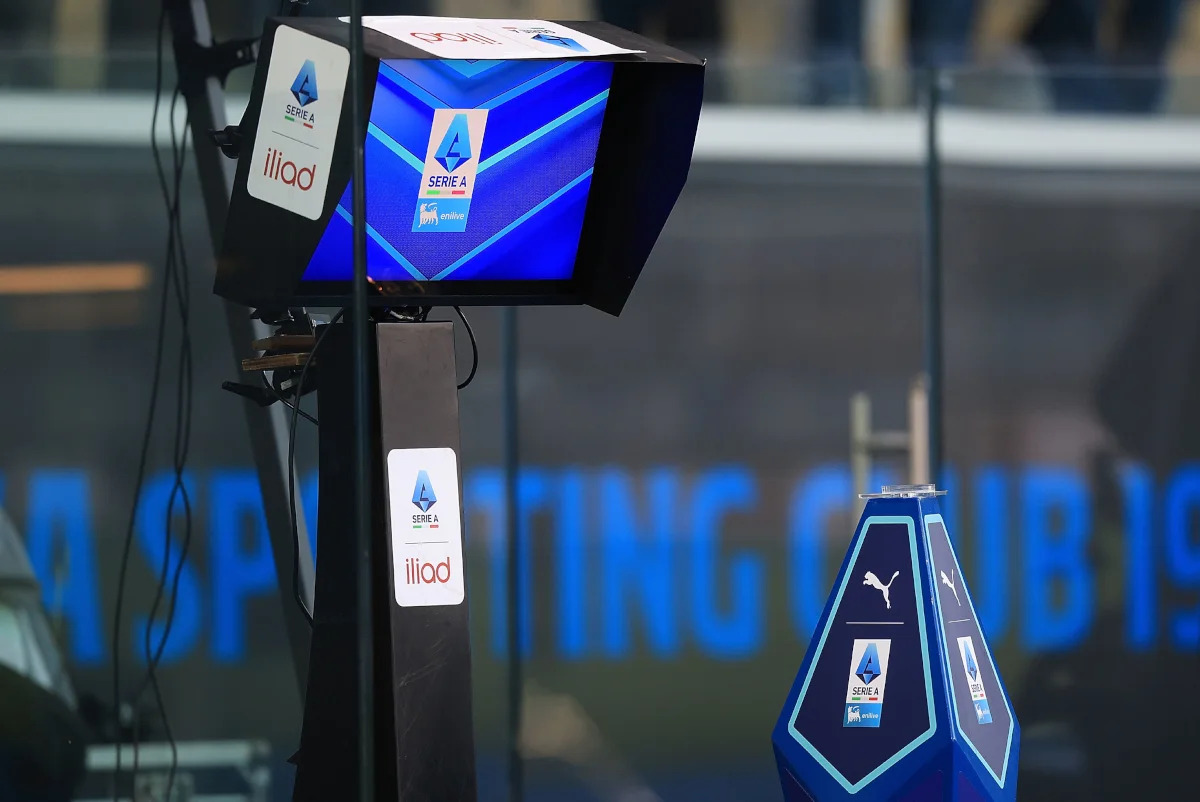
Refereeing designator Daniele Orsato outlined the statistics showing how this season’s new approach to fouls and VAR has transformed Serie A. ‘The objective is to favour football.’
The officials made it clear from the summer that they would be taking a looser view of the sport, after criticism from players and coaches that there were too many soft free kicks.
Advertisement
This in turn slowed down the overall tempo of the game, which became particularly evident when Italian teams had to play in Europe and were easily out-run.
Serie A referees and VAR changed tack
BERGAMO, ITALY – MAY 12: Referee Simone Sozza checks the pitch side VAR monitor during the Serie A match between Atalanta and AS Roma at Gewiss Stadium on May 12, 2025 in Bergamo, Italy. (Photo by Marco Luzzani/Getty Images)
Today the Lega Serie A, the Italian Referees’ Association and representatives from the 20 Serie A clubs met at the Lissone VAR hub near Milan to discuss the five rounds played so far this season.
Advertisement
There were errors that the referees admitted to, but other situations where they stood their ground, insisting that VAR must only intervene in case of clear and obvious error, or a situation that the referee did not have a good view of.

MILAN, ITALY – OCTOBER 19: Referee Daniele Chiffi cancels a goal for Udinese Calcio after consulting the VAR during the Serie A match between AC Milan and Udinese Calcio at Stadio Giuseppe Meazza on October 19, 2024 in Milan, Italy. (Photo by Marco Luzzani/Getty Images)
“We want to give a direct contribution to improving the spectacle offered,” said refereeing director Domenico Messina.
Advertisement
“We’re working to avoid errors, but will not take a single step back on the approach we have taken, especially as it is shared by all the coaches who are present.”
The statistics make clear that the changes are having a big effect on the flow of the game.

ITALY – SEPTEMBER 20: Mario Gila of AC Milan passes the ball under pressure from Joel Monteiro of U.S. Lecce during the Serie A match between AC Milan and US Lecce at Stadio Giuseppe Meazza on September 20, 2026 in Italy. (Photo by Marco Luzzani/Getty Images)
The average time spent with the ball in play is now 59 minutes and 31 seconds, over five and a half minutes more than the last two seasons.
Advertisement
There are on average 22.6 fouls awarded per match instead of 26.23, fewer even this season than the Premier League’s 23.28.
Only two penalties have been given in Serie A this season, compared to nine at this stage in 2025/26, and 14 in 2024/25, even 16 in 2023/24.

MONZA, ITALY – SEPTEMBER 18: Gustavo Varela of AC Monza scores his team’s second goal from the penalty spot during the Serie A match between AC Monza and US Sassuolo at U-Power Stadium on September 18, 2026 in Monza, Italy. (Photo by Marco Luzzani/Getty Images)
The number of yellow cards has also dropped from 3.53 per game to 3.03, with two red cards compared to six at this point in 2023/24 and 2024/25, and five last season.
Advertisement
The biggest shift has been on VAR interruptions, just one On-Field Review this season, compared to six or eight in the last three terms.
“The objective is to favour football and not blow the whistle for the slightest contact,” added refereeing designator Orsato.
“These are the guidelines we are sticking with throughout the season.”
Read the full article here