





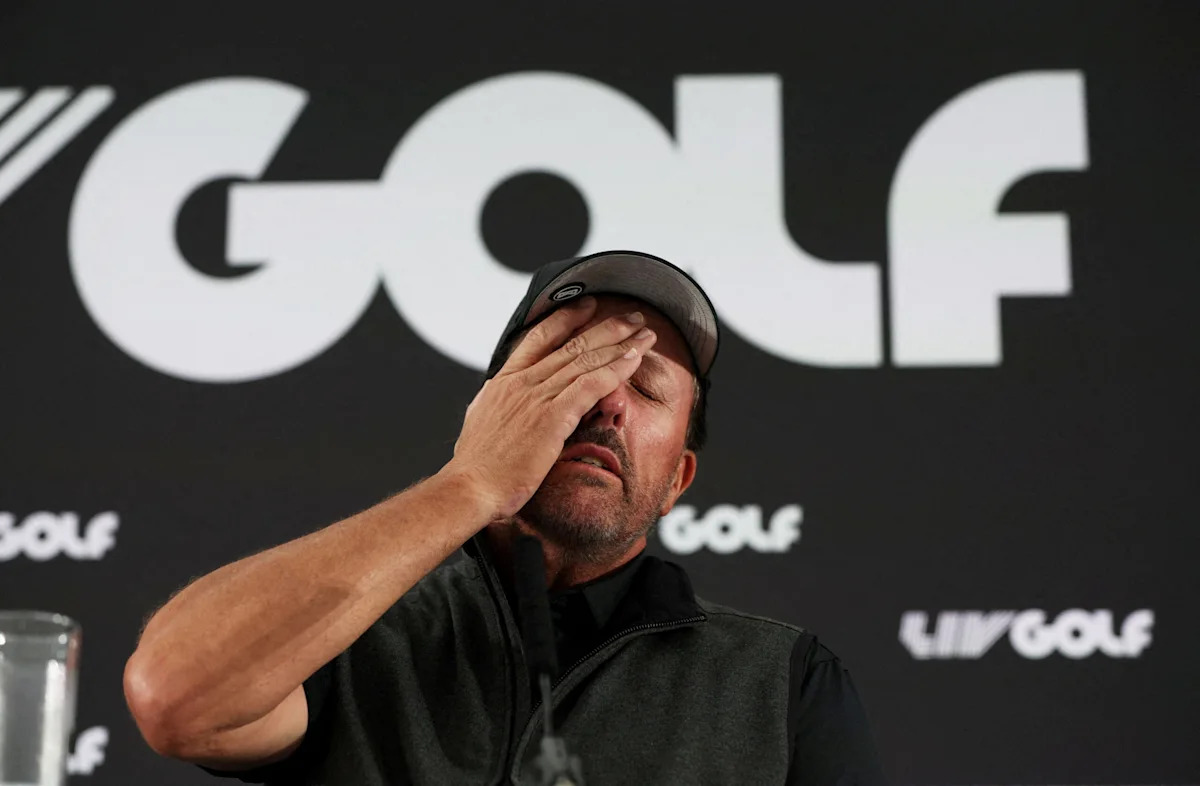
A private meeting during the Open Championship at Royal Birkdale helped reshape the men’s professional golf landscape, with the Asian Tour turning away from LIV Golf and striking a new agreement with the DP World Tour and PGA Tour.
The dramatic change followed the Public Investment Fund’s decision to withdraw its multi-billion-dollar backing from LIV Golf. For the Asian Tour, which had developed a close relationship with LIV through the International Series, the news arrived at an especially difficult moment.
Advertisement
Asian Tour chief executive Cho Minn Thant said discussions about extending the partnership were still underway around the Masters.
“It was the week right after the Masters when LIV Golf was in Mexico. We found out at that time,” Cho said.
The uncertainty went beyond LIV itself. Asian Tour officials initially did not know whether the withdrawal would also affect the International Series, or how quickly the funding would disappear.
“It was a really abrupt thing that happened, and it was very surprising news because, up until the Masters, we were still talking to LIV Golf about the next few years of a partnership,” Cho explained. “We were talking about expanding the International Series, and it came as a total surprise.”
Advertisement
Asian Tour Scrambles After LIV Golf Funding Shock
Action Images via Reuters
The consequences quickly became clear.
The Asian Tour began 2026 expecting a 21-event schedule and was looking toward another five years alongside LIV. Instead, the lucrative 10-event International Series was disbanded, leaving officials scrambling to protect the remainder of the calendar.
Planned tournaments in China and India will not take place. The Philippine Open will remain on the Asian Tour schedule in November, though with reduced prize money, while the Saudi International continues as a $5 million event.
Faced with that upheaval, Cho began exploring alternatives almost immediately.
Advertisement
“We’ve been talking since April,” he said of negotiations with the DP World Tour and PGA Tour. “When the news broke, I had to pivot and start talking to the DP World Tour and PGA Tour.”
Meetings followed in May and June before the decisive discussions took place at Royal Birkdale during the Open Championship.
“Then at the Open Championship we were able to agree to broad terms,” Cho said.
Importantly, the Asian Tour had not immediately ruled out continuing with LIV. Cho said officials remained in contact with the league while monitoring its attempts to obtain new financing.
Advertisement
But the Asian Tour had schedules to build and players who needed tournaments.
“We just couldn’t wait any longer,” Cho said. “We had the second half of the schedule on the Asian Tour to get on with. We already planned events in 2027.”
Royal Birkdale Deal Leaves LIV Without Its Feeder Circuit
Under the new arrangement, the Asian Tour will co-sanction five tournaments with the DP World Tour, including the Hong Kong Open and Singapore Open. Those tournaments are expected to feature split fields, with approximately 50 to 60 Asian Tour positions available.
The deal also strengthens the route from Asia to the DP World Tour. In addition to the Asian Tour Order of Merit winner earning a DP World Tour card, players will have five co-sanctioned opportunities to win and move directly onto the European circuit.
Advertisement
That helps protect opportunities for the Asian Tour’s leading players. However, Cho acknowledged there is still work to do for golfers further down the membership list who benefited from the larger purses and opportunities the International Series provided.
For LIV Golf, meanwhile, losing the Asian Tour partnership creates another complication at a particularly difficult time.
The Asian Tour had effectively provided LIV with an important second-tier structure, including promotion and relegation opportunities. Its national opens were also expected to play a role as LIV attempted to build a schedule after losing PIF backing.
LIV’s proposed “2.0” model now has to operate without that established feeder circuit, potentially complicating its efforts to maintain a structure compatible with world ranking points.
Advertisement
Cho said LIV chief executive Scott O’Neil wanted the Asian Tour to remain involved and presented proposals concerning future investment. Walking away was therefore not an easy decision.
“The International Series meant so much to us,” Cho said. “It was a tough decision. LIV Golf were good partners.”
The separation is not absolute.
LIV players are expected to receive opportunities at Asian Tour events, including the Hong Kong Open, while invitations will also be available for the Saudi International and Philippine Open. Many LIV golfers remain Asian Tour members.
“I expect quite a few of them to play on the Asian Tour next year,” Cho said.
Advertisement
Cho Maps Out the Asian Tour’s Post-LIV Rebuild
Despite the abrupt ending, Cho’s assessment of the five-year relationship was straightforward. He credited the LIV-backed investment with improving fields, increasing prize money and raising the Asian Tour’s standing within professional golf.
Now comes the harder part: replacing what disappeared.
Players have understandably been concerned. Cho addressed the entire membership at an AGM, explaining the loss of PIF and LIV sponsorship, the new agreements with the DP World Tour and PGA Tour, and plans for rebuilding the schedule.
The immediate objective is stability, not an overnight replacement for everything the International Series provided.
Advertisement
“We’re going to take the rest of 2026 and 2027 as rebuilding years and hopefully back to full strength in 2028,” Cho said.
The Asian Tour’s relationship with the established tours has also changed sharply. During its LIV partnership, the circuit could be viewed as a competitor to the DP World Tour. Following the collapse of its previous funding arrangement, those old battle lines have shifted.
Cho described the decision in practical terms.
“I just think we have to adapt to whatever the market dictates,” he said. “I don’t think there’s any feeling of resentment or anything like that.”
Advertisement
He still regards the Asian Tour as Asia’s premier circuit, while acknowledging that it currently sits below the PGA Tour and DP World Tour in the professional hierarchy.
His longer-term target is ambitious but specific: rebuild the Asian Tour to between 25 and 28 tournaments and establish it as what he described as “legitimately the third biggest tour in the world.”
Only months earlier, the Asian Tour was discussing an expanded International Series and another five years alongside LIV Golf. By the time the Open Championship arrived at Royal Birkdale, its leadership was negotiating a very different future.
The agreement reached there gave the Asian Tour a route forward. For LIV, it removed a partner that had been deeply embedded in its plans, and left its post-PIF rebuilding effort with another major problem to solve.
Read the full article here