





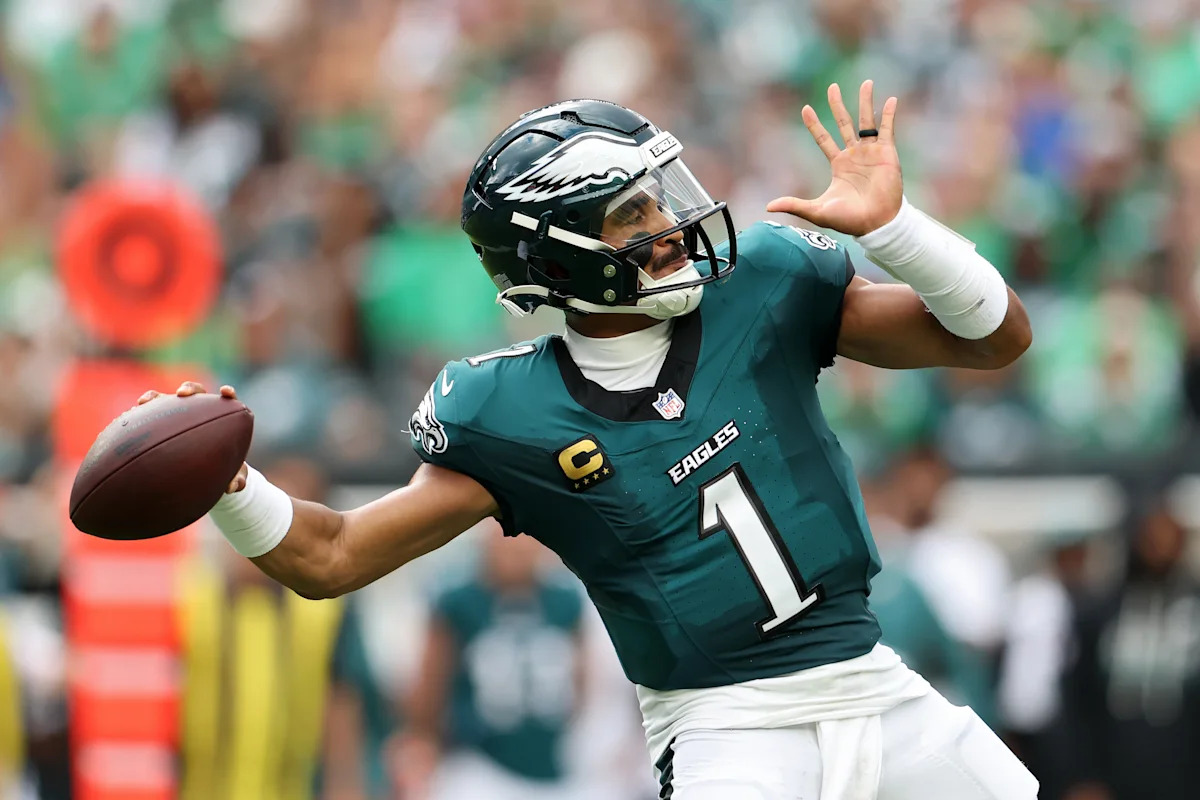
PHILADELPHIA — The reports stacked like cars piling up in Sunday traffic on Interstate 95 en route to Lincoln Financial Field. More than ever, the willingness of Eagles quarterback Jalen Hurts to adapt as a signal-caller and detach from his comfort zone has been under the microscope.
One dispatch chronicled Hurts’ involvement in an underwhelming “four verts” play-call that resulted in Philadelphia’s drama-infested 2025 campaign ending with an anticlimactic whimper during the wild-card round of the playoffs versus the San Francisco 49ers. That April 1 report from ESPN also detailed how, on a much larger scale, Hurts had resisted certain creative modifications that would have diversified the Eagles’ offensive scheme.
Advertisement
For much of last season, beleaguered play-caller Kevin Patullo bore the brunt of criticism regarding the shortcomings of a star-studded yet stuttering Eagles offense. But in the court of public opinion, Hurts wasn’t absolved of blame.
He rolled with the punches this offseason. This Sunday, in a 24-22 season-opening victory over the Washington Commanders, he finally got to throw his own haymakers — with a new offensive coordinator in place, the makings of an explosive attack on display and a nascent narrative sprouting amid the honeymoon of that QB-OC marriage.
Hurts threw for 203 yards and three touchdowns without turning the ball over. He, first-year offensive coordinator Sean Mannion and the unit altogether had to work some kinks out — the same was true for Jayden Daniels and a similarly madeover Commanders offense now coordinated by their young former NFL backup QB-turned-OC, David Blough — however, Philadelphia’s play in the other two phases of the game allowed its offense to grow through its pains.
Advertisement
There were stretches where Mannion’s offense didn’t look pretty. The run game was paltry far too often, actually, with the Commanders mounting 10 tackles for loss. That said, Hurts’ three-touchdown performance, running back Saquon Barkley ripping off a 42-yard run (when he had only four runs of 20-plus yards all last season) and the rise of wideout Dontayvion Wicks are all reasons for optimism, particularly following a 2025 season that was full of head-scratching, mostly stale offense.
“I know how the media is and how Philly is, and we like to overreact a little bit, but it’s not a finished product,” Barkley said. “We’re going to keep working. We’ll keep trusting Sean, we’ll keep trusting the system. We’ll find ways to just continue to get better.”
Besides, when it mattered most, the explosives popped, including a 22-yard Hurts scramble on third-and-18 that preceded a 43-yard catch-and-run touchdown by tight end Dallas Goedert in the fourth quarter. The Eagles emerged victorious from an NFC East battle that slogged at times but ultimately thrilled in the final frame, as defensive tackle Moro Ojomo stymied Washington’s potential game-tying 2-point conversion attempt with 61 seconds left.
It usually takes at least a few weeks for the identity of an overhauled offense to crystallize in the NFL. The proof of concept is in place for Mannion, though. Hurts illustrated the blueprint.
Advertisement
“I think it just says a lot about his ability to adapt,” Eagles right guard Tyler Steen said of Hurts afterward. “Whenever the challenge is presented to him, he always takes it full-on. I think he just showed that today.”
Operating in a Mannion system that pulls from the teachings of Los Angeles Rams head coach Sean McVay and 49ers head coach Kyle Shanahan, the 28-year-old dual threat QB auspiciously navigated a paradigm shift that deviates from several of his reported preferences.
The 34-year-old Mannion has concocted an offense that leans on under-center play and pre-snap motion, plus pure-progression passing, which calls for the quarterback to move through a series of predetermined routes, where timing is integral, namely on throws over the middle. Hurts has been criticized for his perceived reluctance to target that zone in the past, and his ability to effectively function outside his wheelhouse has been questioned by some.
Yet, against the Commanders in Week 1, he made an array of game-changing plays that countered his doubters. His 64-yard second-quarter dime to Wicks began with Hurts under center. And both of his scoring strikes to Goedert were over the middle.
Advertisement
“Down the middle touchdowns are f***ing awesome,” Eagles left tackle Jordan Mailata told Yahoo Sports in the locker room postgame. “People saying that J can’t read or throw down the middle of the field — boom, does that s***.”
Mannion won his first chess match: ‘Sean did a hell of a job with going to those things that he [saw]’
Mannion spent nine seasons in the league as a reserve quarterback after starring at Oregon State. A 2015 third-round draft pick, he appeared in 14 games during that near-decade span. What he lacked in playing time, he gained in knowledge, absorbing concepts from a bevy of today’s NFL head coaches, like McVay, Kevin O’Connell of the Minnesota Vikings, Kevin Stefanski of the Atlanta Falcons and Klint Kubiak of the Las Vegas Raiders while he played for the Rams from 2015-18 and then bopped between the Vikings and Seattle Seahawks from 2019-23.
Mannion is a third-year NFL assistant, having previously studied under another head coach known for his offensive chops, Matt LaFleur, as a Green Bay Packers staffer the past two seasons.
Advertisement
He’s also Hurts’ seventh play-caller in seven pro seasons. There had been five before him in the Nick Sirianni era alone. Shane Steichen and Kellen Moore were such big hits that they landed head-coaching jobs. Brian Johnson and Patullo didn’t pan out. Sirianni himself actually commanded the offense for a chunk of his first go-around at the helm before he handed off play-calling duties to Steichen.
Stability could go a long way for Hurts. That, of course, requires Mannion to do his part. Although he has a learning curve, too, he came out of his first regular-season game with a win, a milestone Hurts characterized at the podium as “a big-time deal.”
Chunk plays made the difference in a duel with another first-time NFL coordinator, Washington’s Daronte Jones, who deployed Brian Flores’ inspired disguises throughout Sunday’s chess match.
“Those ones where we hit explosives, whether it was a pass, whether it was a Jalen scramble, whether it was a Saquon run, we ended up scoring on those drives,” Sirianni said.
Advertisement
“So you can see how important that is to the flow of the game and scoring points.”
Hurts ignited the crowd with his deep shot to Wicks in the first half. It precipitated from a 13-personnel look.
The Eagles had three tight ends on the field, seemingly signaling the ground attack after, on the play prior, Barkley gained 6 yards on a wide-zone run (part of a run scheme that Mannion ushered in this offseason as well). Hurts was once again under center, except this time he faked the handoff and unleashed a sublime spiral.
He dropped a perfectly placed pass over Commanders cornerback Mike Sainristil and into the hands of Wicks, the start of the former Packers receiver’s 2-catch, 73-yard, 1-touchdown coming out party in South Philly.
Advertisement
“It’s a really good feeling when the d-line is playing it one way and expecting outside zone and then we run play-action,” Steen said. “It makes it easier for us to pass block because they’re playing that run. So I think just continuing to build off each play and build off drives and the whole game itself, I think it’s going to be big for us.”
Wicks’ scoring grab came two drives after he took the top off the defense. Mannion picked a play that sent Wicks in motion, from right to left. Sainristil followed him, but Wicks had inside leverage and left him in the dust as he broke out toward the corner of the end zone for a 9-yard touchdown that was made possible by a fadeaway toss from Hurts.
Advertisement
The Eagles used a noticeably high volume of pre-snap motion Sunday a season removed from deploying it on the second-fewest snaps of any team in the NFL, per Next Gen Stats. Wicks explained that the movement can give offensive players like him, in addition to an OC such as Mannion, a “tell,” often unveiling a defense’s coverage.
When asked if he could feel Mannion targeting mismatches throughout the game, Wicks said, “Yeah.”
“I mean, that’s the biggest thing,” he continued. “You see it, go at it. So I think Sean did a hell of a job with going to those things that he [saw], that he [saw] was going to come open.”
Read the full article here