





-
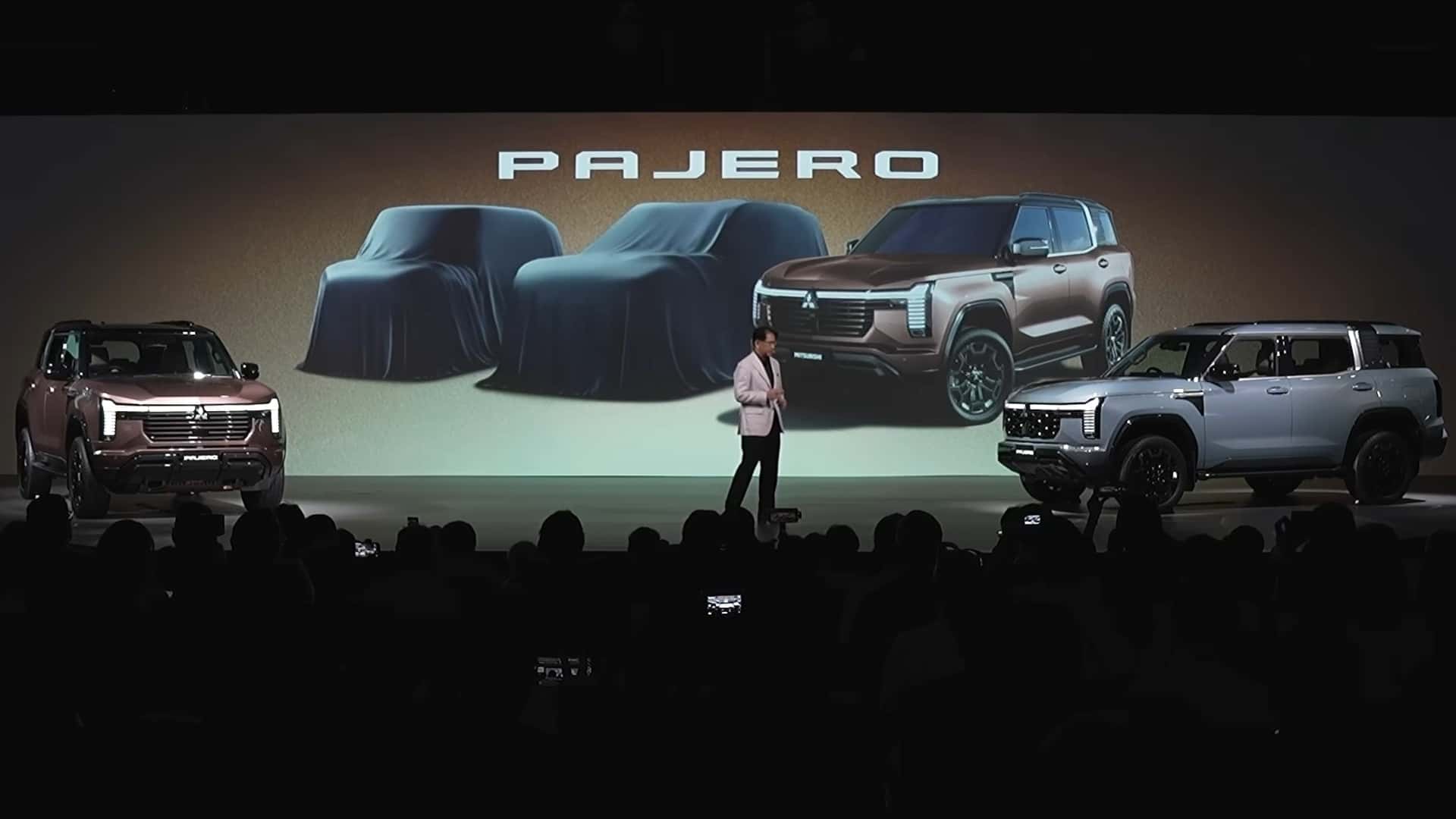
Mitsubishi is expanding the Pajero nameplate to cover multiple market segments.
-
A compact and an even smaller Pajero will slot below the full-size SUV.
-
Meanwhile, the flagship Pajero will be sold in more than 100 countries and regions.
Following a five-year hiatus, Mitsubishi has brought the Pajero back from the dead. To make up for lost time, the revived off-roader won’t remain a one-model affair. The Japanese automaker has confirmed plans to expand the legendary nameplate into a broader family, with at least two smaller SUVs joining the full-size flagship.
The first member of that family has now been revealed. The new Pajero is a proper off-roader riding on a ladder-frame platform derived from the Triton pickup truck. During the world premiere this week, a compact model and an even smaller SUV briefly appeared in the background under covers. Since they’re not coming anytime soon, the company hasn’t provided any details about either, but they’re clearly much smaller.
Indeed, the flagship is the biggest of the bunch. Measuring 4,920 millimeters (193.7 inches) long, 1,925 mm (75.8 in) wide, and 1,910 mm (75.2 in) tall, it has the footprint you’d expect from a full-size SUV. A 2,870-mm (113.0-in) wheelbase helps create room for three rows, while the ladder-frame construction gives it the hardware needed for serious off-road driving.
Photo by: Mitsubishi
Ladder Frame Or Unibody? Likely The Latter
What remains unclear is just how closely the upcoming models will follow the flagship’s off-road formula. Mitsubishi has yet to say whether the compact and small SUVs will use body-on-frame construction or adopt more conventional unibody architectures. We’re leaning toward the latter, especially for the entry-level Pajero, which appears delightfully petite. Engineering a new platform would be costly, especially for a company that isn’t exactly going through the best of times.
The Triton-derived platform makes sense for a large, serious off-roader, but a much smaller SUV could benefit from a lighter and more efficient architecture. Mitsubishi has plenty of experience building crossovers, so we wouldn’t be surprised if the smaller Pajeros take a somewhat different approach. Either way, both additional models are likely to combine boxy styling with some off-road credentials.
The flagship is scheduled to launch first, beginning in Thailand, where it’s made, before expanding to other markets. Mitsubishi says the new Pajero will eventually be introduced in more than 100 countries and regions, with the Montero moniker to be used instead in some parts of the world. Sadly, North America is not on the list, but a recent teaser image makes us hopeful the void will be filled by the decade’s end.

168
Source: Mitsubishi
Motor1’s Take: Mitsubishi is making the right call by turning Pajero into a family rather than treating the revived nameplate as a one-off nostalgia trip. The flagship has the hardware to back up the badge, and smaller derivatives could make the name relevant to buyers who don’t need the big daddy. If Mitsubishi gets the positioning right, Pajero could become the company’s answer to the increasingly diverse Land Cruiser family. Even Mercedes is rolling out a smaller G-Class, which shows that off-road SUVs remain tremendously popular.
The big question is how much of the flagship’s rugged character will trickle down. We don’t necessarily need three ladder-frame SUVs, but the smaller Pajeros should have enough off-road ability to justify the badge. After what Mitsubishi did with the Eclipse name, it’s refreshing to see the company bring back Pajero with a clear connection to its roots. Now it needs to make sure the smaller models don’t dilute what makes the name special.
Read the full article here