





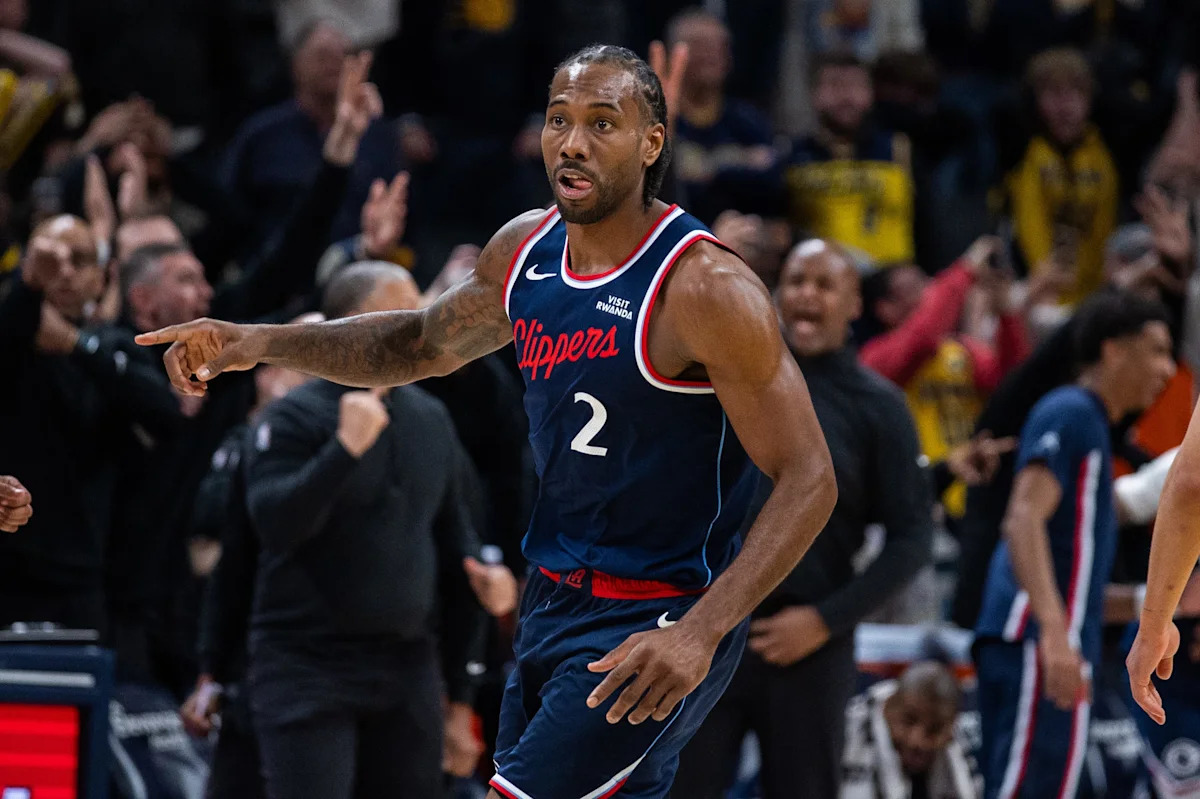
The long-awaited results of the NBA’s investigation into the Los Angeles Clippers’ alleged salary cap circumvention practices were finally released on Wednesday, Sept. 2, and the fallout is just beginning.
Among the punishments handed out, the Clippers must forfeit five first-round draft picks and pay a $30 million fine. Kawhi Leonard, the Clippers’ superstar at the heart of the scandal, has been fined $700,000. Additionally, Clippers owner Steve Ballmer and president of business operations Gillian Zucker have been suspended by the league for one year. Lawrence Frank, the team’s president of basketball operations, has been suspended for six months.
Advertisement
The official investigation report from the law firm of Wachtell, Lipton, Rosen & Katz explicitly lays out why the organization is facing the brunt of the penalties. Throughout the 36-page document, investigators state the three individuals most responsible for the Clippers’ rule-breaking are Ballmer, Zucker and Frank, and call out the organization for obfuscating the investigation’s efforts.
The report also notes investigators “continue to receive information relevant to the subjects discussed in this report” and will supplement their findings as appropriate. Wachtell Lipton said it conducted 73 interviews of 60 people and reviewed 200,000 pages of documents.
Here are 13 must-read segments from the investigation. Each is quoted directly from the report.
-
“Investigators endeavored to conduct their work as expeditiously as possible. This effort was challenged by, among other things, the approach of the Clippers and their outside counsel, who at times delayed in responding to requests for information and operated in an adversarial or obfuscatory manner that slowed investigators’ ability to gather the facts.”
-
“Over the course of the investigation, Ms. Zucker made several statements that proved inconsistent with contemporaneous documents, other witness statements, and the broader chronology of events, professed a lack of recollection on important issues, placed responsibility on subordinates, and offered inconsistent renditions of facts in separate interviews. By contrast, Mr. [Lawrence] Frank openly discussed with investigators his conduct from the relevant time period, recalled details of key events, took responsibility for the actions of subordinates, and was generally consistent across his interviews. While the determination of any consequences for the rules violations described herein lies with the NBA, investigators believe that it would be appropriate in making such determinations to take cooperation and credibility – or the lack thereof – into account.”
-
“The Clippers were especially aware of the CBA’s circumvention rules in this area because the NBA had previously found that the team violated them. In 2015, in circumstances similar to the matter at hand, the Clippers engaged in efforts to facilitate an endorsement agreement between DeAndre Jordan – a player the Clippers were then seeking to sign in free agency – and an incoming team sponsor. The League investigated this matter, determined that the rules had been broken, and fined the Clippers $250,000.”
-
“The Clippers were also aware of circumvention concerns specifically related to Mr. Leonard. In July 2019, Mr. Leonard became a highly sought-after free agent after winning the NBA championship with the Toronto Raptors. In his dealings with the Clippers and several other interested teams, Mr. Robertson (on Mr. Leonard’s behalf) made numerous requests for benefits that were prohibited under the CBA, including equity in teams, housing, access to private transportation, and off-court income such as endorsement deals. Mr. Leonard ultimately signed a player contract with the Clippers. The NBA subsequently questioned the Clippers about these matters, and the team – while acknowledging Mr. Robertson’s improper requests – denied agreeing to accommodate them. The NBA’s investigation of the team was left open pending receipt of further evidence.”
-
“The Clippers advanced a novel theory addressing one part of the conduct at issue here: that NBA rules permit affirmative (not responsive) introductions of players to business partners for the purpose of helping them generate off-court income if such introductions are requested by the player or his representative. The Clippers offered no persuasive explanation for how this theory comports with the clear language of the circumvention rules referenced above, the correct understanding of the rules previously expressed by Mr. Ballmer, Ms. Zucker, and Mr. Frank, or the fundamental purpose of the CBA’s circumvention rules to prevent teams from providing outside income opportunities for players. The Clippers’ position is particularly suspect, as will be described further below, because the team took pains to ensure that its ‘introduction’ emails to team partners were written to appear to be “responsive” to requests from those partners.”
-
“In early June 2020, at the time of Ms. Zucker’s ‘introductions,’ none of Boingo, Daktronics, and Lockton had commercial agreements with the Clippers, but all three companies were in active discussions to provide business services to the team or its arena. Within weeks following the ‘introductions,’ either before or on the same day as the companies signed endorsement agreements with Mr. Leonard, each company entered into a multi-million dollar consulting agreement with the Clippers. Two of the companies received almost the entirety of their consulting fees up front – in payments of $10 million each, delivered prior to these companies entering into endorsement agreements with Mr. Leonard.”
-
“Ms. Zucker had personal relationships at two of the companies. At one, her husband was chair of the board of directors during the relevant time period, and she also had a 30-year working relationship with that company’s CEO. At another, Ms. Zucker had a longstanding relationship with the company’s president (the person who signed the company’s endorsement deal with Mr. Leonard), and she recommended him as “really good people” in an email to an internal colleague charged with the process of securing services for the Clippers in this area.”
-
“The facts surrounding the Daktronics-Leonard endorsement agreement make the conclusion explicit: that company’s agreement with Mr. Leonard was not arranged independently of the Clippers, by virtue of Daktronics’ affirmative interest in Mr. Leonard’s services as an endorser or as a result of any request it made to Ms. Zucker for an “introduction.” Rather, investigators conclude, it was procured by the Clippers in exchange for other business that the team would and did supply to Daktronics. … Daktronics believed that failing to enter into a commercial relationship with Mr. Leonard could jeopardize its ability to win the bid for the Intuit Dome.”
-
“Investigators note, however, that the Clippers’ misconduct may have been even more severe. As set forth above, the timing of the three endorsement agreements with Mr. Leonard coincides with each of the companies receiving multi-million dollar payments from the Clippers, purportedly in connection with business to be provided by these companies to the team. But these payments may in fact have been made principally to fund the endorsement deals with Mr. Leonard.”
-
“During the investigation, it was discovered that the Clippers had made such payments on behalf of Mr. Leonard, his family, and Mr. Robertson during Mr. Leonard’s tenure with the team. A detailed analysis then followed, substantiating hundreds of instances in which the team paid for personal air and ground travel, accommodations, gifts, and tickets without then properly deducting the amounts of these expenditures from Mr. Leonard’s pay (as it was required to do by CBA rules).”
-
“The NBA’s rules enforcement initiative also included a training session on the CBA’s circumvention rules conducted with each team and its senior leadership. On December 4, 2019, in the same time period as the misconduct detailed in this report, the League provided this training to the Clippers, including Mr. Ballmer, Ms. Zucker, Mr. Frank, and other team personnel.”
-
“Mr. Robertson communicated a target: he expected the Clippers’ assistance in obtaining approximately $10 million per year for Mr. Leonard. He communicated these demands primarily to Mr. Frank, but also to Mr. Ballmer and Ms. Zucker. There is no evidence that any of these individuals told Mr. Robertson to stop making such improper requests or – as required by NBA rules – reported them to the NBA.”
-
“In March 2020, the COVID-19 pandemic shut down the NBA. In April 2020, Mr. Robertson spoke with Mr. Ballmer and Mr. Frank to express his frustrations about what he perceived to be a lack of effort by the Clippers to facilitate off-court business opportunities for Mr. Leonard. According to contemporaneous notes kept by Mr. Frank.”


Follow the NBA with USA TODAY
The NBA never rests, and USA TODAY is keeping tabs on the league all year long with reporters on the ground covering every team. Follow the news on our NBA hub. Get our USA TODAY Sports newsletter in your inbox every morning and join our WhatsApp channel to get the latest updates right in your texts.
Advertisement
This article originally appeared on USA TODAY: The 13 most damning details you must read from NBA’s report on Clippers
Read the full article here