





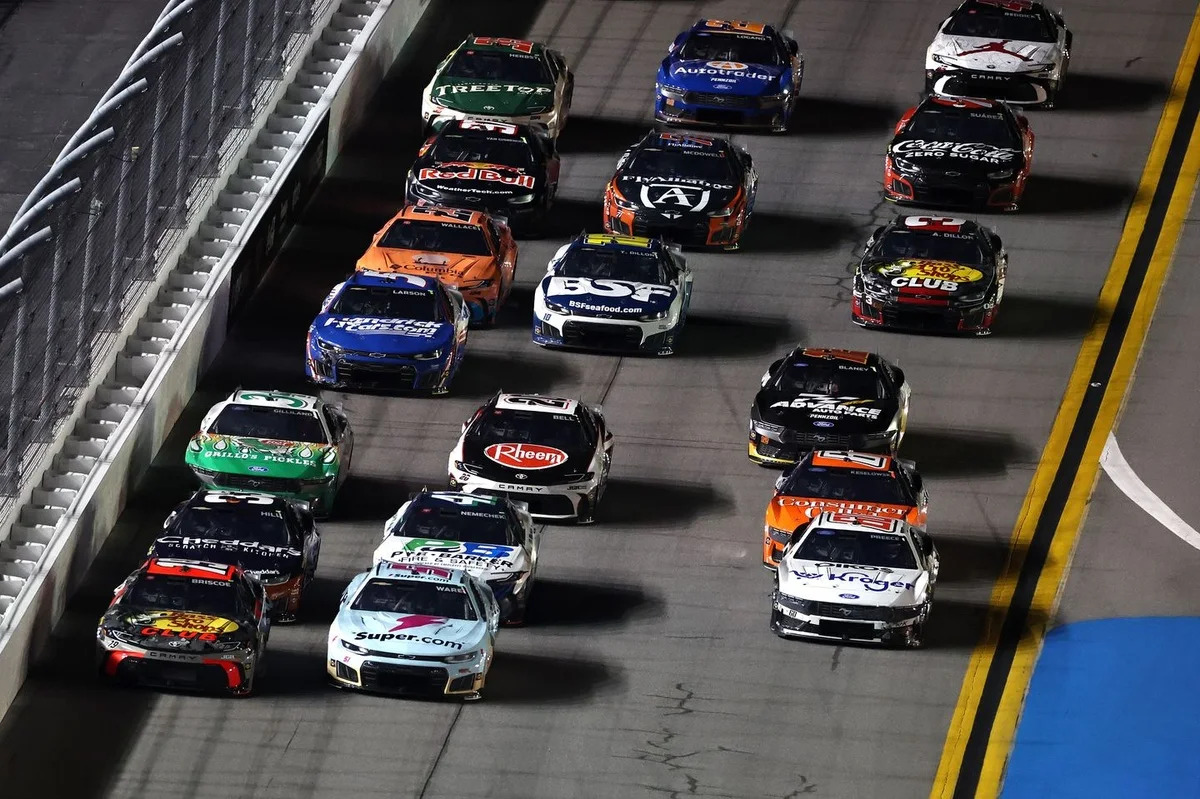
Ryan Preece certainly enjoyed the new NASCAR Cup Series superspeedway package on Saturday night but of course he did.
“I mean, yeah, I won,” Preece said. “I like it. Did you like it?”
Advertisement
That’s a question better asked for his peers, starting with his team owner Brad Keselowski, who preceded him during post-race press conferences.
“Honestly, I could not tell a difference,” Keselowski said. “I couldn’t tell they changed the rules at all. My car drove almost identical to what it did. I was really shocked by that. I thought it would drive poorly, particularly here in the summer – I still call this a summer race.
“I was a bit caught off guard by that. I don’t expect it to look much differently at Talladega.”
Advertisement
In the name of eliminating fuel saving tactics and an inability to pass in these cars due to its inherent dragginess, NASCAR shortened the rear spoiler from 7″ to 4″ and decreased horsepower from 510 to 465.
Fuel saving was still the strategic narrative, as spending less time on pit road means gaining track position, and some teams outright attempted to make full stages without pitting whatsoever. And with less horsepower, that became a more plausible strategic option.
As for the drag, most drivers said they couldn’t tell much of a difference from previous NextGen superspeedway races, although Chase Briscoe was a rare exception
Advertisement
“I thought the package was way better,” Briscoe said. “Who knows if there’s still more to go, but I thought compared to what we had, it was really good. You could make moves and make passes. It was more like traditionally how you would race here.
“The fuel saving was still there, but it was just how the stages wind up. You have to save fuel to not have to pit so I don’t know what they can do to fix that part of it. If the stages were short enough, I think we would just run as hard as we could and it would be really, really good. Not sure how to fix that, but definitely interesting how it all played out.”
Denny Hamlin thought it was directionally positive. He felt like they were a couple of stage length changes away from having drivers race all out.
Advertisement
“I didn’t think it was quite as log jammed as what it was in the past,” Hamlin said. “If you wanted to get to the front I felt like you could. Just the way the stages worked out was interesting. In stage 2 and 3 fuel saving came into play.”
Christopher Bell called his disappointment ‘perplexing’ and said it came down to how much grip these cars had even with the drastically shorter splitter. He felt like this was going to be a ‘totally different race’ and felt like it was worse because of the reduced horsepower and how that altered the fuel strategies.
“It turned into even more fuel saving and we just haven’t figured it out yet,” Bell said.
Advertisement
That’s where William Byron landed too.
“I think the underwing creates so much drag on these cars, and it just, I don’t know, there isn’t a lot of power either,” Byron said, while having hope that more races with this package could eventually produce better results.
Erik Jones, upon being released from the infield care center, said the same thing.
“Unintended consequences, more fuel saving than ever,” Jones said. “We took so much power away that we could make every stage. Kind of a bummer. I didn’t think the racing was any better. It was still super hard to pass and the cars just drove more terrible.
“Back to the drawing board.”
Watch: Briscoe calls new Daytona package ‘a lot of fun’
To read more Motorsport.com articles visit our website.
Read the full article here