





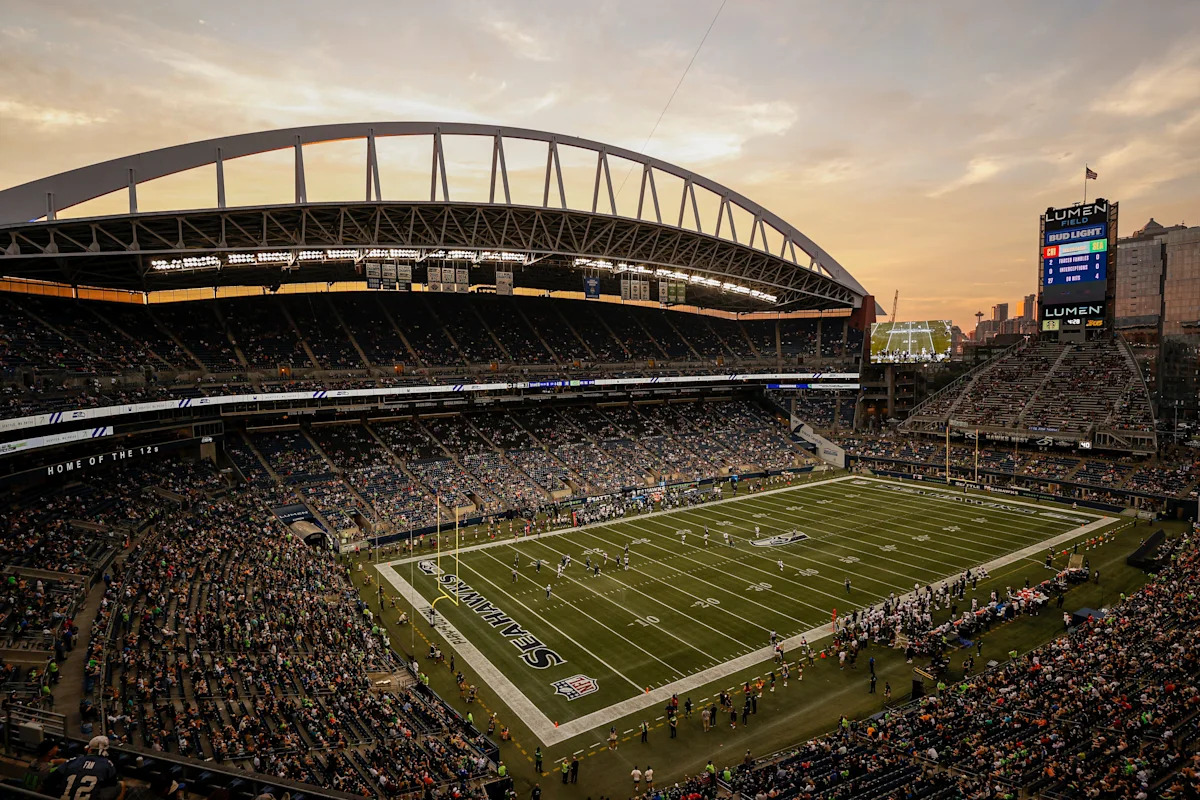
When it comes to investment opportunities, professional sports franchises are hard to ignore. Buying one, of course, is out of reach for almost everyone — but their recent sale-price growth compares favorably with more traditional investments.
NFL owners recently approved the $9.6 billion sale of the Seattle Seahawks to venture capitalist Vinod Khosla and his family. That price tag is nearly 50 times the $194 million Paul Allen paid for the franchise in 1997.
Curious how such an increase stacks up to more standard investments, USA TODAY tracked the Seahawks’ sale price against the S&P 500 and gold, as well as the rate of inflation.
The Seahawks’ sale price increased far faster than all three benchmarks.
Had Allen put $194 million in the S&P 500, with dividends reinvested, at the beginning of 1997, it would be worth about $3.3 billion today or just over one-third of the Seahawks’ sale price.
The same amount invested into gold would have grown to about $2.4 billion. That’s roughly a quarter of the Seahawks’ sale price.
All three outpaced inflation by a wide margin. Matching the purchasing power of $194 million in 1997 would require about $404 million today.
Of course, the Seahawks aren’t alone in their high sale price.
The NBA’s Los Angeles Lakers changed controlling owners at a $10 billion valuation in 2025, then reached another agreement at a $12.5 billion valuation this year. The previous NFL record was the $6 billion sale of the Washington Commanders in 2023.
And like the Seahawks, those teams’ sale prices beat more traditional investments.
In 1979, Jerry Buss paid $67.5 million for a package that included the Lakers, Kings, Forum and a ranch. The Lakers’ portion of the sale was valued at $16 million.
Had that $16 million been invested at the beginning of 1979 in the S&P 500 instead, it would have grown to about $3.6 billion by 2025; in gold, it would have become about $307 million. Both trailed the Lakers’ $10 billion valuation.
For the Commanders, Dan Snyder’s group paid $800 million for Washington’s franchise and stadium in 1999.
By the 2023 sale, an equivalent gold investment would have grown to about $5.8 billion and an S&P 500 investment to roughly $4.9 billion. Both are closer to the Commanders’ $6 billion sale price but remain below.
So, while stocks and gold may be more achievable for everyone else, skipping out on buying a sports franchise might be a hard thing to do if you have the opportunity (and money).
Methodology: Seattle Seahawks’ 1997 and 2026 sales prices from the NFL. Historical returns for the S&P 500 and gold are from Aswath Damodaran at NYU Stern. Purchasing power data from the U.S. Bureau of Labor Statistics’ CPI-U.
Read the full article here