





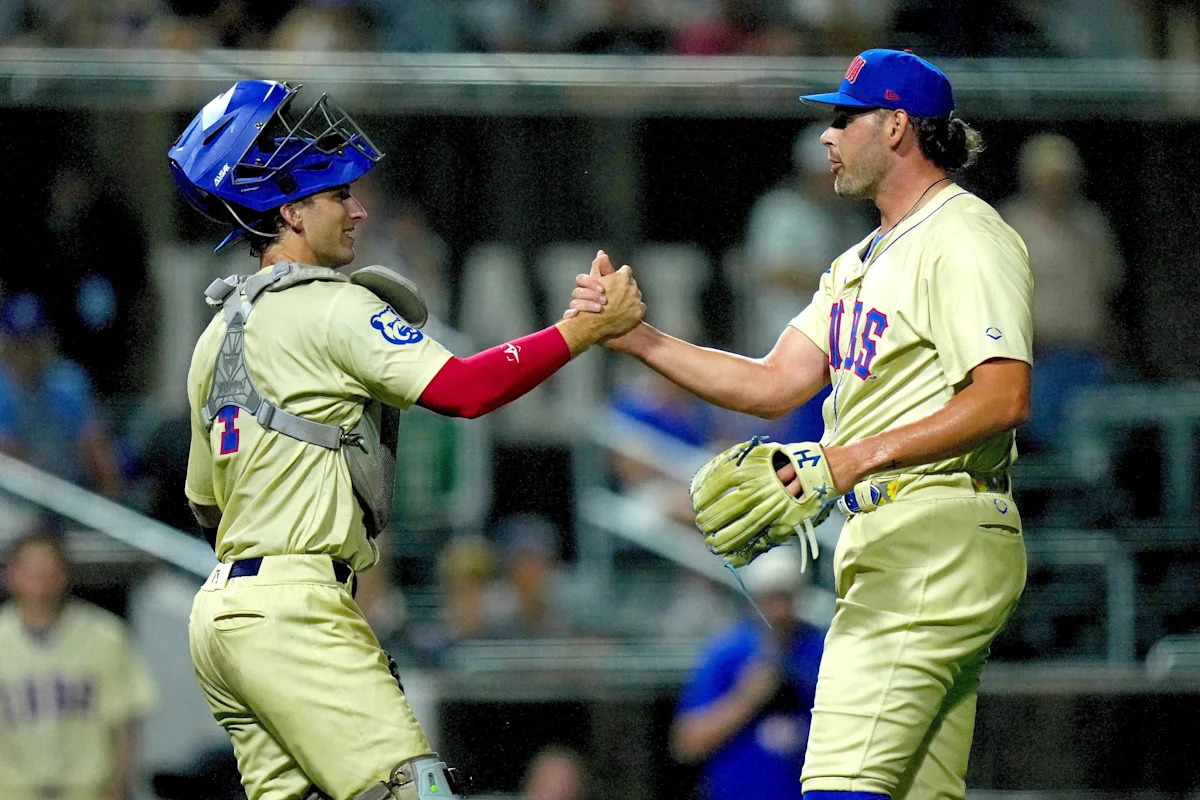
It’s another week here at BCB After Dark: the hippest hangout for night owls, early risers, new parents and Cubs fans abroad. Come on in and sit with us for a while. It may be hot outside, but it’s cool in here. There’s no cover charge. We still have a few tables available. The hostess will seat you now. Bring your own beverage.
BCB After Dark is the place for you to talk baseball, music, movies, or anything else you need to get off your chest, as long as it is within the rules of the site. The late-nighters are encouraged to get the party started, but everyone else is invited to join in as you wake up the next morning and into the afternoon.
Advertisement
Last week I asked you if the Cubs should re-sign Clay Holmes. A large majority of you thought that was a good idea, with 75 percent of you thinking that the three-year, $70 million offer was fair. Another 16 percent of you wanted to re-sign Holmes for less.
Here’s the part where we listen to music and talk movies. You can come join us or you can skip ahead. Or you can stay for the music and movies and skip the baseball stuff. Or you can just read it all. Your call.
Tonight we’re featuring the legendary team of trumpeter Clifford Brown and drummer Max Roach in 1954. This is one of their signature tunes, “Jordu,” from 1954. Joining Brown and Roach are Harold Land on tenor sax, George Morrow on bass and Richie Powell on piano.
Director Edward Dmytryk was coming off an Oscar nomination for Crossfire in 1947 when he was summoned before the House Un-American Activities Committee. Dmytryk refused to testify and became known as one of the “Hollywood Ten” who were charged with contempt and subsequently blacklisted by the film industry. Rather than go to prison, Dmytryk fled to England and directed a few films there before returning to the United States in the early fifties. He then served his six-month prison sentence. After he got out, he changed his mind and agreed to testify before Congress about communism in the film industry and he was cleared to work in Hollywood again. He was the only one of the “Hollywood Ten” who reversed their position and agreed to name names. Dmytryk claimed that he only gave Congress names they already had, but many who suffered under the blacklist never forgave him for testifying.
Advertisement
That’s a long introduction to The Sniper (1952), Dmytryk’s first studio film (and second overall) after getting off the blacklist. It’s a disturbing picture about a mentally-ill serial killer who shoots and kills brunette women from a distance with an M1 rifle. Like many other films by producer Stanley Kramer (High Noon, Inherit the Wind, Judgment at Nuremberg, Guess Who’s Coming to Dinner?), The Sniper is a message picture and in this case, not a very subtle one about mental illness and sex criminals. I can’t say it’s a good film, but there are a lot of good things about it, including an unhinged performance by Arthur Franz as the titular serial killer Eddie Miller.
Miller is what we’d today call an “incel.” He has a menial job as a delivery man for a dry cleaner. He finds himself attracted to women, particularly brunettes, but he is so socially awkward he is invariably rejected by them. This makes him feel emasculated and angry—angry enough to kill them. He first takes out his anger on himself by burning his hand on a hot stove. The doctor who treats him knows that it was intentional and wants to put a psychiatric hold on Miller for his own good, but he’s too busy at the moment and he gets released.
After his release, Miller turns to killing brunettes from a distance. Miller also writes letters to the police begging them to catch him, but of course he doesn’t stop the killing. Adolphe Menjou plays the police lieutenant Frank Kafka, who is assigned to catching the sniper killer. Kafka talks to psychologists to try to narrow down the suspects and understand his motive, which is a very early example of criminal profiling. There’s some suggestion that the killer might be a veteran, although Miller doesn’t appear to be one in the end. I found that interesting because the Defense Department at the time was hyper-sensitive to the idea that soldiers might return from the battlefield with PTSD that turned them into killers. Kramer probably wanted to raise the possibility, but Columbia Pictures probably didn’t want to incur the wrath of the Pentagon.
Much of Kafka trying to catch Miller is just the same kind of stuff you’d see on an episode of CSI or Law and Order, minus the modern forensics. But the film also wants to get a message out about sex criminals. The psychiatrist (Richard Kiley) makes a plea that all sex offenders need to be locked up at their first offense. That’s something that a lot of people today would agree with, but then he goes on to say that “those who can be cured should be released.” That’s an awful lot of trust in the psychological community that they can tell when someone is “cured” of their urges to commit sex crimes or that criminals wouldn’t be able to fool them into thinking they were “cured” to earn their release. It’s a noble but not-very-well thought out sentiment.
Advertisement
I was also disturbed by The Sniper for how prescient it was. While there were certainly serial killers in the 1950s (and the film makes a reference to Albert Fish), Charles Whitman and the Texas Tower sniper shooting was still 14 years in the future. The idea that Miller was some kind of “incel” who turns to murder over his frustrations over being constantly rejected by women has also become a major topic in mass shootings today.
As noted earlier, Franz’s portrayal of Miller is the best part of the movie. He plays him as both unhinged and sympathetic, swinging between the two poles with ease. The film wants to make clear that this is a sick man who can be cured more than a hardened criminal who is a natural-born predator. Noir veteran Marie Windsor plays one of Miller’s victims who doesn’t even realize that she’s rejected Miller’s advances. Menjou is just a stock “wise veteran detective.”
The film also makes great use of the streets of San Francisco to create its world. Cinematographer Burnett Guffey would go on to win Oscars for From Here to Eternity and Bonnie and Clyde, and you can see his skill in an earlier work here. The streets look narrow enough to feel claustrophobic but expansive enough to give sniper a good shot from a distance. There’s lots of crawling around rooftops and fire escapes. Anyone interested in what San Francisco looked like in the early-fifties will want to watch The Sniper.
The Sniper veers too close to an episode of of a police procedural for me to think it’s a good film. The performance of Franz and the terrific black-and-white cinematography certainly keep it from being a bad film. But more than anything else, it certainly disturbed me in the way it predicted events that were years in the future.
Advertisement
Here’s the trailer for The Sniper. The entire film appears to be available for fr on YouTube.
Welcome back to everyone who skips the music and movies.
We are one week away from roster expansion from 26 to 28 players on September 1. The Cubs, like every other team, will be allowed to add one position player and one pitcher.
The Cubs are going to have some hard decisions on the pitching side, as there are several relievers who are getting healthy and will be ready to be activated by next Tuesday. Things aren’t much more straightforward with the position players. Matt Shaw is getting ready to return from his injury and may be activated ahead of the September roster expansion. In his case, however, either Kevin Alcántara can be sent back down to Iowa or Gabriel Arias can be designated for assignment. (Which would be the third DFA this month for Arias.)
Advertisement
One of the bigger questions, however, is who the Cubs should call up to be their 14th position player on September 1. One option that is getting a lot of attention is the Cubs’ number-two prospect, catcher Owen Ayers.
The Cubs have been extraordinarily lucky this season in that neither of their two catchers, Carson Kelly and Miguel Amaya, have been injured this year. It’s especially fortunate because the Cubs’ haven’t had an experienced catcher in Triple-A since Christian Bethancourt opted out of his contract in mid-July. Had either Kelly or Amaya gone down after that, the front office would have had to scramble for a replacement.
The one thing any front office should plan for during a season is that at least one of their catchers is going to get hurt. It’s an incredibly physically-demanding position and all it takes is one pulled hamstring coming out of the crouch or one missed catch that hits them in a bad spot to take them out for a while. We all know this from experience as Amaya missed most of last season with injuries.
Manager Craig Counsell has done a good job of alternating Kelly and Amaya to keep their workloads manageable. Yes, there’s been a lot of luck in the two staying healthy, but giving them days off has probably helped a lot too.
Advertisement
This is where Ayers comes in. When Bethancourt opted out in July, Ayers got promoted from Double-A Knoxville to Iowa. Ayers had never played above Low-A Myrtle Beach before this season, unless you count the Arizona Fall League, but he blew through High-A South Bend in 11 games (hitting .372/.481/.860) and then dominated in Double-A with a line of .304/.417/.591 with 16 home runs in 65 games. The power hasn’t translated to Triple-A, but he’s still performing at a very respectable clip of .270/.387/.370 with two home runs over 29 games.
So would you call up Owen Ayers for his major league debut to help keep Kelly and Amaya fresh down the stretch? He probably wouldn’t play much—just one or two games a week for the final four weeks. The switch-hitter might get an occasional pinch-hitting opportunity as well if he shows he’s not overpowered by major-league pitching. But having Ayers on the major league roster would allow the other two catchers to get a little more rest as well as give Counsell more roster flexibility to pinch-run for Kelly or Amaya in critical situations.
Defensively, Ayers is a mixed bag. No one questions his arm or his ability to control the running game. He’s thrown out ten runners trying to steal in 35 attempts and I suspect that he would throw out a lot more if he had pitchers who could hold runners on better. I’d put a “70” (on the 20-to-80 scouting scale) on Ayers’ arm, and most online evaluators agree with me.
He does struggle a bit with the “catching” part of catching, as he has five passed balls in those 26 games in Iowa. Now some of that may just be him getting used to new pitchers, but he’d (mostly) have that same problem in the majors. He also needs to work on pitch framing, although the ABS system lessens that problem somewhat. Ayers could use more experience calling a game from behind the plate, although one would think that working with Kelly and Amaya for a month would be the best way to improve that skill. There’s also always the choice of calling pitches from the dugout like the Marlins and some other teams do.
Advertisement
The other negative about calling up Ayers for September is that it also means that someone like Kevin Alcántara or James Triantos. The Cubs would also have to put Ayers on the 40-man roster, which might have implications for next year and a possible lockout.
The positive is that Ayers would get his feet wet in the majors, he could be pretty good, he could gain some knowledge working with Kelly and Amaya and he would give Counsell more flexibility with his catchers. The downsides is that he wouldn’t play a lot, he’d have to be added to the 40-man roster, his total defensive might not be fully major league ready and it would prevent the Cubs from calling up someone else.
So would you call up Owen Ayers on September 1?
Thanks for stopping by tonight. We’re always glad when you decide to stop by. Please get home safely. Call a ride if you need one. Don’t forget any personal items. Recycle any cans and bottles. Tip your waitstaff. And join us again tomorrow night for more BCB After Dark.
Read the full article here