





In basketball, ‘ball knowledge’ refers to an internet trend where fans remember obscure, random role players from the past. One mentions Lucas Nogueira. Another name-drops Chris Copeland. Everyone in the room death stares at the guy who deems Monte Ellis as ‘elite ball knowledge’.
But what constitutes as Utah Jazz ball knowledge? The Kyle Korvers and George Hills deserve some praise, but nowhere in this stratosphere do they count. Kris Dunn? A cheeky Ian Clark? Maybe. But I’ve done my research, stringing my vote to resurface ‘forgotten’ Jazz players.
Advertisement
SALT LAKE CITY, UT – JANUARY 29: Miye Oni #81 of the Utah Jazz plays defense against the Dallas Mavericks on January 29, 2021 at vivint.SmartHome Arena in Salt Lake City, Utah. NOTE TO USER: User expressly acknowledges and agrees that, by downloading and or using this Photograph, User is consenting to the terms and conditions of the Getty Images License Agreement. Mandatory Copyright Notice: Copyright 2021 NBAE (Photo by Melissa Majchrzak/NBAE via Getty Images) | NBAE via Getty Images
Ivy League Player of the Year Miye Oni always looked like he was one fundamental step away from being a 10+ year veteran in the NBA. However, the promise of Oni’s skillset was enough for Utah to draft him with the 58th pick of the 2019 NBA draft. He was an energetic 6’5 wing who could play the ‘D and sometimes shoot the 3. Oni got more opportunity out of the three second-rounders, others being Justin Wright-Foreman and Jarrell Brantley, in his two-year Jazz stint. He even represented Nigeria during the 2021 Tokyo Olympics.
The offensive inconsistency and foul trouble led to him being booted out of the Jazz rotation and ultimately out of the NBA by Year 3. A year later, Oni went overseas to sign with the London Lions. Now, he plays for the Criollos de Caguas in the Baloncesto Superior Nacional Puerto Rican league. In another universe of the space-time continuum, Miye Oni was the piece the early 2020s Jazz needed to climb the hill and regain their spot in the Western Conference Finals.
Advertisement
Kyrylo Fesenko

OAKLAND, CA – JANUARY 30: Kyrylo Fesenko #44 of the Utah Jazz gets ready to take on the Golden State Warriors on January 30, 2011 at Oracle Arena in Oakland, California. NOTE TO USER: User expressly acknowledges and agrees that, by downloading and/or using this Photograph, user is consenting to the terms and conditions of the Getty Images License Agreement. Mandatory Copyright Notice: Copyright 2011 NBAE (Photo by Rocky Widner/NBAE via Getty Images) | NBAE via Getty Images
Before Bojan Bogdanovic, Kyrylo Fesenko held the mantle of #44. The former Ukrainian big man stood at a massive 7’1″ and 280-pound frame. He was selected with the 38th pick in the 2007 draft by the 76ers, who instantly traded his draft rights to the Jazz. Fesenko spent the majority of his five-year NBA career with the Jazz as a physical backup center, defining his expertise by rugged post defense, altering shots and setting screens using his bulky frame. I think we will all love a little Kyrylo Fesenko in our lives. Fes was a great person to cheer for. He dunked hard, and he said the best things in interviews.
Unfortunately, Fesenko couldn’t stick around in the league for long. Legendary Coach Jerry Sloan was publicly and privately frustrated by his fitness levels and struggles to lose weight. His lack of elite stamina kept him off the court—he also gained a reputation for being a lovable goofball whose focus drifted. Don’t we all, Fes.
Advertisement
Just as he entered unrestricted free agency to find a more permanent role than what Utah could offer, Fesenko suffered a torn meniscus in his left knee while playing for Ukraine in the 2011 Eurobasket tournament. Teams like Golden State, which had previously shown interest, backed out of talks, which eventually led him to sign a late-season deal with the Pacers, never finding his true home in the NBA.

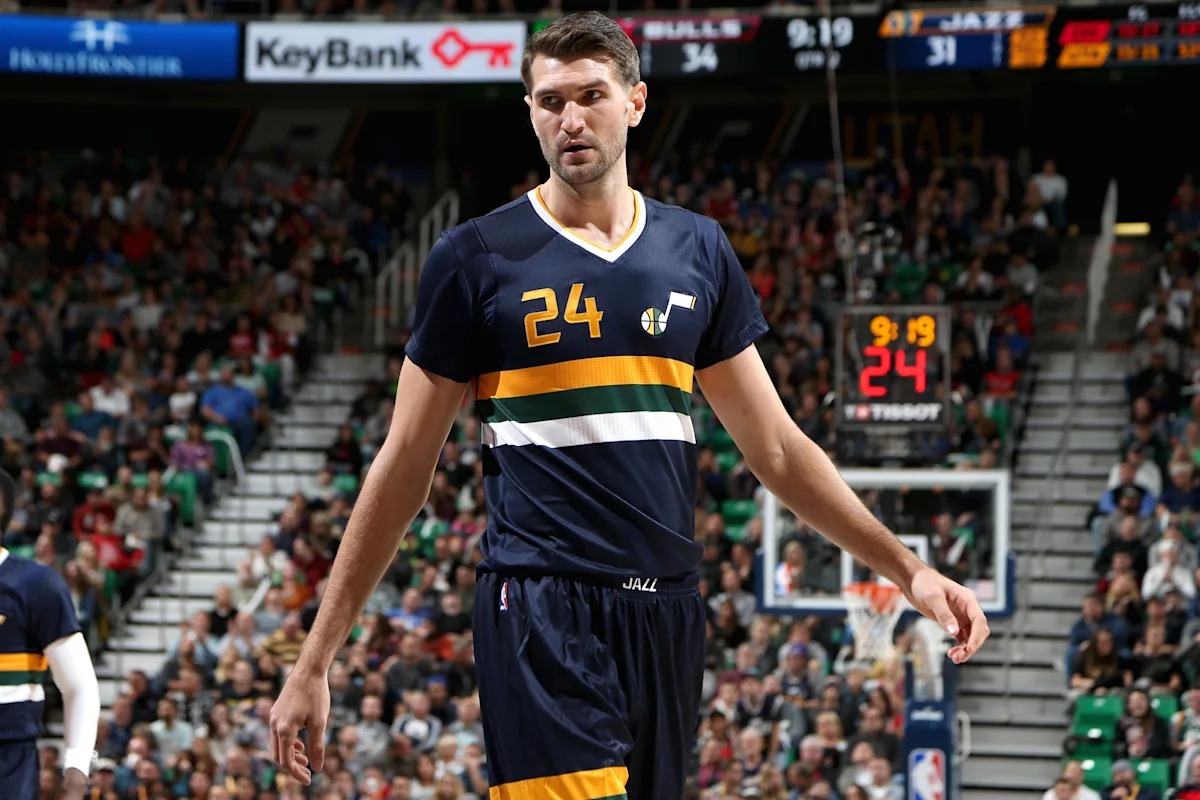
SACRAMENTO, CA – MARCH 29: Jeff Withey #24 of the Utah Jazz looks on during the game against the Sacramento Kings on March 29, 2017 at Golden 1 Center in Sacramento, California. NOTE TO USER: User expressly acknowledges and agrees that, by downloading and or using this photograph, User is consenting to the terms and conditions of the Getty Images Agreement. Mandatory Copyright Notice: Copyright 2017 NBAE (Photo by Rocky Widner/NBAE via Getty Images) | NBAE via Getty Images
There is something deeply wrong with me to be this enamored by unathletic 7-footers. He was recognized for his elite shot-blocking ability and interior D. He had a historic college career with the Kansas Jayhawks — setting an NCAA tournament record for blocks and becoming a two-time Big 12 Defensive Player of the Year — and he was drafted 39th overall in the 2013 NBA Draft.
Advertisement
It was in August 2015 that Withey signed a multi-year deal with the Utah Jazz. He carved a role as a dependable third-string center, buried deep in a front-court rotation behind rising star Rudy Gobert and fan-favorite Derrick Favors. Even in limited minutes, his length allowed him to maintain Utah’s rigid defensive identity outside of the Gobert minutes. However, just as the Jazz were in the middle of a playoff run back in April 2017, Withey was publicly accused of a reported domestic violence incident by his ex-fiancée. The charges never resulted in a conviction, but the Jazz immediately deactivated him until further notice for personal reasons, resulting in a swift defeat to the powerhouse Warriors that same postseason.
Following the conclusion of the 2016-17 season, Withey became a free agent and signed a new deal with the Dallas Mavericks. He was another cruel victim of the NBA’s evolving pace-and-space era. Despite being an elite rim-protector, the new era exposed his lack of lateral quickness and offensive versatility. He eventually chose a highly lucrative and successful international career where his traditional rim-protecting role was still highly valuable.

SALT LAKE CITY, UT – MARCH 24: Juwan Morgan #16 of the Utah Jazz looks on during the game against the Brooklyn Nets on March 24, 2021 at vivint.SmartHome Arena in Salt Lake City, Utah. NOTE TO USER: User expressly acknowledges and agrees that, by downloading and or using this Photograph, User is consenting to the terms and conditions of the Getty Images License Agreement. Mandatory Copyright Notice: Copyright 2021 NBAE (Photo by Melissa Majchrzak/NBAE via Getty Images) | NBAE via Getty Images
Juwan Morgan went undrafted in the 2019 NBA Draft following a four-year college career with the Indiana Hoosiers. He impressed during the Summer League and earned his roster spot with Utah in November 2019. Morgan spent most of his regular-season tenure either on the end of the bench or with the SLC Stars. No kidding—he earned only 134 minutes, mostly in garbage time. But he’s best remembered by fans for a highly unexpected, emergency postseason insertion.
Advertisement
His definitive moment came during the emergency NBA Bubble. Coach Quin Snyder put on his sicko cap. Out of nowhere, Morgan was given his first career start in Game 1 of the first round, when Mike Conley left the bubble to see the birth of his son. He played tough interior D to battle Denver’s frontcourt and assisted Donovan Mitchell’s 57-point night, despite a 135-125 overtime loss.
But alas, the Juwan Morgan ended just a year later. The Jazz handed out massive, lucrative extensions to stars Donovan Mitchell and Rudy Gobert, along with re-signing Mike Conley. Utah couldn’t afford to allocate qualifying offers or standard roster spots to developmental players like Morgan. His high-end hustle made him a G League standout, and he has now progressed in his overseas career with clubs like Zenit Saint Petersburg in the VTB United Russian League.
Juan Toscano-Anderson

NEW YORK, NEW YORK – APRIL 02: Juan Toscano-Anderson #95 of the Utah Jazz controls the ball during the game against the Brooklyn Nets at Barclays Center on April 02, 2023 in New York City. (Photo by Jamie Squire/Getty Images) | Getty Images
Thrown in as an additional piece of the trade that sent Westbrook to Utah in 2023 (the first time), NBA champion Juan Toscano-Anderson was already on his last legs in the NBA. JTA was most known for his high energy and defensive hustle that earned him playoff minutes in Golden State’s 2022 run. His trademark was the #95, used to represent his childhood home on the 95th Avenue of East Oakland
Advertisement
He became the first player of Mexican descent to participate in the Slam Dunk Contest back in 2022. He was the first player in Jazz franchise history to wear the number #95. Playing in 22 games for Utah post-deadline, Toscano-Anderson averaged 3.4 points in 15 minutes per game.
He provided solid wing defense and transition play, but he struggled mightily with his perimeter shooting. HE shot just 17.4% from beyond the arc. He became an unrestricted free agent after the season ended, and the Jazz had no interest in re-signing the veteran. In 2026, JTA spent the last two seasons playing for Pallacanestro Trieste in the Lega Basket Serie A.
Stephen Howard

MINNEAPOLIS, MN – 1992: Stephen Howard #43 of the Utah Jazz shoots against the Minnesota Timberwolves circa 1992 at Target Center in Minneapolis, MN. NOTE TO USER: User expressly acknowledges and agrees that, by downloading and/or using this photograph, user is consenting to the terms and conditions of the Getty Images License Agreement. Mandatory Copyright Notice: Copyright 1992 NBAE (Photo by NBA Photos/NBAE via Getty Images) | NBAE via Getty Images
Despite going undrafted out of DePaul in 1992, Stephen Howard’s gritty determination in a rookie tryout camp earned him a roster spot where he played three seasons under Jerry Sloan. Fun Fact: Howard was contacted by Midway Games to serve as a physical model for the legendary NBA Jam title. He’s a hidden, unlockable secret player alongside Stockton and Malone. He’s an elite scholar, being one of two players in DePaul basketball’s history to be named a two-time First Team Academic All-American.
Advertisement
Howard’s most notable stint as a Jazzman was when he suited up for the legendary 1997 Jazz, playing 42 games and contributing to the squad that battled Jordan’s Bulls. It’s not much as he could have been playing—stuck behind a crowded forward rotation that put him behind Karl Malone, Ty Corbin, Tom Chambers, David Benoit and Byron Russell.
Howard was never offered a long-term deal. He was stuck in a one-year contract trap after he spent his entire four-year career playing on short-term contracts. He didn’t possess a high-volume offensive game to justify heavy minutes. Rather than scraping by in the US, Howard chose to transition into a highly successful 11-year international career across France, Spain and China.

PORTLAND, OR – OCTOBER 18: Tibor Pleiss #21 of the Utah Jazz looks on during the game against the Portland Trail Blazers on October 18, 2015 at the Moda Center in Portland, Oregon. NOTE TO USER: User expressly acknowledges and agrees that, by downloading and or using this Photograph, user is consenting to the terms and conditions of the Getty Images License Agreement. Mandatory Copyright Notice: Copyright 2015 NBAE (Photo by Cameron Browne/NBAE via Getty Images) | NBAE via Getty Images
I’m gonna be honest, Tibor Pleiß (cruelly spelt ‘Pleiss’ on the back of his jersey) has the coolest name in Jazz history. Nicknamed ‘The Octopus’ due to his versatile tools and endless wingspan, he was one of the most prominent traditional big men in European basketball. The 7’3″ German was a two-time EuroLeague champion in the 2021 and 2022 seasons with the Turkish powerhouse Anadolu Efes Istanbul.
Advertisement
His NBA stint began when he was selected 31st overall in the 20210 draft, only transitioning to the NBA for the 2015-16 season with the Utah Jazz. Pleiß didn’t stick in the NBA for long. He was caught in the middle of a massive league-wide tactical shift away from slow-moving 7-footers, combined with Utah’s deep big man depth chart in the midst of Rudy Gobert’s defensive emergence. He only appeared in 12 games, not being able to establish a polished offensive upside or command the touches needed to make up for his defensive or physical limitations.
He was later traded to the Philadelphia 76ers in August 2016, where Pleiß chose to return to Europe rather than grind it out in the G League.
Blue Edwards

PORTLAND, OR – CIRCA 1990: Blue Edwards #30 of the Utah Jazz rebounds against the Portland Trailblazers circa 1990 at the Veterans Memorial Coliseum in Portland, Oregon. NOTE TO USER: User expressly acknowledges and agrees that, by downloading and or using this photograph, User is consenting to the terms and conditions of the Getty Images License Agreement. Mandatory Copyright Notice: Copyright 1990 NBAE (Photo by Brian Drake/NBAE via Getty Images) | NBAE via Getty Images
“Bluuueeee!” Theodore ‘Blue’ Edwards was an athlete at that. He played four out of his ten seasons with the Jazz, establishing himself as a high-flying fan favorite. Edwards was drafted 21st overall by Utah in the 1989 draft out of East Carolina, carving out a complementary role alongside Stockton and Malone.
Advertisement
That high-flying led him to participate in the 1991 NBA Slam Dunk Contest, where he finished 6th. He played all 82 games of his rookie season shooting an incredibly efficient 51.1% from the field. He peaked during the 1992 season, when he averaged a career-best 12.6 points per game. Edwards served as a defensive and scoring safety valve in Utah’s Western Conference Finals defeat against the Trail Blazers. Beyond the flashy dunks, Edwards ranks 9th all-time in Utah Jazz history with a .516 field-goal percentage.
The shortcomings came on the other side of the court — his lack of defense and glass-cleaning ability didn’t fully align with Sloan’s grit-and-grind identity. 1992 trade rumors began circulating, which visibly bothered Edwards. He missed a defensive assignment in a regular-season game, leading to Sloan benching him and creating a public verbal confrontation on the sidelines. That summer, the Jazz packaged Edwards, Eric Murdock and a draft pick to the Bucks for Jay Humphries. He had a reunion with the Jazz in 1994-95, but was promptly selected by the Vancouver Grizzlies in the 1995 Expansion Draft that same Summer.
Don’t be shy and let us know your deep pulls in the comments. August is the dead end of the NBA off-season.
Read the full article here